Nanatsusaya-no-Tachi (shichishitō) — The Ancient Inscribed Sword Preserved at Isonokami Jingū and 4th-Century Diplomacy between Wa and Baekje
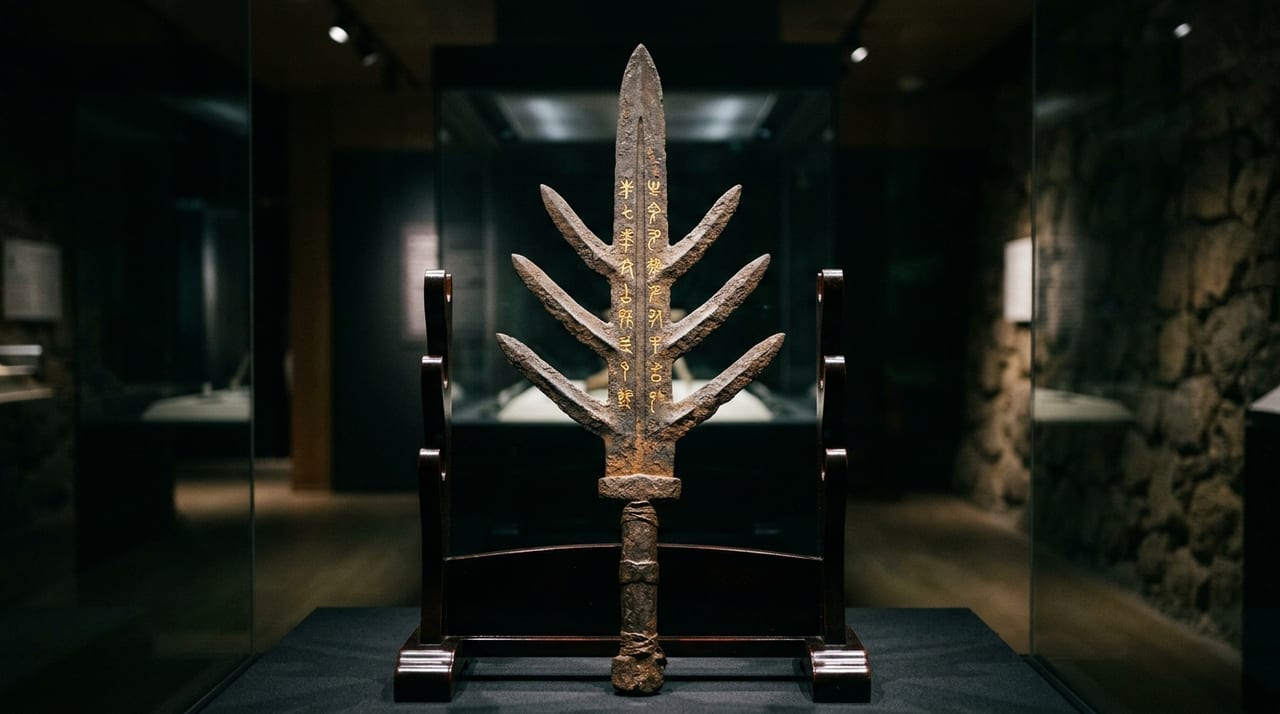 * Image is for illustrative purposes only.
Table of Contents
The Nanatsusaya-no-Tachi (shichishitō), long preserved at Isonokami Jingū in Tenri, Nara Prefecture, is an ancient iron sword indispensable to any consideration of the history of Japanese swords. It was designated kokuhō (National Treasure) in 1953 (Shōwa 28).
Distinctive Form and Mei
The Nanatsusaya-no-Tachi has the following distinctive features of form and mei:
- Overall length: approximately 74.8 cm
- Form: three branching blades on each side of the blade, staggered, for a total of six; together with the central blade, this creates the distinctive appearance known as "seven branches"
- Character: considered to have a strong ritual and symbolic character rather than being intended for actual combat
- Mei: approximately 60-odd characters applied in gold inlay on both the front and reverse of the blade
Since the Meiji period, decipherment has advanced through the efforts of researchers, but some sections remain difficult to read due to corrosion, and there remain various theories to this day regarding the identification and interpretation of individual characters.
What the Mei Says about Wa and Baekje
According to a leading reading of the mei, this sword was made at the command of the crown prince (heir apparent) of the Baekje king in "the fourth year of Tai□" and presented to the king of Wa. The theory that "Taiwa" in the mei is a phonetic borrowing for the Eastern Jin (Tōshin) era name "Taiwa" (366–371 CE) is widely accepted, and if so, manufacture dates to the latter half of the 4th century, estimated at around 369 CE. However, there are dissenting views on the identification of the era name, and no definitive conclusion has been reached.
The context of a gift from Baekje to Wa is regarded as a rare written source attesting to the diplomatic relations between the Korean Peninsula and the state of Wa (the Yamato polity) in the 4th century. Together with the Kōkaidō-ō-hi (Kōtaio-hi), which also records 4th-century East Asia, it is a precious clue to an era poorly represented in written sources.
Relation to the Record in the Nihon Shoki
The Nihon Shoki, in the entry for the 52nd year of Empress Jingū's regency, contains a record that emissaries from Baekje presented the "Nanatsusaya-no-Tachi" and other items. The view that connects the Nanatsusaya-no-Tachi of Isonokami Jingū with the sword in this record has long been influential, and research comparing the mei on the blade with the textual record has continued to accumulate.
The fact that a single artifact can be examined both through a contemporary written source — the mei — and through a document compiled in later ages is extremely rare in the ancient history of Japan. However, the correspondence between the chronology of the Nihon Shoki and actual historical dates requires careful examination, and debate continues to this day, including the question of whether the sword in the record and the surviving Nanatsusaya-no-Tachi can be identified as the same object. The very absence of a settled conclusion speaks to the depth of the research history surrounding this sword.
Isonokami Jingū as the Place of Transmission
Isonokami Jingū is an ancient shrine located in Tenri, Nara Prefecture, said to have been deeply connected in ancient times with the management of the imperial court's weapons. The fact that an ancient iron sword has been passed down as a sacred treasure at a shrine dedicated to the deity of martial affairs speaks to the fact that swords have long been objects deeply intertwined with religious faith.
The mei of the Nanatsusaya-no-Tachi became widely known when, during the Meiji period, gold-inlaid characters were confirmed beneath the rust on the blade, and it became the starting point for subsequent mei research. There are almost no other examples of an iron sword this ancient surviving as a handed-down heirloom above ground rather than being excavated from the earth, and the existence of the shrine as the place of transmission is inseparable from the value of the Nanatsusaya-no-Tachi.
The Technique of Gold Inlay
The gold inlay used to engrave the mei is a technique in which grooves in the shape of characters are carved into the iron surface with a chisel, and gold wire is then hammered in and fixed. Unlike ink inscriptions written on the surface, gold and iron are physically bonded together, so the characters can be preserved for over a thousand years as long as the adhesion to the base metal is maintained. The fact that the mei of the Nanatsusaya-no-Tachi can still be read today is largely due to both the durability of this technique and the preservation environment in which it has been handled with great care as a sacred treasure. On the other hand, since corrosion from rust also affects the inlaid portions, the identification of individual characters in the mei remains an ongoing research challenge.
Significance in the History of Ancient Swords
The Nanatsusaya-no-Tachi carries forward the culture of iron swords from the era of straight blades (chokutō), before the curved tachi with its sori (curvature) came into being. Its great value lies in the fact that, as a surviving artifact, it testifies to the process by which iron implements and forging techniques flowed into the Japanese archipelago through exchanges with the continent and the Korean Peninsula.
The fact that it was long protected as a sacred treasure within the shrine precinct made possible the preservation of the mei in a legible state even after more than a thousand years. It is a symbolic sword demonstrating that ancient swords were not mere weapons but were treated as proof of diplomacy and objects of religious faith.
From the Nanatsusaya-no-Tachi to the Japanese Sword — Understanding the Age of Straight Blades
The swords of the era of the Nanatsusaya-no-Tachi were straight blades without sori, differing from the later Japanese sword both in appearance and in context of manufacture. The establishment of curved blades with sori is dated to around the mid-Heian period, and the several hundred years before that were a time when craftsmen on the Japanese archipelago received and absorbed the wrought-iron techniques that had flowed in from the continent and the Korean Peninsula. Viewing in chronological order the straight swords excavated from kofun (burial mounds), the Shōsōin treasures that preserve Nara-period swords, and others, it becomes easier to grasp the flow of the pre-history of the Japanese sword. The Nanatsusaya-no-Tachi, as a surviving artifact accompanied by written information in the form of a mei, occupying the earliest stage of that history, continues to be referenced widely from textbooks to specialist research.
For Further Study
Since opportunities to view the actual Nanatsusaya-no-Tachi are limited, a practical entry point is to become familiar with its distinctive form and characters through photographs and transcriptions of the mei in illustrated catalogues and research publications. Ancient swords differ in context of appreciation from Japanese swords of the medieval period and later, but having a broad picture of "where iron swords came from and how they developed into the Japanese sword" forms a foundation for understanding swords regardless of era.