What Is a Hoko? How the Ancient Spear Differs from the Yari, from Bronze Hoko to Gion Festival's Naginata-boko
 * Image is for illustrative purposes only.
Table of Contents
Hoko is a long-handled weapon with a double-edged blade tip attached to the end of a long shaft, and it is a predecessor of the yari and naginata. While we hear the word in the "hoko" of the Gion Festival and the myth of "Ame-no-nuboko" (Heavenly Jeweled Spear), in the world of swords, the differences from yari tend to be discussed in ambiguous terms. Here, we organize the notation of hoko and hoko (as festival decoration), their structural differences, the rise and fall in Japan, and the form of "hoko" that remains in festivals today.
矛, 鉾, and 桙—the notation of "hoko"
Multiple Chinese characters have been applied to "hoko," including 矛, 鉾, 桙, 戈, and 戟. Looking at the Japanese readings, since all of these are read as "hoko," it has been suggested that in ancient times, "hoko" was not a term referring to a specific form but rather a general term for long-handled weapons.
In current usage, "矛" is often used when referring to the form as a weapon, while "鉾" is used when referring to the decoration placed at the end of festival floats (dashi). However, there are no strict rules, and notation varies depending on the literature.
The structure of hoko—fukuro-ho as a joining method
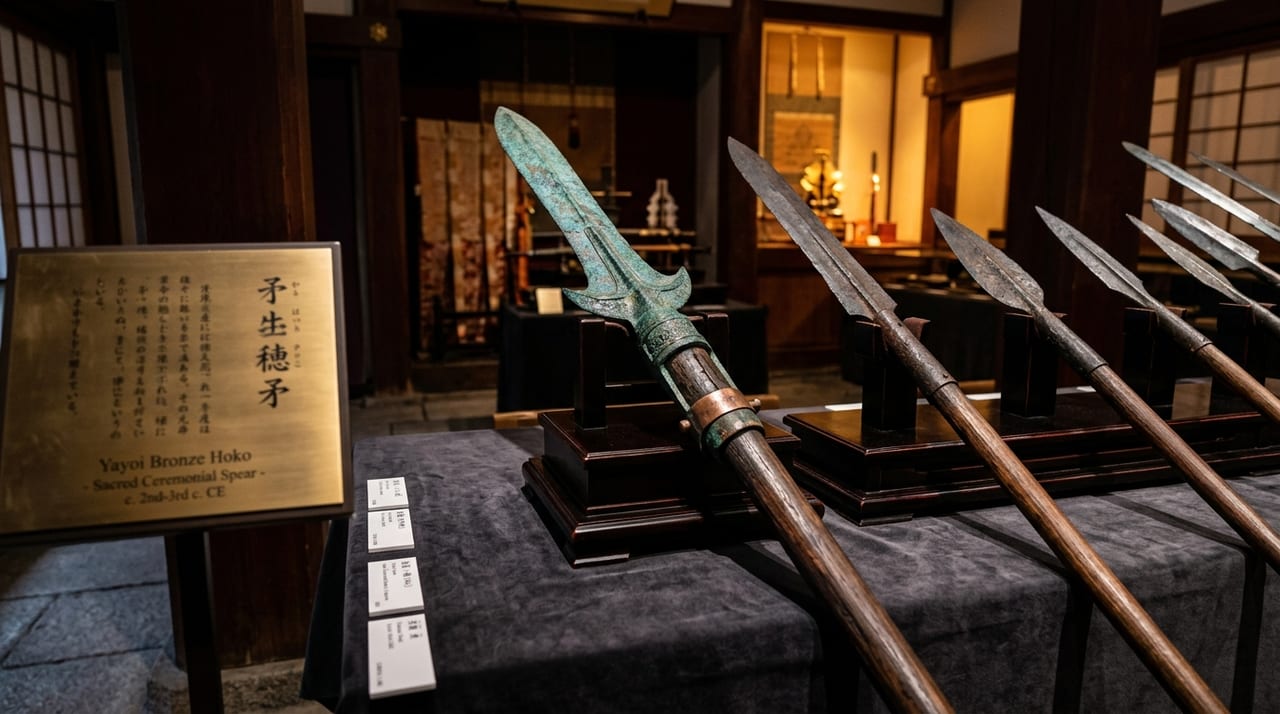
The most distinctive feature of hoko is the method of joining the blade tip to the shaft. The root of the hoko is a socket-shaped tube called fukuro-ho, and the tip of the shaft is inserted into it and fixed with rivets and similar fasteners.
The blade tip is typically double-edged with a wide blade, with a blunt, rounded point. It is explained as a shape designed for both thrusting and slashing.
Differences between hoko and yari
Hoko and yari are generally contrasted on the following points.
| Item | Hoko | Yari |
|---|---|---|
| Joining with shaft | Shaft inserted into fukuro-ho | Blade tang (nakago) inserted into shaft |
| Blade tip shape | Usually wide with rounded point | Linear with sharp point |
| Main period of use | Yayoi to Heian period | Appears in late Kamakura, spreads in Nanboku-Cho period |
However, this is merely a rough guideline. Yari also has fukuro-yari, where the base of the blade is made bag-like and the shaft is fitted over it, so a clear line cannot be drawn between hoko and yari based solely on the joining method. It is more practical to view both the blade shape and the historical context together.
- Joining method: Hoko uses fukuro-ho style, most yari use tang style (fukuro-yari is an exception)
- Blade tip: Hoko is double-edged with rounded shape, yari has a sharp thrusting shape
- Era: Hoko came first, yari came later
For the form of yari itself, refer to Yari (spear): types and classification, and for how yari became the main weapon, refer to Transition from naginata to yari.
History of hoko in Japan
Japanese hoko began with bronze hoko transmitted from the continent during the Yayoi period. Bronze hoko came through the Korean Peninsula and were distributed mainly in northern Kyushu. Initially weapons, they gradually became larger and took on the character of ritual implements, and in the late Yayoi period, they were buried and used in rituals. Bronze hoko evolved in stages from slender to medium-slender, medium-wide, to wide forms, and large wide-form bronze hoko are frequently unearthed from Tsushima. They are thought to have been made more as ritual objects than as practical weapons. The base of the blade is bag-shaped, and the structure for inserting the shaft was present from the beginning.
Iron hoko appeared during the Kofun period. During the Nara period, they were weapons for infantry, and cavalry are said not to have used hoko. Gradually, mounted warfare increased in importance, and by the late Heian period, the primary long-handled weapon shifted to the naginata. While hoko were used until around the early Kamakura period, they were subsequently replaced by yari and naginata, which required less effort to produce. Yari appeared in the late Kamakura period, spread during the Nanboku-Cho period, and became the primary force on the battlefield in the Sengoku period.
The flow of ancient swords and blades is summarized in Tsurugi (double-edged sword): a history of its forms and Burial swords of the Kofun period. Hoko is positioned as one of the ancient weapons alongside these.
Mythology and "hoko" in festivals
Even after hoko finished its role as a weapon, it lived on, retaining its symbolic significance. In Japanese mythology, it is told that Izanagi and Izanami stirred the sea with the Heavenly Jeweled Spear (Ame-no-nuboko), and the brine that dripped from its tip solidified into islands. The fact that hoko appears as an instrument of land creation suggests it was regarded as an object imbued with sacred power.
The most familiar "hoko" in modern times is the yamaboko (decorative floats) of Kyoto's Gion Festival. Among these, the Naginata-boko is so named because it has a large sword (naginata) attached to the spear point. The naginata was believed to ward off plague and evil, and in ancient times, a naginata said to be made by Sanjo Kokaji Munechika was used. Today, a naginata said to be made by Sanjō Nagayoshi in Daiei 2 (1522) is preserved, and a replica is attached to the hoko head. The fact that the swordsmith's name is connected to the festival hoko is something that those familiar with swords cannot overlook. For Sanjo Munechika, refer to Sanjo Munechika and Mikazuki Munechika.
Summary
Hoko is a double-edged long-handled weapon fixed to the shaft with fukuro-ho, and it supported Japanese warfare and rituals from the bronze hoko of the Yayoi period to the Heian period. The differences from yari can be organized into three points: joining method, blade tip shape, and era, and it is important to note that there are exceptions like fukuro-yari. While hoko as a weapon has disappeared, its legacy lives on in mythology and the hoko of the Gion Festival.
Those who wish to expand their knowledge of the world of swords, from long-handled weapons to Japanese swords, can view swords currently on display at Sword catalog.