A Guide to English Translations of Japanese Sword Terminology — How to Express Katana, Hamon, Nakago and More Abroad, and Mistranslations to Watch Out For
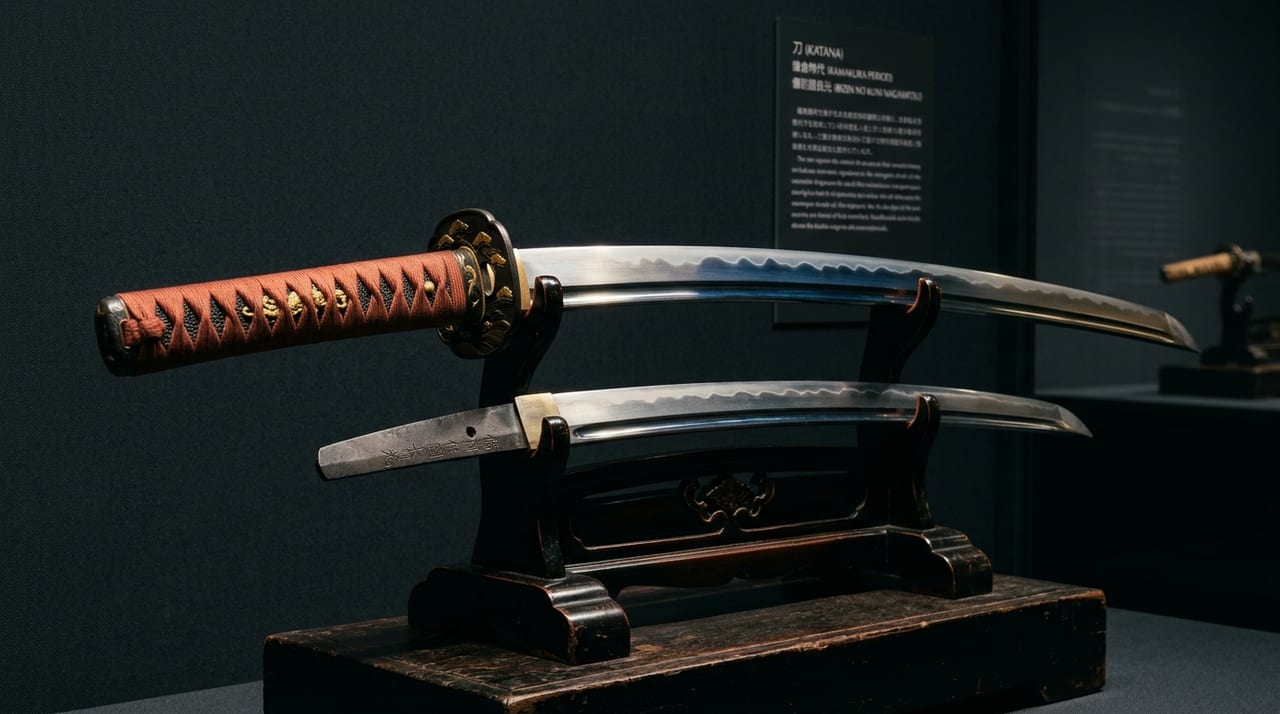 * Image is for illustrative purposes only.
Table of Contents
Many Terms Are Understood in Their Japanese Form Even in English-Speaking Countries
When reading descriptions by overseas enthusiasts, museum explanations, and auction listings, Japanese sword terminology is often used in romanized form without being translated into English. Terms such as tsuba, habaki, hamon, nakago, and kissaki are more accurately conveyed by using the Japanese reading as-is rather than replacing them with English equivalents. When an English translation is added, the standard practice is to treat the romanized term as primary and the English explanation as supplementary.
For a general term referring to the nihontō itself, alongside "Japanese sword," the word "Nihonto" is used among collectors. In general-interest articles, Katana is used as a catch-all for Japanese swords, but in the world of Japanese swords it is also a word that distinguishes the type of sword and the style of mounting. This difference is the starting point for the misunderstandings discussed below.
This article organizes English expressions that are easy to use when communicating with overseas counterparts, and points where a literal translation shifts the meaning. Questions of measurements and regulations are not addressed; the focus is confined to the correspondence and use of terms.
Terms for Types of Swords
The types of swords are distinguished by length and how they are worn. In English too, the Japanese terms are used as-is.
- Tachi: tachi. A term used to refer to a sword worn suspended from the waist with the blade facing downward. In English it is customary to write it as Tachi, distinguished from Katana.
- Katana: katana. A term referring to a sword thrust through the belt with the blade facing upward. In English-speaking countries it is widely used as a general term for long Japanese swords.
- Wakizashi: wakizashi. A shorter sword worn alongside the long sword.
- Tantō: tantō. A short sword, often described in English as a dagger or knife.
What needs attention is that the scope of the term "Katana" does not correspond between Japanese and English. In English-language media, it is not uncommon to refer to a tachi as a Katana as well. On the other hand, Japanese sword descriptions distinguish between tachi and katana, so when explaining to an overseas audience, adding a word about the difference in how they are worn — suspended versus thrust through the belt — reduces misunderstanding.
The term "Samurai sword" also has broad currency, but it is an ambiguous expression that cannot specify type or period. For trade and exhibition descriptions, it is better to be explicit about the type, such as Tachi, Katana, or Wakizashi.
Terms for Parts of the Blade
For parts of the blade, romanized terms take center stage in English descriptions as well.
- Hamon: hamon. In English it is sometimes described as temper line or hardening line.
- Hada: jihada/kitae-hada. The grain pattern that appears on the surface of the steel, described as grain or steel texture.
- Sori: sori. Described as blade curvature.
- Kissaki: kissaki. Described as blade tip or point.
- Shinogi: shinogi. The ridge line running along the side of the blade, described as ridge line.
- Nakago: nakago. The part that fits into the tsuka, described as tang.
- Mekugi: mekugi. A peg of bamboo or similar material that secures the tsuka to the nakago, described as peg.
Translating hamon as temper line is widely seen, but caution is required. In Western metallurgy, temper often refers to the process of reheating after quenching to adjust toughness. The hamon of a nihontō is a pattern that appears at the boundary where the blade area hardens through quenching, so describing it as hardening line is closer to the actual process. In practice, however, using Hamon as-is is the most reliable approach. For the types of hamon, the explanatory guide organizing hamon patterns is also useful.
The nakago may bear a signature called Mei, which is written as Mei in English as well. Since tang also refers to the part of a general blade that enters the handle, writing Nakago in the context of discussing nihontō avoids misunderstanding when discussing signatures or the condition of rust.
Terms That Tend to Cause Misunderstanding When Translated Literally
Even among terms for which an English translation is current, some have a shifted range of meaning.
- When translating tsuba as guard: Guard is a broad term that also encompasses the cross-shaped guards of Western swords, and does not convey the character of the Japanese tsuba with its traditions of form, material, and decoration. It is safest to write Sword guard while also noting Tsuba.
- When translating habaki as collar: This is the metal fitting fitted onto the blade below the tsuba, but Collar alone makes its role difficult to understand. Add Blade collar and note that it is the fitting responsible for securing the blade.
- When translating togi as polish: Togi is not mere surface polishing; it is also the process of making the hamon and jihada visible. Writing Polishing makes it sound like a cosmetic operation, so add an explanation such as Traditional Japanese polishing.
- When translating kitae as folding: It refers to orikaeshi tanren, but folding is not the entirety of kitae, so do not describe the quality of a sword by Folding alone.
Furthermore, writing Samurai sword alone does not distinguish between modern forged pieces and decorative reproductions. Whether something is intended as a nihontō or a replica must also be made explicit with different wording in English descriptions.
Practical Points When Explaining to Overseas Counterparts
In exchanges with overseas counterparts, it is useful to agree on terminology from the outset. For example, a workable approach is to use the romanized forms — Tachi, Katana, Wakizashi, Tantō for types, and Hamon, Hada, Nakago and so on for parts — as primary, with a brief English explanation in parentheses. Adding photographs and indicating which part is being referred to reduces further misalignment in language.
When there is a signature it is written as Mei, and when unsigned as Mumei. Since the presence or absence of a signature affects valuation, these are used as-is without English translation. The complete mounting is often written as Koshirae, and a plain wood storage saya is often written as Shirasaya; in English these are supplemented only to the extent of Mounting or Storage scabbard.
The depth of explanation also varies depending on the background and experience of the person being addressed. Trends among overseas collectors are covered in detail in the guide on overseas collectors. Questions of cross-border shipping and customs handling are matters of procedure rather than terminology, so please refer to the separate article Country-by-Country Export Guide.
Summary
The basis for discussing nihontō in English is to treat the romanized specialized terms as primary and English as supplementary. Grasping the points where literal translation causes misunderstanding — the distinction between Katana and Tachi, the gap between tsuba and guard, and the difference in process between hamon and temper — enables misunderstanding-free conversation with overseas counterparts.
If you are ever uncertain about terminology, please contact us through the inquiry form.