Nihonto Overseas Export Country Guide — Regulations for Recipients to Verify in the United States, the United Kingdom, Australia, and Canada
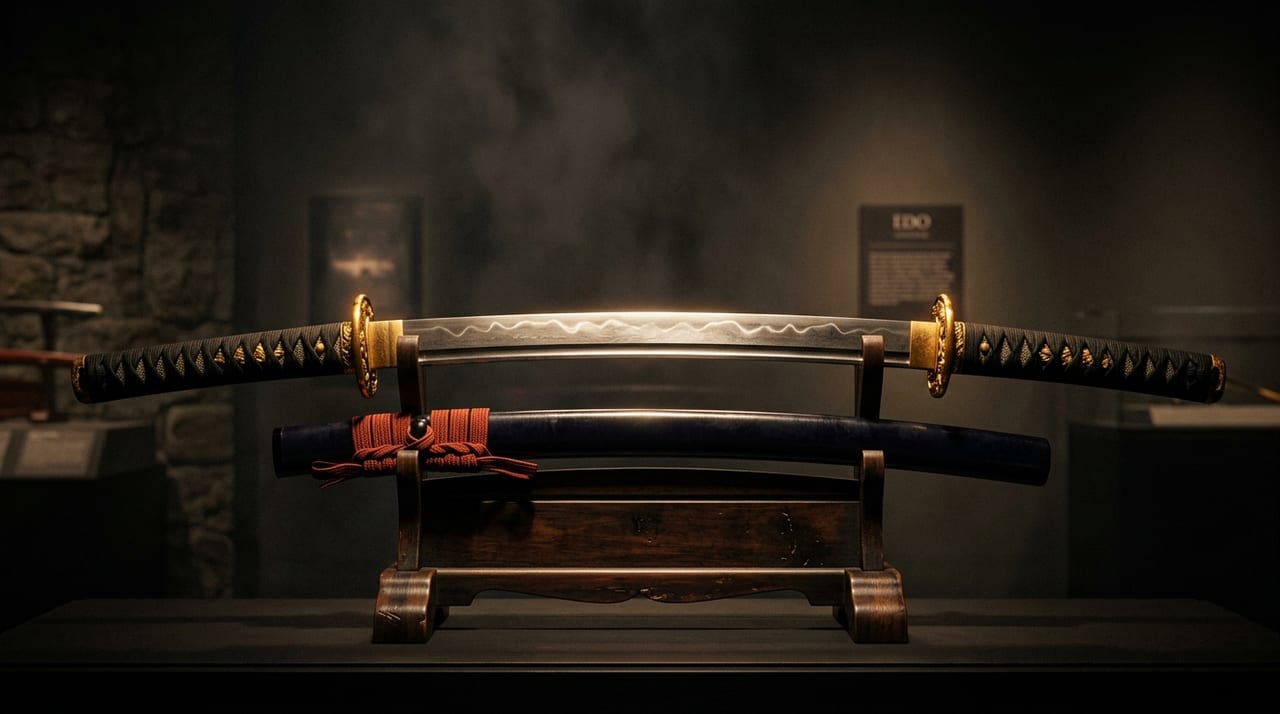 * Image is for illustrative purposes only.
Table of Contents
Scope of This Article — Japan-Side Procedures and Destination-Country Rules Are Separate
When shipping nihonto to overseas buyers, you must satisfy both the procedures for exporting from Japan and the rules of the receiving country for importing and possessing swords. This article covers the latter — specifically the United States, the United Kingdom, Australia, and Canada — and summarizes only what has been confirmed through each country's legal databases and customs materials. Continental Europe and Asia are covered in "Nihonto Import Regulations: Country Guide (Europe and Asia)".
Japan-side procedures — the Agency for Cultural Affairs' ancient art export examination certificate, and returning the registration certificate to the Board of Education of the prefecture where the sword was registered — are summarized in "How to Take Nihonto Abroad" (Agency for Cultural Affairs "Ancient Art Export Examination Certificate"). If the koshirae uses ivory, tortoiseshell, or other materials covered by the Washington Convention (CITES), an export permit handled by the Ministry of Economy, Trade and Industry (METI) is required for export from Japan (METI "Washington Convention (CITES)"). For an overview of the entire transaction process, see "Nihonto Overseas Export Regulations and the International Market".
Destination-country rules are subject to revision. The following is a guide for reading the statutes; it is assumed that the recipient will ultimately confirm the details with that country's customs or police.
United States — Federal Law Names Only the Switchblade Knife
The only bladed weapon named in US federal law — including importation from outside the country — as prohibited from distribution is the switchblade knife.
- Title 15, United States Code, Section 1241 defines a switchblade knife as a knife whose blade opens automatically by pressing a button on the handle or by inertia or gravity, and includes transactions with places outside the United States within interstate commerce. Section 1242 penalizes the importation, transportation, and distribution of such knives (govinfo "15 U.S.C. Chapter 29").
- Customs regulation 19 CFR 12.97 classifies the importation of switchblade knives as unlawful importation subject to seizure, except as provided (eCFR 19 CFR 12.97).
These statutes, and the US Customs and Border Protection (CBP) page for travelers on "Prohibited and Restricted Items," contain no items naming swords (CBP "Prohibited and Restricted Items"). The Harmonized Tariff Schedule (HTS) includes 9307.00.00 (Swords, cutlasses, bayonets…) for swords and 9706 for antiques more than 100 years old (US International Trade Commission HTS). The applicable HTS number and duty rate should be confirmed by the recipient with a customs broker or CBP.
Swords with ivory koshirae require attention. The same CBP page states that importation of nearly all ivory — except warthog tusks — requires a US Fish and Wildlife Service (FWS) permit, and that antiques more than 100 years old can be imported with documentation proving their age (other requirements may apply).
Rules on possession and carrying are separately established by state and local law. Please ask the recipient to verify the rules of the state and city where they live.
United Kingdom — Curved Blades of 50 cm or More Are on the Regulated List
Section 141 of the Criminal Justice Act 1988 makes it an offense to manufacture, sell, hire, offer for sale or hire, give, or lend weapons specified by order, and subsection (4) prohibits the importation of such weapons. In England and Wales, from 14 July 2021, possession in private places also became an offense (subsection (1A)) (legislation.gov.uk "Criminal Justice Act 1988 section 141").
The list of specified weapons is in the Schedule to The Criminal Justice Act 1988 (Offensive Weapons) Order 1988, and item 1(r) specifies "a sword with a curved blade of 50 centimetres or over in length." Blade length is the straight-line distance from the top of the tsuka to the tip (legislation.gov.uk "The Criminal Justice Act 1988 (Offensive Weapons) Order 1988" Schedule). The Schedule provides two exceptions:
- Schedule 2: An antique made more than 100 years before the date of the alleged offense is excluded from the list.
- Schedule 3: For curved blades under item 1(r), demonstrating that the sword was made before 1954, or that it was made by traditional hand craftsmanship, serves as a defense against offenses under section 141(1) and (1A), and against offenses under section 50 of the Customs and Excise Management Act 1979 (improper importation).
Since Schedule 3 is a defense that the recipient must "demonstrate," it is advisable to have documentation available showing the date of forging, the maker, and the handmade nature of the sword. In England and Wales, from 1 August 2025, a "ninja sword" (blade length 14–24 inches) with a straight blade, an unsharpened spine, and a tantō-type tip has also been added under item 1(u).
Carrying a bladed article in a public place is separately an offense under section 139, unless there is good reason or lawful authority (legislation.gov.uk "Criminal Justice Act 1988 section 139"). The Schedule order was revoked in Scotland and replaced by a 2005 order specific to Scotland, so for shipments to Scotland the recipient should verify that order.
Australia — Federal Import Rules and State Possession Rules
Section 4H of the Customs (Prohibited Imports) Regulations 1956 prohibits the importation of weapons listed in Part 2 of Schedule 13, unless one of the criteria in that item (official use, specific purpose, licensed dealer, police certificate, etc.) is met (Federal Register of Legislation "Customs (Prohibited Imports) Regulations 1956").
- The Part 2 list contains no item naming swords, and the daggers item (item 2) explicitly states "not including swords or bayonets."
- However, items that conceal a blade (item 20; objects shaped like a cane sword may fall under this), throwing stars (item 23), and nunchaku (item 9) are on the list.
Possession rules are set by each state and territory. Victoria Police identifies swords as prohibited weapons under the Control of Weapons Act 1990 and the Control of Weapons Regulations 2021, notes that an article can be a sword even if the blade is not sharp, and states that possession requires either a Chief Commissioner's Approval or being covered by a Governor in Council exemption order (Victoria Police "List of prohibited weapons"). For shipments to other states and territories, the recipient should verify the rules with the police of that state.
Canada — Only What Falls Under the Penal Code Definition Is a Prohibited Weapon
Canada Border Services Agency (CBSA) Memorandum D19-13-2 explains that only items meeting the definition in subsection 84(1) of the Penal Code — knives that open automatically and weapons designated as prohibited weapons by regulation — are classified as prohibited weapons, and that weapons not specifically prohibited by law are generally admissible (CBSA "Memorandum D19-13-2").
The regulatory prohibited weapons listed in the memorandum include nunchaku, shuriken, manrikigusari, push daggers, and similar items. The only mention of swords is in paragraph 33, which gives cane swords exceeding 30 cm in length as an example that "generally does not constitute a prohibited weapon." Confirm that any accessories shipped with the sword do not qualify as prohibited weapons, and ask the recipient to verify state and municipal rules on carrying.
Summary of All Four Countries
| Country | Statutes Reviewed | Points Relevant to Swords | What the Recipient Should Verify |
|---|---|---|---|
| United States | 15 U.S.C. 1241, 1242; 19 CFR 12.97; CBP page | Only switchblades are named. Ivory koshirae requires FWS permit or age documentation | HTS number and duty rate; state and local rules |
| United Kingdom | Criminal Justice Act 1988 s141, s139; 1988 Order Schedule | Curved blades of 50 cm or more are on the list. Antiques are excluded; made before 1954 or handmade is a defense | Documentation to demonstrate the defense; Scotland's order |
| Australia | Customs (Prohibited Imports) Regulations 1956, Schedule 13 | No sword item in the federal list | State/territory possession requirements (Victoria requires approval or exemption) |
| Canada | CBSA Memorandum D19-13-2 | No sword item. Shuriken and similar are prohibited weapons | Accessories included in the shipment; state and municipal rules |
What to Confirm Before Shipping
- Ask the recipient to confirm in advance with customs or police that importing and possessing a sword is permitted under the rules of their country, state, and city
- Verify the materials in the koshirae and accessories (ivory, tortoiseshell, etc.) and confirm the procedures on both the Japan side and the recipient-country side
- Confirm that any accessories included in the shipment do not qualify as weapons on the recipient country's list (shuriken, concealed bladed items, etc.)
- Prepare documentation showing the date of forging and the maker, and declare the name and contents accurately
As in the case of Australia, even if there is no sword item on the federal import list, some countries require approval for possession under state rules. The most reliable approach is a division of responsibility: the sender covers the statutory entry points, and the recipient makes the final confirmation with the relevant authority in their country.