Nihonto Import Regulations Country Guide — Europe (EU, Germany, France) and Asia (Taiwan, Singapore, Mainland China, Hong Kong)
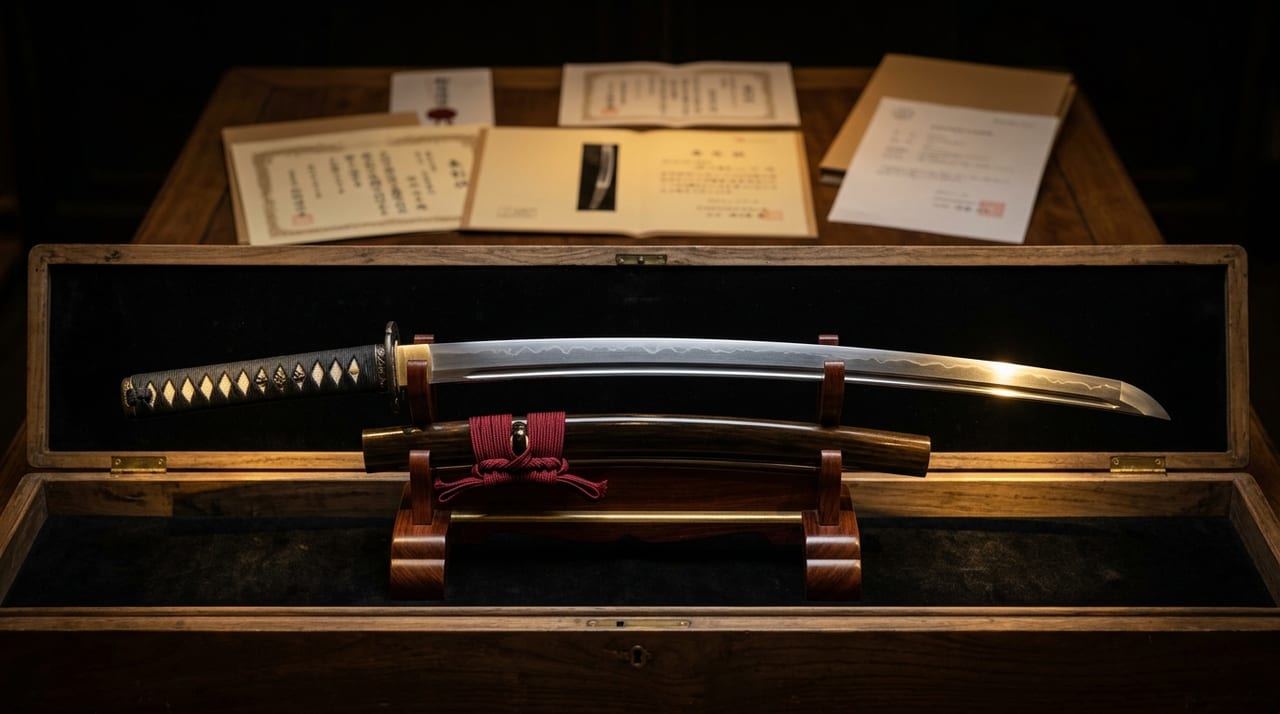 * Image is for illustrative purposes only.
Table of Contents
Before Checking the Receiving Country's Regulations
When sending nihonto overseas, separate from the procedures for exporting from Japan, it is necessary to verify whether swords can be imported and possessed in the receiving country or region. This article summarizes, within the scope confirmed through each country's legal databases and official government pages, the situation in Europe (EU, Germany, France) and Asia (Taiwan, Singapore, mainland China, Hong Kong). The United States, United Kingdom, Australia, and Canada are covered in "Nihonto International Export Country Guide."
For procedures on the Japanese side (the Agency for Cultural Affairs' antique export inspection certificate and surrender of the registration certificate), see "How to Take Nihonto Abroad." For procedures and transaction flow when the koshirae contains CITES-regulated materials such as ivory, see "Nihonto Export Regulations and the International Market." The regulations of the receiving country may be revised, and it is assumed that the recipient will perform final verification with the customs authority or police in their country.
EU — The Common Weapons Directive for Member States Focuses on Firearms
The EU Weapons Directive (Directive (EU) 2021/555, on the control of the acquisition and possession of weapons) defines "weapon" under this directive in Annex I as the firearms defined in Article 1 and "weapons other than firearms as defined in national legislation," with the category subject to differentiated regulation being firearms (EUR-Lex "Directive (EU) 2021/555").
In other words, this directive does not contain a uniform rule covering swords across the EU as a whole. The import, possession, and carrying of swords must be verified under the domestic law of the destination member state. Examples for Germany and France are given below.
Germany — Possession for Adults and the Prohibition on Carrying under §42a
Section 2 of Germany's Waffengesetz (WaffG) restricts the handling of weapons to persons aged 18 and over, requiring a permit (Erlaubnis) for weapons in Section 2 of Annex 2 and prohibiting weapons in Section 1 (WaffG §2). Section 2, which requires a permit, covers firearms and similar weapons under Annex 1, Part 1, Section 1, Subsection 1 (WaffG Annex 2).
What is relevant to swords is "cutting and thrusting weapons (Hieb- und Stoßwaffen)" as defined in Annex 1 — items "whose essential purpose is to cause injury by cutting, thrusting, stabbing, striking, or throwing using direct muscular force" (WaffG Annex 1). The main points the WaffG establishes for such weapons are as follows.
- §42a Paragraph 1 prohibits carrying (führen) Hieb- und Stoßwaffen. Paragraph 2 exempts use in photography, film, or television productions and theater, transportation in a closed container (verschlossenes Behältnis), and cases involving a legitimate interest; Paragraph 3 lists occupational use, preservation of traditional customs, and sports as examples (WaffG §42a).
- Section 1 of Annex 2 (prohibited weapons) lists Hieb- und Stoßwaffen disguised as other objects or concealed within everyday items (1.3.1), and star-shaped throwing discs (Wurfsterne, 1.3.3). It is necessary to verify whether items in the form of a sword cane or shuriken fall under these prohibitions.
Even if a sword qualifies as a Hieb- und Stoßwaffe, since the list requiring permits covers firearms and similar weapons, mere possession by an adult is not listed among items requiring a permit under Annex 2. Carrying, however, is in principle prohibited, and transportation must be done in a closed container. Recipients should verify the customs treatment at import with German customs (Zoll).
France — Purchase and Possession under catégorie D, and Restrictions on Carrying and Transportation
The official French administrative information website Service Public classifies catégorie D as weapons for which "purchase and possession are freely permitted (acquisition et détention libres)," and describes subcategory a) as "all items that may constitute a weapon dangerous to public safety (Tous objets pouvant constituer une arme dangereuse pour la sécurité publique)." Examples given include disguised non-firearm weapons, daggers (poignard), couteau-poignard, batons, and similar items, but swords are not named explicitly (Service Public "Armes de catégorie D").
According to the same page, only adults may purchase catégorie D weapons, and carrying or transporting them outside the home (including in a vehicle) is prohibited without a legitimate reason (motif légitime). Whether a reason is legitimate is determined on a case-by-case basis based on the location, time, type of weapon, and the owner's circumstances. The cited legal bases include Article R311-2 (classification), Articles L315-1 et seq. (carrying and transportation), and Article L317-8 (penalties) of the Code de la sécurité intérieure.
Recipients should verify with French customs (douane) and the police which classification applies to a sword and what procedures are required for import.
Taiwan — Nihonto Are Classified as Daojiè; Pre-Import Consent Documents Required
Taiwan's Arms, Ammunition, and Bladed Weapons Control Act defines "daojiè (controlled bladed weapons)" in Article 4, Paragraph 1, Item 3 as "wushidao, shouzhangtao, yuanyangdao, shouzighu, steel (iron) whip, bianzuan, and bishou (each as illustrated in the attached diagrams)," as well as items subject to control by public notice from the central competent authority, and Article 6 prohibits manufacturing, selling, transporting, transferring, renting, lending, or possessing these without permission from the competent authority. Persons who possess them without authorization are subject to penalties under Article 14 (National Laws and Regulations Database "Arms, Ammunition, and Bladed Weapons Control Act").
The permit procedures are governed by the Regulations for the Permit and Management of Guns, Ammunition, and Bladed Weapons (National Laws and Regulations Database "Regulations for the Permit and Management of Guns, Ammunition, and Bladed Weapons").
- Article 19: Individuals and groups may apply for a permit to possess daojiè for commemorative, decorative, physical fitness performance or practice, or legitimate recreational purposes.
- Article 21: Before importing daojiè, the importer must apply to the competent authority of the special municipality or county (city) of their household registration for a "consent document," attaching materials such as the catalog, model number, quantity, and intended use of the daojiè, and must present this document to clear customs at the relevant offices under the Customs Administration of the Ministry of Finance. Within 7 days from the day following import, the importer must present the item for inspection at the police bureau of their household registration and apply for issuance of a permit.
When shipping to buyers in Taiwan, it is a prerequisite to confirm that the recipient has obtained the consent document in advance before dispatching.
Singapore — Swords Are "Weapons"; a Licence Is Required for Import and Possession
Singapore's Guns, Explosives and Weapons Control Act 2021 defines "weapon" as the items listed in the First Schedule, with item 7 listing "A sword, being a thrusting, striking or cutting weapon with a long blade having one or 2 cutting edges and a hilt." The same Schedule also includes shuriken (item 12), Kama (item 16), Sai or Jitte (item 19), nunchaku (item 20), and Manrikigusari (item 21) (Singapore Statutes Online "Guns, Explosives and Weapons Control Act 2021" First Schedule).
- Article 29: Possessing a weapon without a licence or other authorization is an offense.
- Article 31: Importing or exporting a weapon without a licence or other authorization is an offense.
The text of Article 29 and Article 31 can be verified at those links. It is necessary to confirm before shipping that the recipient can obtain a licence for import and possession.
Mainland China and Hong Kong — Recipients Must Verify with the Relevant Authorities
Regarding mainland China, the "List of Items Prohibited from Entry into and Exit from the People's Republic of China" (General Administration of Customs Order No. 43) lists "all types of weapons, imitation weapons, ammunition, and explosives" as the first category of prohibited items (Chinese Government Website "List of Items Prohibited from Entry into and Exit from the People's Republic of China"). Whether nihonto falls under these "weapons," and whether they may be possessed within China, cannot be determined from this list alone. The recipient must verify in advance with Chinese customs (haiguan) and public security authorities.
Regarding Hong Kong as well, recipients should verify the treatment of sword imports and possession in advance with Hong Kong customs and police.
Summary — Key Points to Check by Country
| Country/Region | Regulation Checked | Points Relevant to Swords | What the Recipient Must Verify |
|---|---|---|---|
| EU | Directive (EU) 2021/555 Annex I | The directive differentiates firearms. Non-firearms are governed by each country's national law | Domestic law of the destination member state |
| Germany | WaffG §2, §42a, Annex 1, Annex 2 | Carrying is prohibited (transportation in a closed container, etc. is exempt). Concealed blades and shuriken are on the prohibited list | Applicable classification for swords, customs treatment at import |
| France | Service Public catégorie D page | catégorie D is freely available for purchase and possession by adults; a legitimate reason is required for carrying and transportation | Classification of swords, import procedures |
| Taiwan | Arms, Ammunition, and Bladed Weapons Control Act; Permit and Management Regulations | Nihonto (wushidao) is classified as daojiè. Pre-import: consent document required; post-import: permit required | Obtaining the consent document |
| Singapore | Guns, Explosives and Weapons Control Act 2021 | Swords are weapons. A licence is required for import and possession | Whether a licence can be obtained |
| Mainland China / Hong Kong | List of Prohibited Items for Entry and Exit (mainland China) | Whether they constitute "weapons" cannot be determined from the list alone | Prior verification with customs and police |
For every country and region, in addition to the sword itself, it is advisable to confirm that any accompanying accessories (such as shuriken, jitte, or concealed blades) do not fall under the receiving country's restricted list. The most reliable approach is a division of responsibility in which the sender identifies the relevant legal provisions, while the recipient makes final confirmation with the appropriate authority in their country.