Machi and Machi-okuri — What the Shapes of Hamachi and Munemachi Tell Us About Period Identification and Appraisal Significance in Nihontō
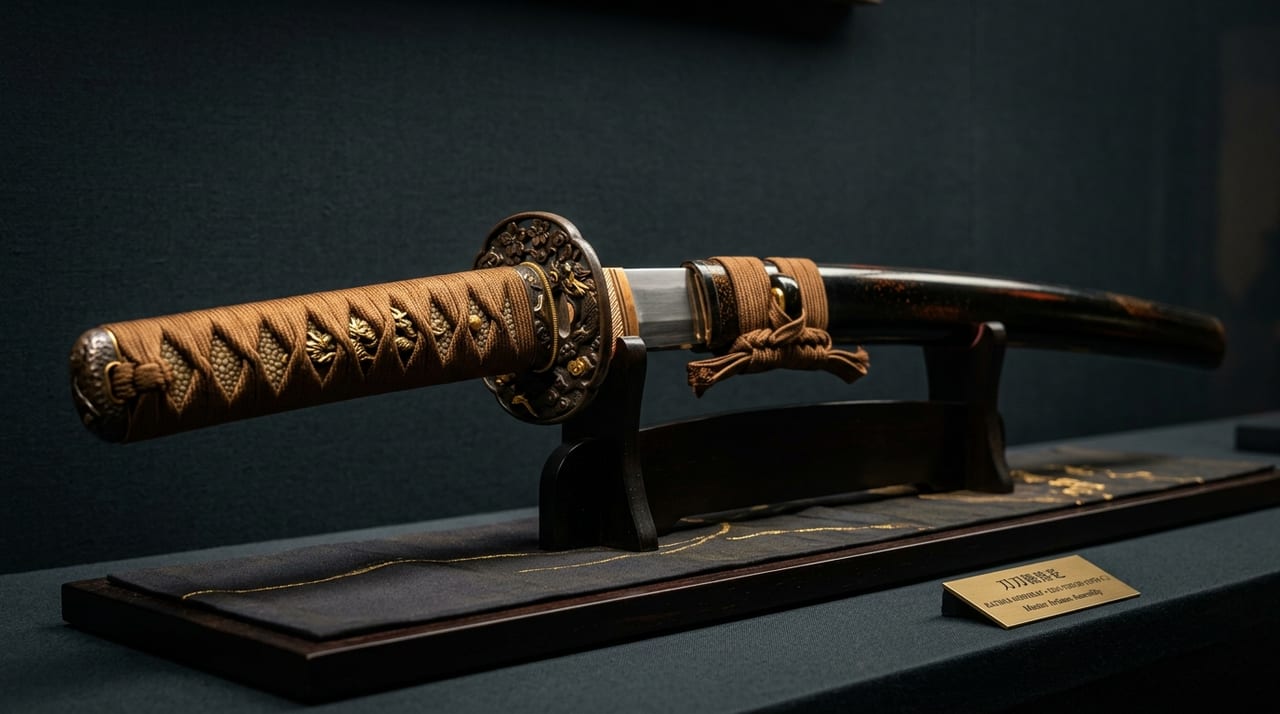 * Image is for illustrative purposes only.
Table of Contents
What Is the Machi? — The Boundary Separating the Blade from the Nakago
At the boundary between the blade and the nakago (tang) of a nihontō, there is a stepped notch called the "machi." The machi consists of two elements.
Hamachi: The notch on the cutting-edge side. The starting point from which the cutting edge begins.
Munemachi: The notch on the mune (back of the blade) side. The starting point from which the ridgeline of the mune begins.
The hamachi and munemachi face each other but are not necessarily at the same height. The straight-line distance from the hamachi to the munemachi (the width measured perpendicular to the blade axis) is sometimes called the "machi-haba."
The machi is not merely a structural boundary; it also serves as a "stop" when securing the blade in the tsuka (hilt). Working in conjunction with the mekugi hole, it controls axial movement of the blade and is an important functional element in practical use.
Classification of Machi Shapes — The First Step in Reading the Period
Machi shapes vary by period, region, and school, and serve as important clues in appraisal. The principal shape classifications are as follows.
Hamachi Shapes
Chokkaku-machi: A shape in which the hamachi is cut almost perpendicularly to the blade axis. The standard form found on swords of many periods.
Naname-machi: A shape in which the hamachi is set at an angle to the blade axis. Found on some swords of the kotō period.
Marumi-machi: A shape in which the hamachi has a rounded contour. A chokkaku-machi can also take on a rounded appearance through repeated togi (polishing).
Shinogi-ochi-machi: A shape in which the shinogi (ridge line) drops near the machi. A distinctive shape found on hira-zukuri swords.
Munemachi Shapes
Sugu-munemachi: A shape in which the munemachi is set in a straight line. The most common form.
Iri-munemachi: A shape in which the munemachi is slightly recessed into the inner side of the blade.
Hari-munemachi: A shape in which the munemachi projects slightly to the outer side of the blade.
As a general period tendency, fine swords of the Kamakura period have machi shapes that are crisp and deep. From the Muromachi period onward, mass-produced swords tend to have shallower machi shapes. Carefully made swords of the Edo period once again show clearly defined machi shapes.
Machi-okuri — Evidence That Records the Togi History
"Machi-okuri" is one of the most important concepts in nihontō appraisal. It refers to the technique of intentionally grinding up the hamachi and munemachi in order to shorten the blade. Its defining characteristic is that only the machi is raised while the nakago is left uncut and in its original ubu state. The extent of this displacement is called the "machi-okuri-ryō."
How to Determine Machi-okuri:
- Check the orientation and sharpness of the hamachi and munemachi surfaces. When the displacement is large, the machi surface becomes dull.
- Measure the distance from the mekugi hole in the nakago to the machi, and compare with swords of the same period and type.
- Check the positional relationship between the tsuka (hilt) of the koshirae and the machi. On a sword with a large machi-okuri, the fit between the tsuka and the blade may appear unnatural.
- Observe changes in the shape at the transitional area from the machi to the nakago.
Evaluation by Degree of Machi-okuri:
- Virtually no machi-okuri (under 1 mm): Little togi history. The blade is likely in a highly sound condition.
- Moderate machi-okuri (1–5 mm): Togi for proper maintenance has been performed. A standard condition.
- Large machi-okuri (over 5 mm): Evidence of repeated togi in the past. The nagasa (blade length) may be shorter than the original.
Both machi-okuri and suriage (shortening) are processes that shorten the blade, but they differ in how the nakago is treated. Suriage shortens the entire blade by cutting down the nakago, whereas machi-okuri is a technique in which only the machi is ground up while the nakago remains uncut and in its ubu state. The practice of togi and finishing of the machi is covered in The Finishing Techniques of Hamachi and Munemachi.
What the Observation of the Machi Reveals About Use History
The condition of the machi also yields information about a sword's use history.
Machi of swords in practical use: Near the machi of a sword that has actually been drawn and sheathed in its saya (scabbard), friction marks from the interior wall of the saya (the wooden lining beneath the habaki) may be present. In particular, where minute wear is visible near the munemachi — which corresponds to the lower edge of the habaki (blade collar) — this can be taken as evidence of frequent use.
Distribution of kitae-kizu (forging flaws): The area near the machi is prone to concentration of stress during forging, making it a location where minute defects arising during forging (kitae-kizu, metal fatigue) are likely to occur. Irregularity in the grain pattern from the machi toward the hamachi warrants careful attention.
Condition of rust: Where rust originates on the blade reveals the storage conditions. If rust has developed near the machi, there is a possibility that the area beneath the habaki (blade collar) was not kept properly dry or maintained.
Integrated Appraisal of the Machi and the Nakago
It is important not to observe the machi in isolation but to grasp it as an integral part of the entire nakago (tang).
Continuity between the hamachi and yasurime (file marks): When the yasurime pattern on the nakago begins just below the hamachi, it is highly likely that the original nakago shape has been preserved since manufacture.
Relationship between the position of the mekugi hole and the machi: The distance from the mekugi hole to the machi shows consistent tendencies by period and school. If this distance is too long or too short, the possibility of suriage or later reworking must be considered.
Consistency between the mei (signature) and the machi: A mei engraved very close to the machi carries a different significance from one with some distance between them. On a sword with a large machi-okuri, the machi may be brought too close to the mei.
The machi, a small part of the sword, is a silent witness that speaks to the nihontō's history. By observing its shape, condition, and position with care, the full picture of its togi history, storage conditions, and use history — from the time of its creation to the present — comes into view.
Differences Between Suriage and Machi-okuri — Comparison Table
| Item | Machi-okuri | Suriage (shortening) |
|---|---|---|
| Part worked | The hamachi and munemachi are ground up toward the kissaki | The nakagojiri is cut down |
| Condition of the nakago | Remains in the ubu (original, uncut) state | Becomes shorter |
| Nagasa (blade length) | Becomes shorter | Becomes shorter |
| Effect on the mei | In principle, remains | Lost in the case of ō-suriage (may be preserved via gaku-mei or orikaeshi-mei) |
| Treatment in appraisal | Treated on a par with ubu but noted as "machi-okuri" | Evaluated with a clear distinction as "suriage" or "ō-suriage" |
Frequently Asked Questions
What is the hamachi?
The hamachi is the notch set on the cutting-edge side of the boundary between the blade and the nakago (tang). It is the starting point of the cutting edge and serves as the reference point for where the habaki (blade collar) is fitted.
What is the munemachi?
The munemachi is the notch set on the mune (back of the blade) side of the boundary between the blade and the nakago. It forms a pair with the hamachi; the habaki fits over both machi to secure the blade. The depth and crispness of the machi are important clues in period identification.
What is machi-okuri?
Machi-okuri is a process in which the hamachi and munemachi are ground up toward the kissaki to reduce the nagasa (blade length). Because the nakagojiri is not cut, the nakago remains in its ubu (original) state. It has been performed to address flaws or wear at the base of the blade, or to re-fit a sword to the dimensions of a mounting.
Does a sword with machi-okuri lose value?
It depends on the degree. If the ubu nakago and the zaimei (signed) mei are preserved, the appraisal does not fall as much as it would for suriage; however, a sword with a large displacement is considered in terms of soundness, since it departs from its original form at the time of manufacture. When the nagasa recorded on the registration certificate differs greatly from the measured value, it is standard practice in appraisal to check for evidence of machi-okuri or suriage.
What is the relationship between the habaki and the machi?
The habaki is a fitting that hooks over the hamachi and munemachi to seat the blade, securing it within the saya (scabbard) from the machi as its reference point. Because the habaki loosens when the machi wears, the condition of the machi and the fit of the habaki are always observed together. Looseness is addressed by having a new habaki made or refitting the existing one; the machi itself is never filed down to match.