The Theory and Appraisal Significance of Monouchi — A Scientific Look at the "Effective Striking Zone" of the Nihontō
 * Image is for illustrative purposes only.
Table of Contents
What Is the Monouchi? — The "Most Used Part" of the Blade
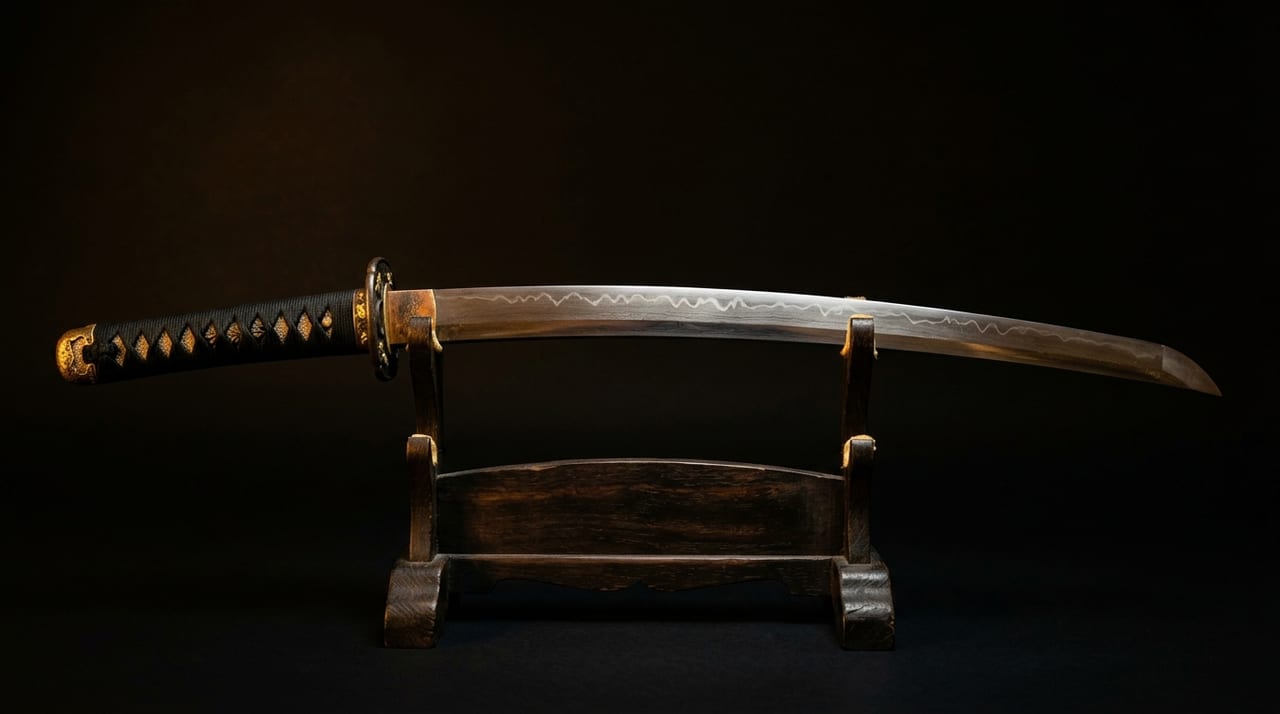
Monouchi is one of the most important concepts in the nihontō, yet it is frequently oversimplified in general reference works. The monouchi is the name for the section comprising approximately one-third of the blade measured from the kissaki (point) end, and has traditionally been defined as the optimal zone where the blade should make contact when actually cutting through an object.
More precisely, many schools define the monouchi as the section spanning approximately "three sun (roughly 9 cm)" before the kissaki, meaning that for a uchigatana with a nagasa (haiwatari) of two shaku three sun (approximately 70 cm), the monouchi corresponds to the section roughly seven sun to one shaku (21–30 cm) from the kissaki. However, this varies by school and period, and the essential understanding is the conceptual one of "the effective striking zone on the tip side of the blade" rather than any precise figure.
The Measurement System of the Blade and Its Relationship to the Monouchi
To understand the concept of monouchi, one must know the measurement system of the nihontō. The blade of a nihontō has the following principal measurement points.
- Nagasa (blade length): The length from the munomachi (mune-side notch) to the kissaki (point). Commonly referred to as the "haiwatari."
- Motohaba: The width between the blade edge and the mune (back of the blade) near the hamachi (blade-side notch), at the base of the blade. This is often the widest part of the blade.
- Sakihaba: The blade width near the yokote. The yokote is the boundary line where the monouchi transitions into the kissaki. It is an important line that visually demarcates the lower limit of the monouchi.
- Motokasane: The blade thickness near the hamachi (the thickness of the mune).
- Sakikasane: The blade thickness near the yokote.
- Fukura: The degree of roundness of the edge at the kissaki. Whether it is "fukura-tsuku" (rounded) or "fukura-karabi" (sharply pointed) is a key observation point in appraisal.
What determines the function of the monouchi is the balance between the sakihaba and sakikasane. If the sakihaba is too wide, resistance during cutting increases; if too narrow, strength is insufficient. If the sakikasane (thickness) is not appropriate, the risk of bending and damage increases. In appraisal, the ratio of sakihaba to motohaba (sakihaba/motohaba) is an important indicator, and there are characteristic numerical ranges for each period.
Changes in Monouchi Position and Blade Shape by Period
The concept of monouchi and blade shape have changed over time.
- Heian-Kamakura tachi: Characterized overall by a strong koshi-zori and a "fukura-tsuku" kissaki. The tip section corresponding to the monouchi is relatively wide, a shape suited to sweeping cuts in mounted combat. The sakihaba/motohaba ratio is approximately 0.60–0.65, a comparatively wide shape. The production process of tachi from this period is explained in detail in the kotō-period tachi production process.
- Nanbokuchō ōdachi: Characterized by a wide mihaba (blade width) and thin kasane (blade thickness) ("wide mihaba and thin kasane"), with a particularly wide monouchi section. The emphasis is on destructive power rather than sharpness.
- Muromachi–Momoyama uchigatana: When a tachi was shortened by suriage (shortening) to become a uchigatana, the relative position of the monouchi shifted. In uchigatana newly produced during this period, there was also a tendency for the kissaki to become larger (ō-kissaki), expanding the monouchi section.
- Edo-period blades: Greater emphasis on formal dress over battlefield function. Both motohaba and sakihaba became narrower, and a "fukura-karabi" sharp kissaki became fashionable. Around the Keichō–Kan'ei period in particular, a slender, deeply curved form was in vogue, and the monouchi became correspondingly slender and sharp. Around the Enpō–Genroku period, there was a tendency to become wide again.
- Shinshintō (Bakumatsu) period: Driven by a mood of return to practicality, swords in a "revival style" modeled on the tachi forms of the Kamakura–Nanbokuchō periods became popular. The tip section, including the monouchi, tended to become wider and more substantial.
The Theory of Monouchi in Swordsmanship and Iai
Viewed from the perspective of the martial arts, the concept of monouchi is not merely a name for a part of the blade but is deeply connected to the theory of tōhō (sword techniques).
- The basic principle of "cutting with the monouchi": Many kenjutsu schools have the principle that "one should cut with the monouchi." The theory is that maximum cutting power is achieved not by thrusting with the kissaki but by bringing the monouchi, just before the kissaki, into contact with the target. This has a mechanical basis that can be explained through the relationship between the natural frequency of the blade and the center of gravity.
- The function of the yokote: The yokote is a clear step-line marking the lower limit of the monouchi, and in sword technique there are schools that distinguish "below the yokote is used for hikigiri (drawing cuts)" from "oshigiri (push cuts) and hikigiri (pull cuts) are performed at or above the yokote (within the monouchi)."
- Alignment of the center of gravity and the monouchi: The center of gravity of a fine nihontō is located "approximately three sun from the tsuba (hand guard)," while the monouchi is on the tip side of the blade. The sword is designed so that when swung one feels the "monouchi running (accelerating through centrifugal force)," expressed as "easy to swing through" or "little resistance near the hand."
Key Observation Points for Monouchi in Appraisal
The following summarizes the key observation points for examining the area around the monouchi in nihontō appraisal.
- Suriage (shortening) and changes to the monouchi: When an original tachi has been shortened by suriage to become a uchigatana, the nagasa is reduced, which changes the relative position of the monouchi. Suriage can also alter the sakihaba, potentially disrupting the original sakihaba/motohaba ratio. For the influence of suriage on the position of the mei (signature) and the interpretation of omote and ura, identification of omote and ura and their appraisal significance is also useful.
- Condition of the yokote: The yokote is one of the parts most easily lost through polishing. When the yokote is indistinct, it may indicate excessive polishing or problems with polishing technique.
- Concentration zone of hakobore (edge chipping): In swords that were actually used, hakobore tends to be concentrated in the monouchi. This is also evidence of "a sword used correctly." The location of hakobore allows one to infer whether a past owner handled the sword properly.
- Shape of the hamachi and munomachi: The shape of the machi (notches) has characteristics that vary by period, region, and school. By combining the shape of the machi with the various blade measurements, the accuracy of estimating the period of production increases.
The concept of monouchi symbolizes that the nihontō is not a mere cutting implement but a precision instrument integrating the mechanics of cutting, center-of-gravity design, and martial theory. For appraisers as well, the condition of the monouchi section is an important key to reading the sword's history of use, history of polishing, and period of production. A comprehensive approach to appreciation, including changes in the hamon (temper line), is also covered in How to Read the Hamon — Decoding the Beauty of the Nihontō, and we encourage readers to consult that article as well.