Identifying Haki-omote and Haki-ura and Their Appraisal Significance — The Secrets of Wearing, Mei, and Jigane Revealed by the "Orientation" of the Nihontō
 * Image is for illustrative purposes only.
Table of Contents
Haki-omote and Haki-ura — The Basics of Nihontō "Orientation"
The nihontō has two faces: the haki-omote and the haki-ura. These are not merely names for front and back; they are a fundamental concept that bears on every aspect of how the sword is worn, the position of the mei, the observation of the jigane, and appraisal.
When wearing a nihontō at the waist, the face that turns outward from the body is called the haki-omote, and the face that turns inward toward the body is called the haki-ura. An important caveat, however, is that tachi and uchigatana are worn differently, so even though both refer to the face that turns outward from the body, the direction the blade faces is reversed.
Omote and Ura of the Tachi
The tachi is worn in a style called tachi-haki, suspended from the koshiobi (waist belt) with the blade facing downward ("ha-kuda"). In this case, the face that turns outward from the body with the blade pointing downward becomes the omote of the tachi.
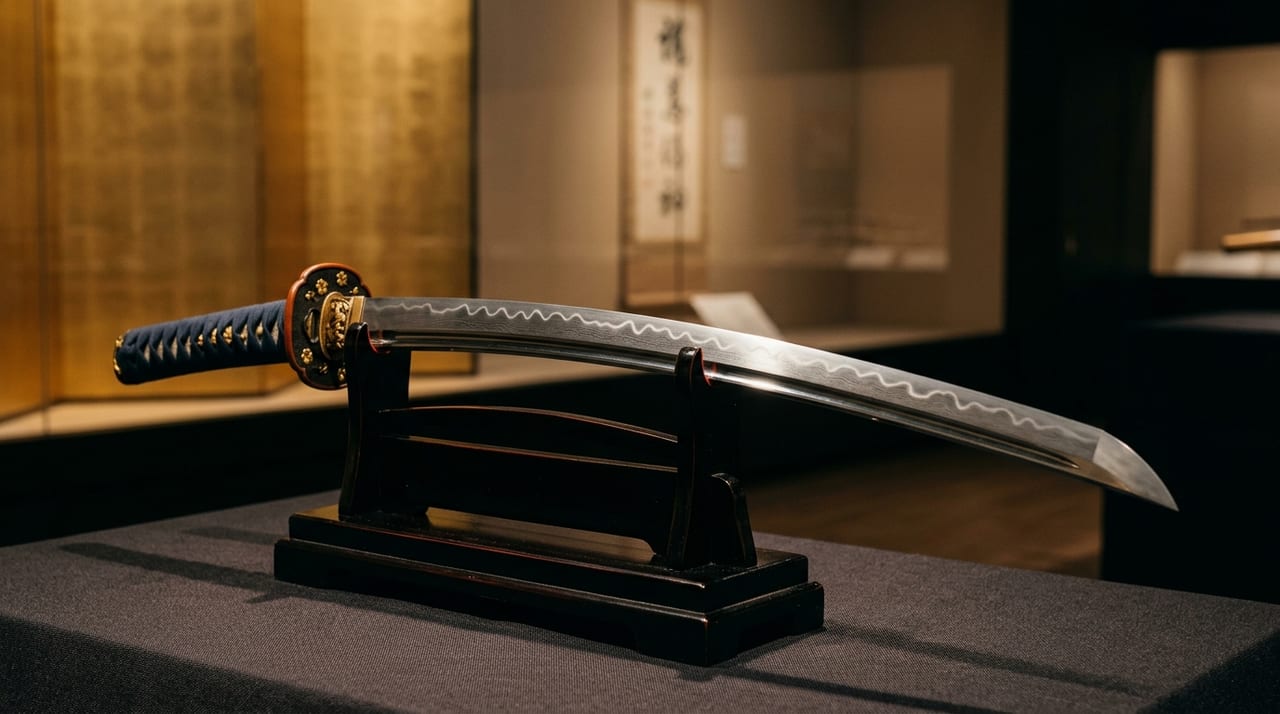
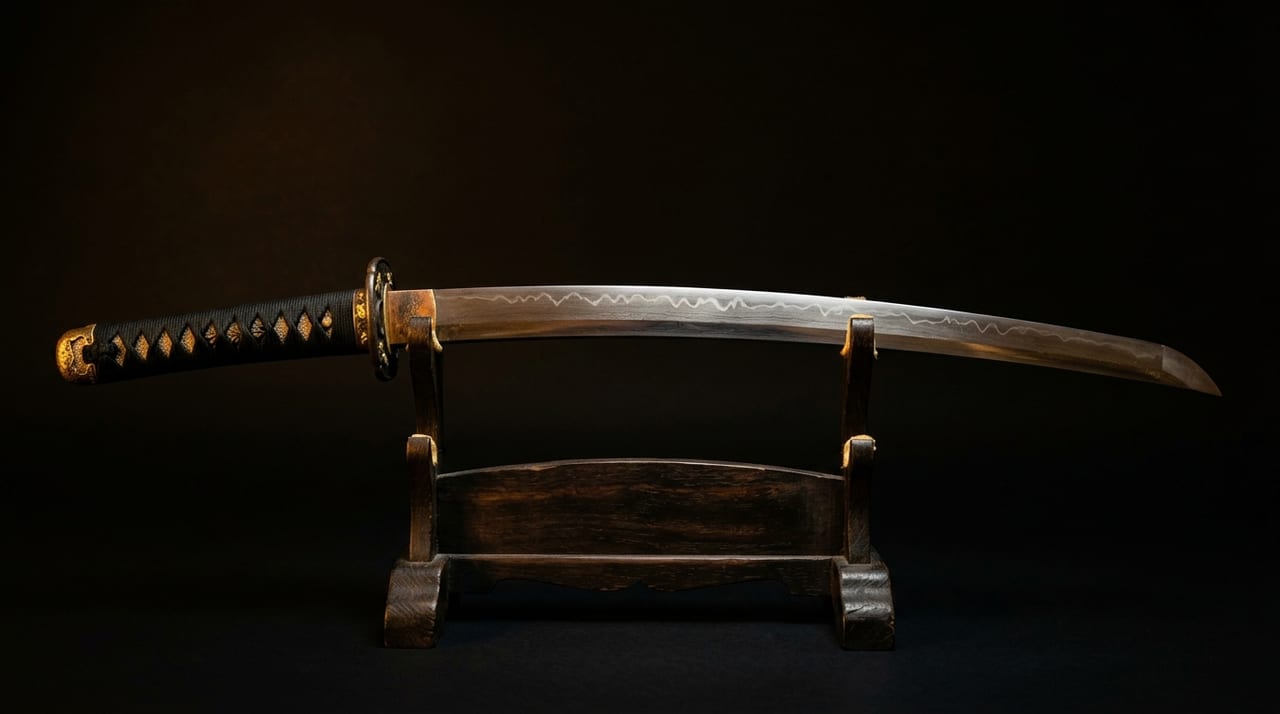
When viewing the tachi from the front (in the standard viewing posture, with the blade directed toward the lower right) —
- The face on the viewer's right is the omote
- The face on the viewer's left is the ura
Omote and Ura of the Uchigatana
The uchigatana is worn in a style called sashi, thrust into the koshiobi with the blade facing upward ("ha-jō"). The face that turns outward from the body when the uchigatana is worn in this manner is the outward face with the blade pointing upward.
When viewing the uchigatana from the front (in the standard viewing posture, with the blade directed toward the lower right) —
- The face on the viewer's left is the omote
- The face on the viewer's right is the ura
Note that this is the reverse of the tachi.
Why Omote and Ura Are Reversed Between Tachi and Uchigatana
The outer face of the tachi (worn blade-down) and the outer face of the uchigatana (worn blade-up) are both on the "right-hand side from the wearer's perspective." However, because the blade directions are reversed, when the blade is laid horizontally the left and right sides are also reversed, and so the omote and ura swap when the standard viewing posture (blade directed toward the lower right) is applied.
The Reasons and Significance of Mei Being Carved on the Omote
As a general rule, the mei of a nihontō is carved on the omote. This custom has the following rational basis.
Visibility: Because the mei is on the face that turns outward when the sword is worn at the waist, the mei can be seen from outside when worn (and is in a particularly visible position in the case of tachi-haki).
Etiquette: When showing the sword to another person, having the mei on the outer face (omote) is said to signify "turning the tōkō's name outward — showing respect to the tōkō."
Production convention: There has long been a tradition of "cutting the mei on the uwate (superior) face," and the omote side has been regarded as the "uwate (production front)." The specific techniques for engraving mei on the nakago are introduced in detail in Mei-kiri techniques.
When determining omote and ura from the position of the mei, there are exceptions to be aware of.
Ryōmenmei (double-face mei): In some cases mei is carved on both the omote and the ura. This is seen on special commissions and bōmei (long-line mei).
Uramei: The main mei is on the omote, and the date of production or additional information (such as "Hon'ami kao") may be carved on the ura.
Conversion from tachi to uchigatana: When a tachi is converted to an uchigatana by suriage, the original omote of the tachi may become the ura of the uchigatana. For this reason, on a suriage blade the mei may appear to be on the ura, and this is sometimes called sakamei (reversed mei).
Differences in Jigane Between Omote and Ura
Subtle differences between the omote and ura surfaces can arise in the jigane of a nihontō. These originate in the forging process.
Orikaeshi tanren and the formation of omote and ura: During orikaeshi tanren, depending on which direction the final fold is made, the grain of the jigane may have subtly different orientations on the omote and ura. Experienced appraisers may read the omote and ura from the direction of the jigane grain flow.
Yaki-ire and the response of jigane: Minor differences in the uniformity of heating and cooling during yaki-ire (quenching) can affect the jigane on the omote and ura. Differences in the jigane texture between omote and ura are particularly observed in kotō.
Directionality of horimono: Horimono such as hi are often applied to the omote, while on the ura they may be omitted or applied in a different form.
Identifying Omote and Ura — Practical Appraisal Methods
The methods for identifying omote and ura in actual appraisal are summarized below.
Identification by Mei (Most Reliable)
As noted above, the face bearing the mei is, as a general rule, the omote. However, cases involving suriage, ryōmenmei, or uramei require separate judgment.
Identification by the Shape of the Nakago
When the cross-sectional shape of the nakago is asymmetrical (as it is in many nihontō, where the nakago is not perfectly bilaterally symmetrical), omote and ura can be determined by which face is "the front in the direction of thickness."
Identification by the Direction of the Blade
A standard viewing procedure is established for determining omote and ura by placing the blade horizontally and combining the direction of the blade (right or left) with the wearing style (tachi or uchigatana). Observation in conjunction with the tip-side area of the blade, namely the position of the monouchi, deepens understanding. For the theoretical range of the monouchi and its appraisal significance, please refer to Theory and Appraisal Significance of the Monouchi.
Identification by the Direction of Jigane Grain
The method of reading the differences in the direction of jigane grain described above requires advanced skill, but is used as an auxiliary means of identifying suriage blades without mei and blades of unknown authorship.
Risks and Consequences of Misidentifying Omote and Ura
Misidentifying omote and ura in appraisal can give rise to the following problems.
Error in wearing: If omote and ura are mistaken when making the koshirae (sword mounting), the orientation of the mei and the direction of the blade when worn will be the reverse of the traditional style. In formal contexts this is a serious problem.
Misreading the directionality of horimono: The orientation of the Kurikara dragon follows the convention of "omote orientation (the dragon ascending toward the blade tip)." Misidentifying omote and ura results in a reversed interpretation of the horimono's orientation.
Error in mei interpretation of suriage blades: Misidentifying the sakamei of a suriage blade affects the identification of the maker and the determination of authenticity.
Accurately identifying omote and ura and understanding their significance is one of the most fundamental and essential forms of literacy in nihontō appraisal. What appears to be a simple question of "orientation" in fact contains within it the history of sword-wearing, the culture of mei, and the science of jigane.