Mei-kiri: The Art of Chiseling Signatures on Japanese Swords — Tools, Techniques, and School Styles
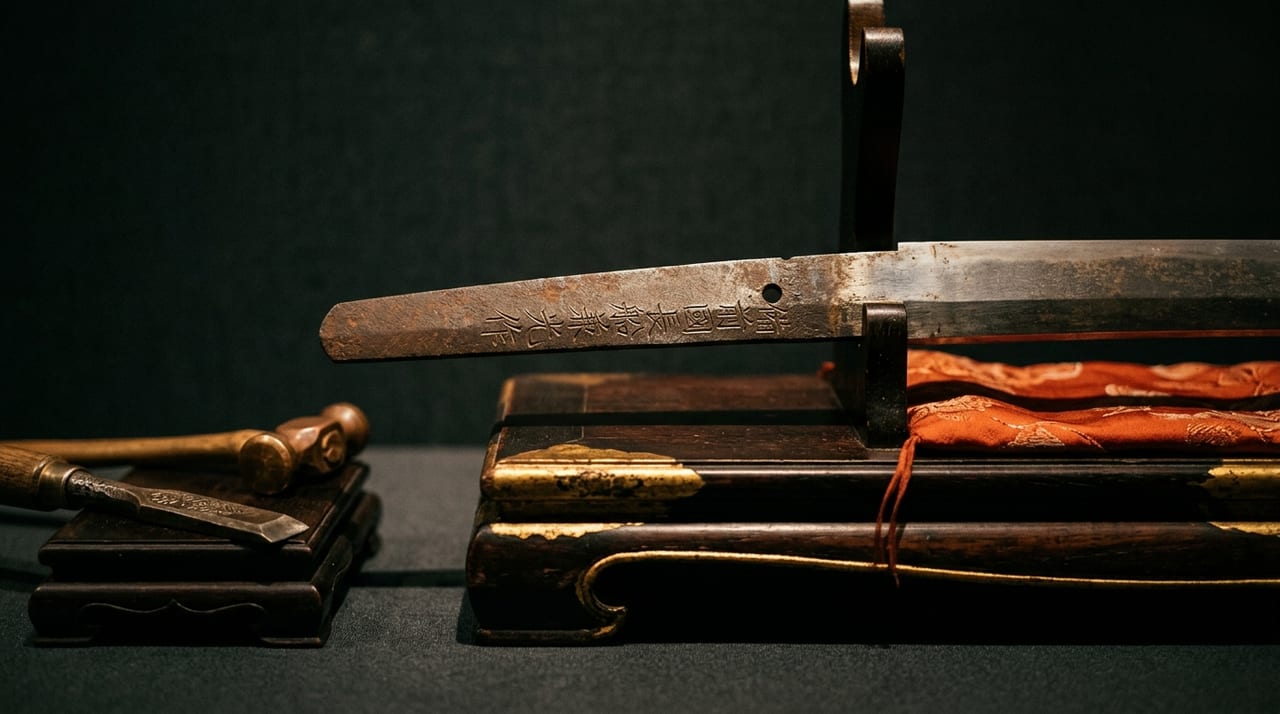 * Image is for illustrative purposes only.
Table of Contents
Mei-kiri: Engraving the Seal of Completion in the Final Process
The creation of a Japanese sword is divided into multiple stages—forging (kaji), polishing (togi), and mounting construction (koshirae seisaku)—but mei-kiri (signature engraving), in which the swordsmith inscribes their signature on the sword, is the final act that serves as proof that the swordsmith has recognized the quality of their work by engraving it on the tang.
Mei-kiri is not simply engraving a name; it often includes various information such as the year of production, location, and the results of test-cutting (tameshigiri). There are also cases where a blade is offered as mumeizai (unsigned), which is done either because "the swordsmith did not have enough confidence to inscribe a signature" or because "the blade was given to an apprentice as a secret tradition and could not be released to the outside." Even famous smiths from the ancient sword period (kotou) produced many unsigned works, and mumeizai does not equate to poor quality. Rather, when an unsigned ancient sword is identified through examination as the work of a renowned smith, it is sometimes highly valued as a "kiwame" (connoisseur's authentication).
Tools for Mei-kiri: Choosing the Chisel and Hammer
The main tools used for mei-kiri are two types: the "nomi" (chisel) and "tsuchi" (hammer).
- Nomi (chisel): A miniature chisel with a flat blade (hiraba) or rounded blade at the tip, and the angle, width, and hardness of the blade directly affect the quality of the characters. Chisels specially sharpened for signature engraving are called "mei-kiri nomi," and a swordsmith uses multiple types. For thin lines, a chisel 1-2mm wide is used, while for thicker lines, chisels 3-5mm wide are used. Since the outline of the characters changes with the way the chisel is sharpened, the maintenance of the chisel can be said to be part of the skill of mei-kiri.
- Tsuchi (hammer): A small hammer used to strike the head of the chisel, and the striking force varies depending on the weight and material of the head (iron or brass). The force applied with each strike is something a swordsmith acquires through years of experience; if the force is too strong, cracks will form in the tang, and if too weak, the lines will be shallow.
- Kotei-dai (fixing stand): A specialized stand that keeps the sword horizontal during mei-kiri. Since the direction of the tang changes during work, many smiths use a stand with multiple fixing grooves. Some smiths continue to use their own handmade stands, and it is said that after years of use, the feel of the sword becomes absorbed into the stand.
How to Engrave the Signature: The Order and Angle of Each Line
Each line of the signature is engraved by either holding the chisel at a fixed angle and striking it with the hammer—"tsuki-bori" (chiseling)—or by sliding the chisel while engraving—"hiki-bori" (trailing carving)—or a combination of both methods.
Complex curves in kanji characters (for example, the curved portion of the character for "fujiwara") are particularly difficult, and a technique in which each curve is approximated with multiple minute straight lines (called "bunkatsu-bori" or segmented carving) is often necessary. When engraving fine characters, the actual size of the signature is only a few centimeters, and for aging smiths, a magnifying glass becomes an essential tool.
The order in which signatures are engraved varies from smith to smith, but in general, the order is typically "larger strokes first, finer details last." There is no preliminary sketch (or sometimes only a very fine sketch in oil pen is made and then erased), and the work is usually done in a single attempt without revision. It is said that "a signature reveals the swordsmith's true skill in calligraphy," making this a process that demands intense concentration.
Calligraphic Style by School and Era: Reading Origin Through Signatures
The style of characters and quality of lines in a signature vary by school, era, and region, making them an important reference indicator for authentication.
Bizen Tradition (Fukuoka Ichimonnji School, Osafune School): Characterized by thin, uniform lines with a formal, kaisho (regular script) style of calligraphy. The signatures of Osafune Kagemitsu are particularly known for their elegance, with clear "tome" (termination strokes) at the beginning and end of each line. Signatures from this school maintain a consistent style across generations, making them effective clues for identifying the school.
Soshu Tradition (Kamakura): The signatures of Masamune and Sadamune are known for their thick and forceful characters. The variation in line width is significant, and there is a sense of liveliness as if written by a brush. The two characters of Masamune's "Masamune" signature are among the most imitated sword signatures in the world, and numerous comparative studies of genuine and forged signatures exist. Distinguishing between authentic Masamune signatures and forgeries is an important practical skill in sword authentication.
Yamashiro Tradition (Awatasuji School): Signatures by Awatasuji Nagayoshi are characterized by a delicate and vertically elongated style. The lines are thin yet deeply carved, suggesting precise chisel handling.
Yamato Tradition (Tekai School): Signatures by Kanenaaga feature an antique (kossetsu) style of characters, with a distinctive mark of a strong chisel strike remaining at the beginning point of each stroke. The signatures of Yamato smiths become more rustic the older the era, and many reveal a spiritual aspect rather than purely technical considerations.
Shintou Period (Edo): Smiths such as Echizen Kanenori and Kawachi no Kami Kunisuke often used flowing cursive (gyousho) script for their signatures, reflecting the influence of Edo period calligraphy. The increase in official rank signatures ("Kawachi no Kami," "Settsu no Kami," etc.) is also characteristic of the Shintou period, serving as an indicator of the swordsmith's social status.
Date Signatures and Test-Cutting Signatures: Additional Information Told by Signatures
Various information in addition to the swordsmith's name is often added to signatures.
Nenki (date): Indicates the year of production, such as "Tensho ○ year" or "Kan'ei ○ year." Combining era names and numbers, this is an essential information source for historical research. During forgery, discrepancies between the era name and calligraphic style often reveal the fake, frequently serving as a breakthrough in authentication. Furthermore, authentication through distinguishing between genuine and false is also performed by utilizing the fact that the way era names are written differs by era.
Basho-mei (location signature): Indicates the place of production, such as "Harima ju" (residing in Harima) or "Goushu Hikone" (Hikone, Omi Province). Even for the same swordsmith, the location signature changes when their work location changes, and this is used in research on distribution routes.
Tameshigiri-mei (test-cutting signature): An additional signature indicating the results of test-cutting (tameshigiri), such as "futatsudou" (two bodies) or "mitsudou" (three bodies), recording public certification by a test-cutting expert (togakushi) of the blade's sharpness. Many record human body parts and numbers, which raises ethical concerns, but it is important as a historical record. Blades with test-cutting signatures were highly valued by warriors, as their cutting ability was guaranteed.
The Inheritance of Mei-kiri in the Modern Era
Contemporary swordsmiths learn mei-kiri techniques directly from their masters, but opportunities to receive instruction are surprisingly rare, and this is a skill that can only be honed in the practice of "engraving a signature once the sword is completed."
In public competitions (sword-making technique presentations, new master-work sword exhibitions), the presence or absence of a signature and evaluation of calligraphic style are also criteria for scoring, so contemporary swordsmiths also place importance on mei-kiri. Since swords without signatures cannot establish themselves as worthy of evaluation even if submitted, swordsmiths who are poor at mei-kiri struggle even if they have great confidence in forging. Even if a sword's overall quality is high, an unstable signature is evaluated as lowering "the overall dignity of the sword." Mei-kiri is another form of "craftsmanship" distinct from forging technique and remains an area requiring continued transmission in modern times.
As the number of successors decreases, efforts to document and preserve traditional mei-kiri techniques are also advancing. Transmission of techniques to the next generation is being explored through modern means such as video recording and workshop tours. It can be said that the single line a swordsmith engraves on a tang contains the crystallization of that swordsmith's lifetime and accumulated technique.