Practical Daily Maintenance and Long-Term Storage of Nihontō — A Practical Manual on Oil, Uchiko, and Storage Environment
 * Image is for illustrative purposes only.
Table of Contents
The saying "a nihontō is a living thing" has long been passed down in the world of Japanese swords. Though a blade of iron and carbon, it responds sensitively to temperature, humidity, oil, and minute vibrations, and even a slight change in storage conditions can cause rust or saya abrasion. Properly maintaining a sword is also a responsibility — to pass on to the next generation a work into which a master craftsman breathed life. This article explains the specific methods that collectors can put into practice, from the procedures of day-to-day maintenance to the practicalities of long-term storage.
The Basics of Daily Maintenance — the Role of Oil, Uchiko, and Soft Cloth
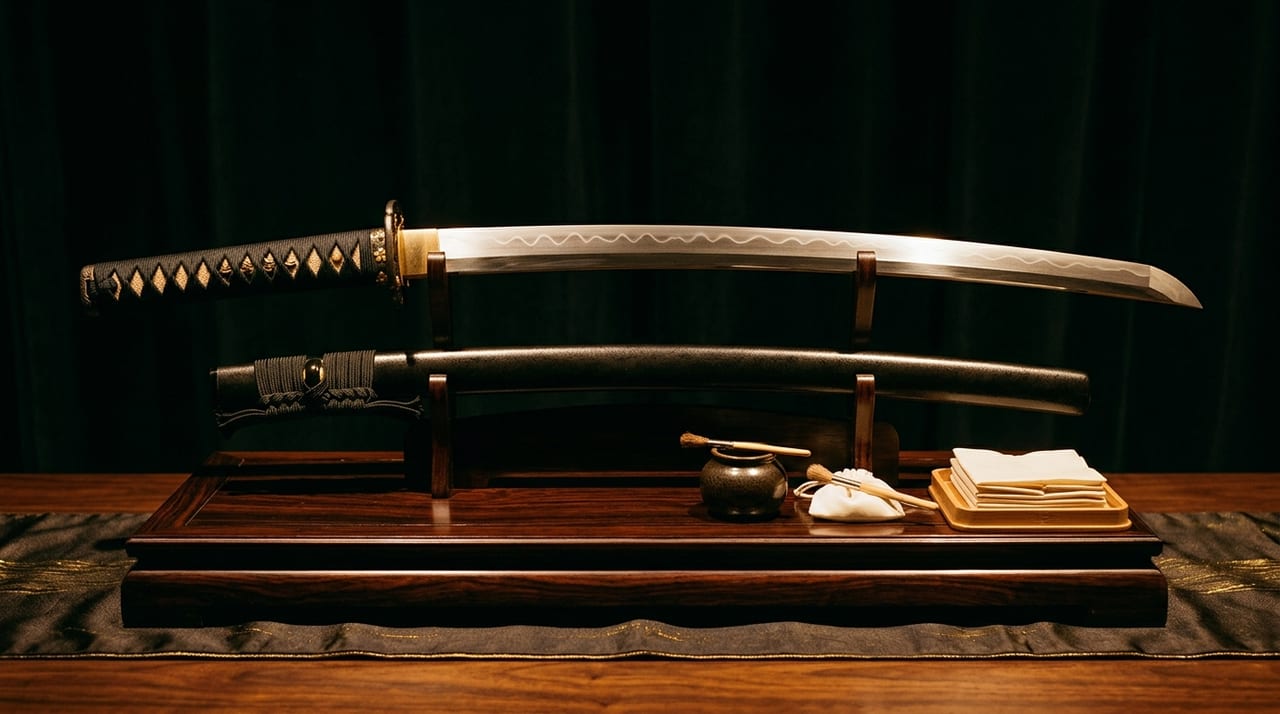
The tools used in nihontō maintenance can be reduced to three.
- Chōji oil: A light rust-preventing oil made by blending the essential oil of cloves into white mineral oil; applying it thinly and evenly to the blade cuts off contact with moisture in the air. Over-application causes it to soak into the interior of the saya, deteriorating the wood, so the right amount is to spread a thin layer with the pad of a finger and then gently even it out once more with nuguigami.
- Uchiko: A silk pouch filled with powdered whetstone, used to remove the previous application of old oil from the blade. By lightly tapping the uchiko to deposit powder on the blade and then wiping in a longitudinal direction (from the mune toward the edge) with nuguigami, both the old oil and the fine oxidized film can be removed together. Since uchiko also has the character of an abrasive, rubbing with force in a transverse direction risks damaging the boundary of the hamon (the ha edge). It is essential always to wipe in a single direction toward the cutting edge.
- Nuguigami or menuki cloth: A soft finishing paper or cloth used to spread chōji oil thinly and to wipe away old oil and oxidized film lifted by the uchiko.
On the frequency of maintenance, considering Japan's warm and humid climate, many collectors use the following as a guide.
| Season | Recommended maintenance frequency |
|---|---|
| Rainy season (June–September) | At least once a month |
| Dry winter (November–February) | Once every 2–3 months |
That said, there is individual variation, and in cases where the storage environment is a sealed paulownia box with dehumidifying agents, once every six months in winter may present no problem.
Saya Interior Management — the Relationship Between Habaki, Koiguchi, and Saya Material
When storing a sword sheathed in its saya, what is easily overlooked is the relationship between the habaki (blade collar) and the saya-guchi (koiguchi). The habaki is the metal fitting that connects the blade to the saya; by fitting snugly into the koiguchi, it keeps the sword from shifting inside the saya. When this suction weakens, "saya-nari" (saya rattle) occurs, and the blade vibrates minutely inside the saya, potentially scratching the hamon.
As the interior of the saya dries out, the wood contracts and the koiguchi may loosen. Conversely, when there is too much moisture, the wood swells and "saya-zumari" (saya jamming) occurs, making the sword impossible to draw. As leaving either condition unaddressed will adversely affect the blade, it is important to make a habit of checking the koiguchi's suction fit regularly.
Moreover, the saya of a koshirae (lacquered saya) often has a silk or similar inner lining, and storing a sword in a new lacquered saya can sometimes cause volatile components from the lining to be released, leading to rust. When fitting a sword to a new koshirae, it is advisable to consult a specialist in advance or to store the sword in a shirasaya and observe its condition.
Shirasaya (plain storage scabbard) is a storage-only saya made from ho wood; the grain of the wood gently absorbs and releases moisture, making it well suited for long-term storage. If you intend to keep a sword as a long-term collection piece, it is ideal to have a shirasaya prepared separately from the koshirae.
Designing the Storage Environment — Temperature, Humidity, Light, and Vibration
The most important factor in the long-term preservation of a nihontō is humidity management. When relative humidity exceeds 60%, a water film tends to form on metal surfaces and the risk of rust rises sharply. The recommended storage environment is a temperature of 15–20°C and a relative humidity of 40–55%, and the standard approach is to store the sword in a paulownia box containing a dehumidifying agent (such as silica gel) that can stably maintain these conditions.
Paulownia has high thermal insulation and moisture-absorption-and-release properties, and has the characteristic of buffering sharp fluctuations in the temperature and humidity of the outside air. For this reason it has long been used for storing swords and works of art. However, in many cases a paulownia box alone is not sufficient, and when the environment outside the box is extremely humid it is important not to neglect replacing the desiccant before storing the sword. Since the moisture-absorbing capacity of desiccants is depleted over time, it is advisable to make a habit of always checking and replacing them around the end of the rainy season.
Exposure to light cannot be ignored either. Not only direct sunlight but also the ultraviolet rays of fluorescent lighting will discolor and deteriorate the lacquer of the saya and the tsuka wrapping. Even when displaying a sword, using a glass case with a UV-blocking film and taking care not to expose it to constant lighting is necessary.
Vibration is a risk that is easily overlooked. If a sword is placed where it receives construction noise from an adjacent room, on a shelf facing a heavily trafficked road, or in a location where washing-machine vibration reaches it, the blade may continue to shift very slightly inside the saya, leading over the long term to minute scratches on the hamon. It is preferable to use a wall-mounted shelf rather than floor placement, and on a shelf to store the sword horizontally on a soft mat.
When displaying on a katana-kake (sword stand), it is important to note that the correct orientation differs by sword type.
- Uchigatana, wakizashi, tantō: Storage with the edge facing upward ("ha-ue") is considered suited for long-term storage as an oil film tends to remain on the cutting edge.
- Tachi: Following the orientation for wearing, it is correct to display with the edge facing downward ("ha-shita").
Managing Swords That Will Not Be Used for Extended Periods
When there is a possibility that no maintenance will be performed for a year or more, application of chōji oil alone may be insufficient. Sword specialty stores sometimes carry out a long-term preservation treatment of applying a thin coat of petroleum jelly or industrial neutral grease, then wrapping in washi and placing in a shirasaya. This is based on the thinking that it suppresses evaporation of the oil while the washi buffers sudden changes in the outside air.
However, when taking a sword out of long-term storage, always use uchiko to completely remove the old oil and confirm the condition of the entire blade before returning it to normal storage. If oil evaporation and oxidation have progressed over the long period, it is also important to consider consulting a professional togishi.
When staying abroad for an extended period or when a sword is left in a storage situation of unknown conditions due to inheritance or similar circumstances, temporary deposit at a specialized art storage facility for nihontō is also one option. A specialized facility with temperature and humidity management can maintain a significantly more stable environment than personal storage.
Troubleshooting — Common Problems and Initial Responses
- When faint rust appears: If caught early, maintenance with uchiko and chōji oil may be sufficient, but when red rust (ferric oxide) appears in spots, one should not attempt to deal with it oneself but have a specialist togishi examine it. When polishing becomes necessary it takes both cost and time, but if left unaddressed the rust may progress internally and there is a risk that the hamon will disappear.
- Loosening of the mekugi: When a bamboo or copper mekugi loosens, the blade and tsuka may shift when the sword is drawn, creating a dangerous situation. Moistening the mekugi hole with a small amount of water may cause the bamboo to swell and the looseness to subside, but if it loosens frequently, it is safest to ask a specialist to replace it with a new mekugi.
- Koiguchi sticking fast: When the wood has swelled from moisture and the saya cannot be drawn, one must never attempt to pull it out by force. It is strongly recommended to either tap the kashiragashira (pommel) section lightly to introduce vibration or to consult a sword specialist. If pulled out by force, bending stress is applied to the blade and there is a risk of damage.
Summary
Daily maintenance of a nihontō is a task that anyone can carry out by observing three points: appropriate frequency, procedure, and tools. Prepare the three basic tools — oil, uchiko, and nuguigami — and be mindful of the maintenance frequency appropriate to the season. By regularly confirming the relationship with the saya and being attentive to the temperature, humidity, light, and vibration of the storage environment, a sword can preserve its beauty for decades or even centuries.
If you have any questions about specific storage after purchase, please feel free to contact us via the inquiry form.