Successor Development for Tōkō and Togishi and the Industry's Talent Crisis — The Risk of Traditional Craftsman Discontinuity and the Path to Rebuilding
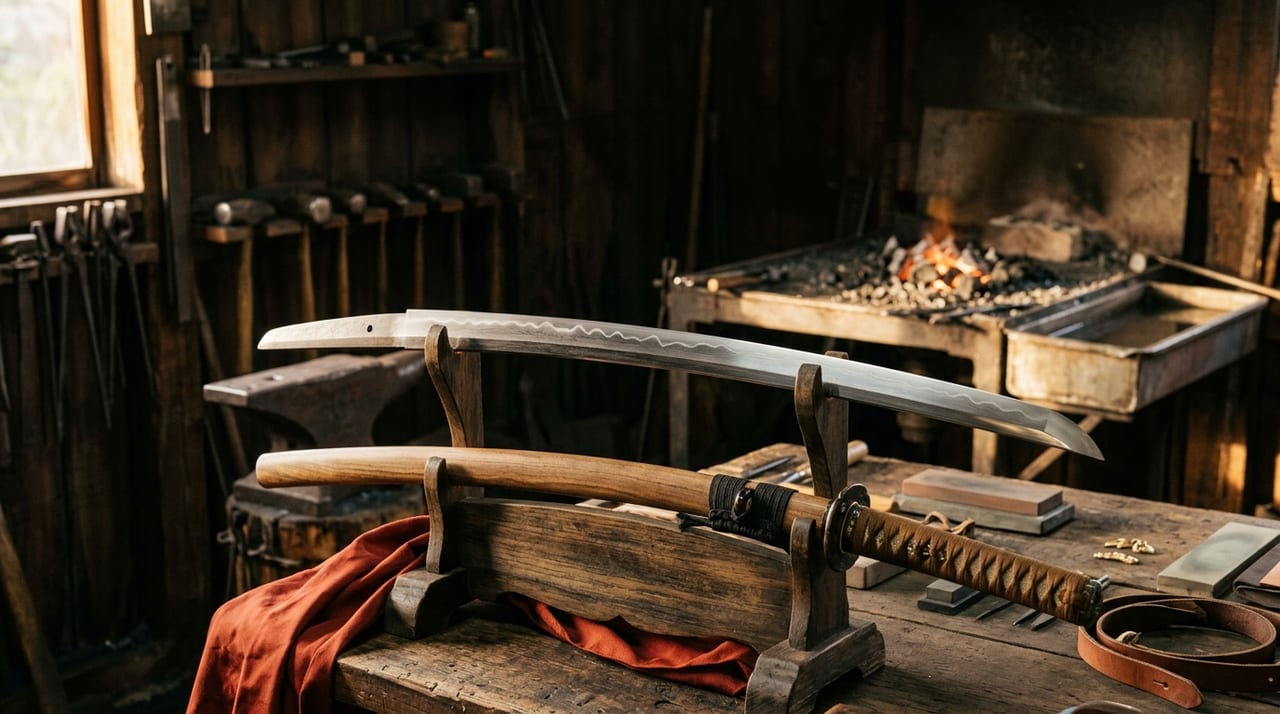 * Image is for illustrative purposes only.
Table of Contents
The world of nihontō harbors serious problems that are hard to see from the outside. The number of craftspeople required to complete a single nihontō — kaji, togishi, sayashi, kinkōshi, and others — is wide-ranging, and a shortage of successors is advancing in nearly every one of these occupational fields, stalling workforce reproduction across the industry as a whole. This article surveys the current state of this talent crisis while examining the frontlines of successor training challenges, the rise of female craftspeople, and employment conditions for tōkō in regional areas.
The Succession Problem for Kaji — A Serious Reality Shown by the Numbers
Of the kaji who have received authorization to produce swords, only a small number are said to make a living exclusively by forging swords full-time. It was once standard practice to study under a first-rate master for five to seven years, but the number of regions where the number of aspiring apprentices far falls short of the master's capacity to accept them is increasing, and there are cases in which maintaining a lineage has become difficult.
At the root of the problem is an economic barrier. While the Regulations for Approval of Production of Art Swords set no annual limit on the number of swords (Regulations for Approval of Production of Art Swords (e-Gov Law Search)), prefectural screening criteria stipulate the minimum number of tanren days per sword (15 or more days for tachi, katana, and naginata; 10 or more days for wakizashi, tantō, and similar) (Aomori Prefecture "Approval for Production of Art Swords" Screening Criteria), and many voices say it is difficult to make a living without a side job within this de facto constraint. That income during the training period is nearly zero is also a factor that causes younger generations to hesitate before entering apprenticeship. For young people raised in urban areas to make the choice to "relocate to a rural area where a forge is located and continue unpaid training for several years," strong will and financial support are required.
Meanwhile, global demand for nihontō is rising. Attention from collectors and martial artists overseas has increased, and interest in nihontō culture in the English-speaking world and Europe in particular has expanded greatly since the 2010s. A structural mismatch has arisen in which, despite the demand side's base broadening, the number of craftspeople on the supply side has stagnated.
Training Systems and Current Conditions for Togishi and Sayashi
Alongside the kaji, the world of the togishi is experiencing an equally serious shortage of personnel. Polishing a nihontō requires advanced skill in drawing out the jigane and hamon of the blade, and it is said to take more than 10 years to become fully proficient. Accurate statistics on the total togishi population nationwide are difficult to obtain, and there are also observations that the successor functions of organizations that once served as togishi training institutions are weakening.
The path to becoming a togishi is fundamentally based on the apprenticeship system, centered on entering the service of a master and inheriting the craft. However, when an aging togishi retires, a "gap period" of several years may arise during which the region's demand for polishing cannot be met while the apprentice achieves independence. The situation in which no togishi capable of properly polishing a sword forged by a tōshō exists in the vicinity is actually occurring in some regional areas.
Sayashi face the same problem. The production of shirasaya and koshirae saya requires both specialized woodworking skills and knowledge of swords, but the number of masters willing to accept apprentices is itself small, and the number of craftspeople across the industry as a whole is trending downward. If the skills of sayashi are lost, it could develop into a problem directly tied to collection preservation — the inability to supply the shirasaya needed for properly storing swords.
The Rise of Female Craftspeople and Changes in the Industry
The nihontō production site was once dominated by men. Particularly regarding sword forging, the folk belief that "the gods will be angered if a woman enters the forge" remained in some quarters, and there were masters who would not accept female apprentices. In recent years, however, this situation has been quietly changing.
The appearance of female tōkō is no longer unusual, and it is known that multiple women have obtained authorization to produce swords and are active in the field. The widespread use of social media and video distribution has also accelerated the change in the industry's image by making the activities of female tōshō widely visible. As the fixed notion that "nihontō are for men" fades, the pool of those hoping to enter the craft is broadening.
In adjacent occupational fields such as togishi, sayashi, and kinkōshi as well, the proportion of female craftspeople is said to be trending upward. In fields involving delicate finishing work — such as metalwork, hilt wrapping, and braided cord — there are even cases where the participation of women is actively welcomed. The increase in diversity across the industry as a whole carries important significance from the perspective of securing successors as well.
Employment Conditions for Regional Tōkō and Attempts to Rebuild Production Areas
In regions historically renowned as nihontō production centers — Bizen, Sōshū, Yamashiro, and Mino — many tōkō were once concentrated, but in the modern era the number of tōkō has plummeted in nearly all of these areas. While there are some cases of local governments supporting the opening of tōkō workshops as part of cultural promotion efforts, in many cases such support does not extend to sustained livelihood assistance.
The challenge facing regional tōkō is the difficulty of securing orders. Gendaitō are often priced at over 1,000,000 yen, and participation in exhibitions in urban areas and online information dissemination are effective for developing a customer base, but the resources that can be dedicated to such activities are limited for a solo workshop in a regional area. In recent years, collaboration with inbound tourism incorporating kaji workshop tours and hands-on programs has been attempted, and efforts combining improved workshop visibility with supplementary revenue have been reported.
There are also regions where successor training programs developed in collaboration with local governments and educational institutions are gradually being put in place. Measures combining the promotion of young people's relocation with successor training in traditional crafts have produced results in other craft fields as well, and their application to the sword industry is attracting attention.
Challenges in the Training System and Future Prospects
The greatest challenge of the current master-apprentice system is the high degree of dependence on a single master. If the master suddenly passes away or retires, there is a risk that the training of apprentices will be interrupted, and in a single-workshop system in a regional area in particular, there is a possibility that the craft will be severed within a single generation. The development of a "multi-master apprenticeship system" in which one learns from multiple masters, and of inter-workshop technical exchange and short-term training programs, is emerging as a future industry challenge.
The use of digital technology is also being discussed. Digital records of tōshō's work footage, temperature data, and forging procedures may be useful for visualizing and systematizing tacit knowledge. However, since nihontō forging ultimately depends greatly on embodied knowledge such as "judging the color of the fire" and "the feel of the steel," it cannot be completely replaced by video records alone. Even so, expectations are high for it as a backup for reducing the risk of craft discontinuity.
As an approach from the demand side, the most direct contribution collectors and enthusiasts of nihontō can make to indirectly support craftsperson training is to purchase gendaitō and sustain the market. Purchase behavior that gives importance to the swordmaker's name, technique, and place of origin supports the income stability of craftspeople and the sustainability of the industry.
Conclusion
The shortage of successors spanning kaji, togishi, sayashi, and kinkōshi is a structural problem that concerns the survival of nihontō culture. The following elements are required in combination.
- Reducing economic barriers
- Creating an environment that is accessible to women, young people, and those living in regional areas
- Enriching technical records using digital technology
- Revitalizing the gendaitō market
Coming to know the world of craftspeople behind a single nihontō should deepen the meaning of owning and appreciating a sword.
It is also possible to inquire about further details through the contact form.