Japanese Sword Troubleshooting — How to Handle Saya Noise, Loose Mekugi, and Stuck Koiguchi
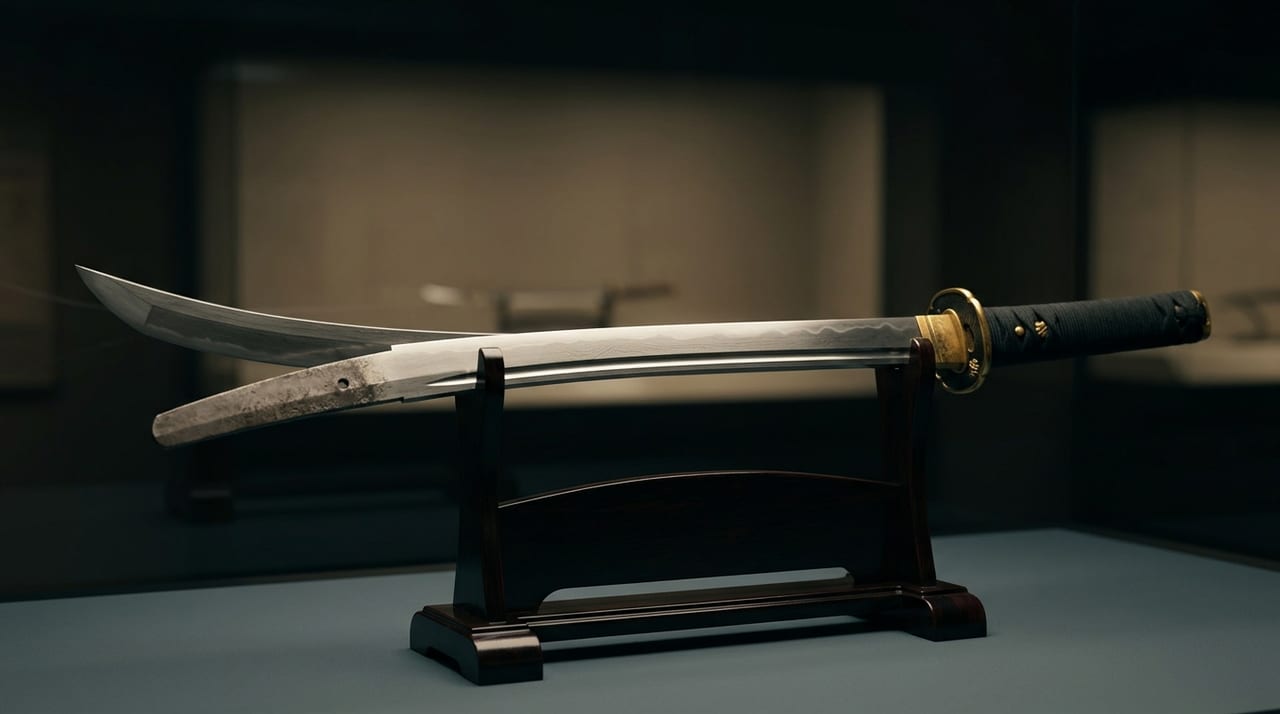 * Image is for illustrative purposes only.
Table of Contents
Saya Noise — Causes and Remedies for the Sound of the Blade Moving Inside the Saya
The state in which a rattling sound occurs when the saya is lightly shaken is called saya noise. This is a condition in which a gap has formed between the blade and the interior of the saya (the saya wood), and the cause in most cases is shrinkage of the saya wood due to humidity changes, or wear of the interior of the saya wood from years of use. If left untreated, the blade will continue to move subtly inside the saya, causing scratches on the blade surface or causing the lacquer inside the saya to peel away.
The first thing to check as a remedy is the humidity environment. If saya noise becomes pronounced in winter when dryness increases, returning humidity to around 50% may naturally resolve the problem. As a temporary measure, there is the method of inserting a few sheets of thin paper near the koiguchi of the saya to restore contact between the blade and the saya wood. However, this is only a temporary fix; at root, you will need to have a saya craftsman shave and re-fit the saya wood and readjust the interior diameter to fit the blade precisely — a process known as "saya interior re-fitting." In particular, for precious blades, a temporary fix carried out at your own discretion may instead damage the interior, so it is advisable to consult a specialist promptly.
Loose Mekugi — The Importance of the Small Bamboo Pin Connecting the Tsuka and Blade
The mekugi is a small bamboo pin that passes through the tsuka and the nakago to fix them together, and it is an extremely important component that supports the overall stability of the blade. When the mekugi loosens, the blade will wobble inside the tsuka, and during iai or test cutting there is a risk of a serious accident. During daily inspection, grip the tsuka and gently move the blade up and down to check that there is no sensation of a clunk. If there is even the slightest sense of something being off, always inspect the condition of the mekugi.
When removing the mekugi, use a dedicated mekugi-nuki. Never knock it out by force. Check the removed mekugi for cracks, deformation, or wear, and if any deterioration is found, replace it with a new mekugi immediately. Handmade bamboo mekugi vary greatly in strength depending on the direction of the grain and the degree of drying, so purchasing from a trustworthy sword dealer or saya craftsman is the safe approach. In cases where the mekugi hole itself has widened, replacing the mekugi alone will not solve the underlying problem, and re-making the tsuka or repairing the mekugi hole will be necessary. In this case, be sure to consult a tsuka craftsman or saya craftsman.
Stuck Koiguchi — Staying Calm When the Blade Will Not Draw or Return
A situation in which the koiguchi (the opening through which the blade enters and exits the saya) is stuck so that the blade cannot be drawn, or once drawn cannot be returned to the saya, can be caused by a sudden change in humidity, hardened uchiko residue inside, or the accumulation of oxidized old oil. The greatest danger is forcing the blade out and allowing the spine or edge of the blade to strike the interior of the saya, causing serious damage.
If sticking is suspected, first do not force the blade to move; leave it for several hours to half a day in an environment with controlled room temperature and humidity. The subtle expansion of the saya wood due to humidity changes may relax and the blade may move naturally. If it still does not move, absolutely do not attempt to force it out yourself — bring it to a trustworthy sword dealer or saya craftsman. Specialists understand the internal structure and possess the skill to safely remove the koiguchi. Also note that frequently drawing and sheathing for viewing purposes can itself damage the lacquer and wood inside the saya, so it is important to reconsider the frequency of drawing as well.
Wobbling Tsuka — Understanding the Relationship Between the Tsuka Wrapping and the Nakago
If the entire tsuka wobbles, or if you feel a subtle twisting when gripping it, the problem may lie not only in the mekugi but also in the tsuka wrapping itself or the tsuka wood (the wood beneath the ray skin). It is natural for the tsuka wrapping to loosen with use, and especially for swords used in iai or practice, re-wrapping every few years is necessary. Deterioration of the interior tsuka wood, separation of the ray skin, and loosening of the under-wrapping are difficult to judge by visual inspection alone and cannot be determined without opening the tsuka.
When the wobbling is pronounced, the basic principle is to suspend use for safety and ask a tsuka craftsman to inspect it. In particular, in cases where the rust on the nakago has progressed, the nakago may move slightly inside the tsuka wood and over time affect the strength of the nakago itself. This is an extremely dangerous condition for iai and test cutting and must never be taken lightly. On the other hand, when wobbling occurs in a sword kept purely as a work of art, the urgency is lower, but early restoration is preferable for the sake of long-term preservation.
Symptoms You Should Not Treat Yourself — Criteria for Leaving the Decision to a Specialist
There are symptoms in Japanese sword problems that you should never attempt to handle yourself and must always entrust to a specialist. When red rust appears on the blade, uchiko is an abrasive that contains polishing powder and cannot be used to remove rust; using it on a rusted surface will spread the damage, so it must not be used. First, carefully wipe away old oil with soft wiping paper and assess the extent and depth of the rust. If it is not merely surface discoloration but involves point rust or deep rust, it must be entrusted to a togishi. Never attempt to polish the blade yourself. Inappropriate polishing will permanently damage the shape of the blade and greatly reduce its appraisal value.
Symptoms that require professional treatment by a togishi include the following.
- Point rust or deep rust
- Chipping
- Deep rust on the nakago
- Deformation of the kissaki
- Distortion of the sori
Also, if signs of insect damage (fine wood dust or small holes) are found inside the saya, this is a serious problem. If insect damage is progressing inside the saya wood, the structure may weaken without any visible sign, and one day the saya may suddenly split. In this case, consult a saya craftsman promptly and consider re-making the saya if necessary. In the preservation of Japanese swords, "early detection and early response" is the cardinal rule. If you sense anything out of the ordinary, consulting a specialist without hesitation is the surest path to passing the sword on to the next generation.