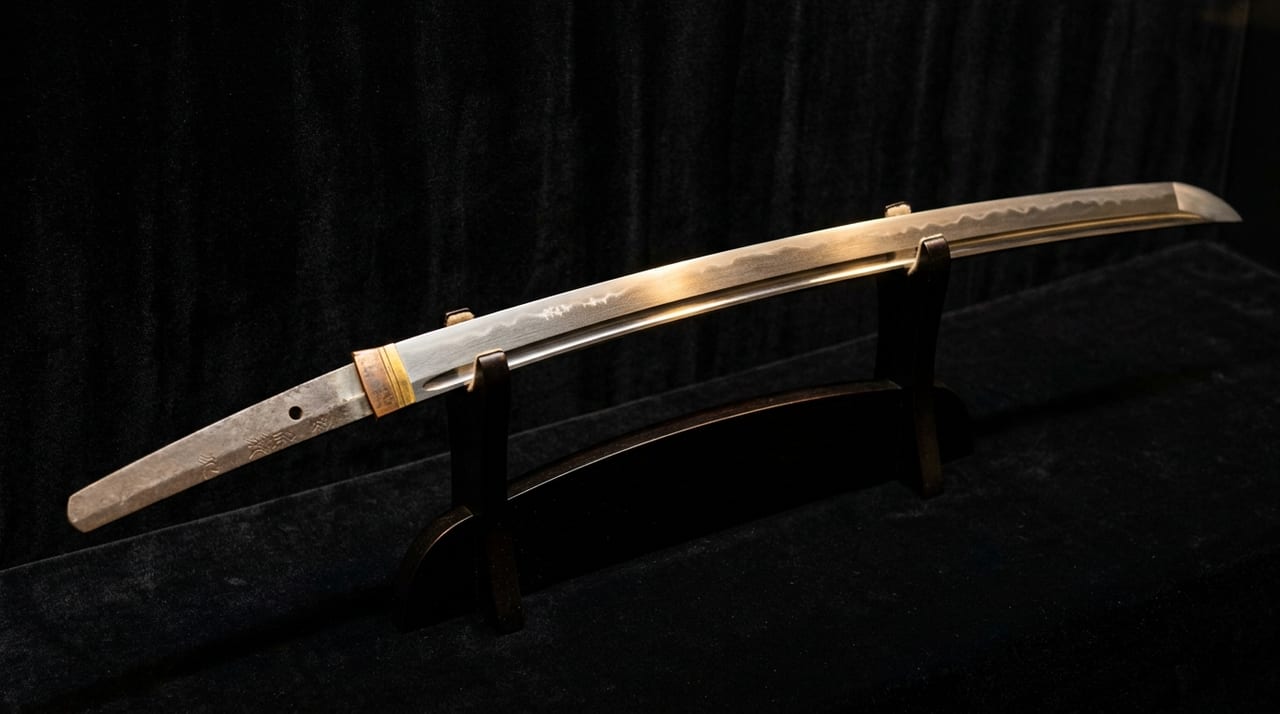
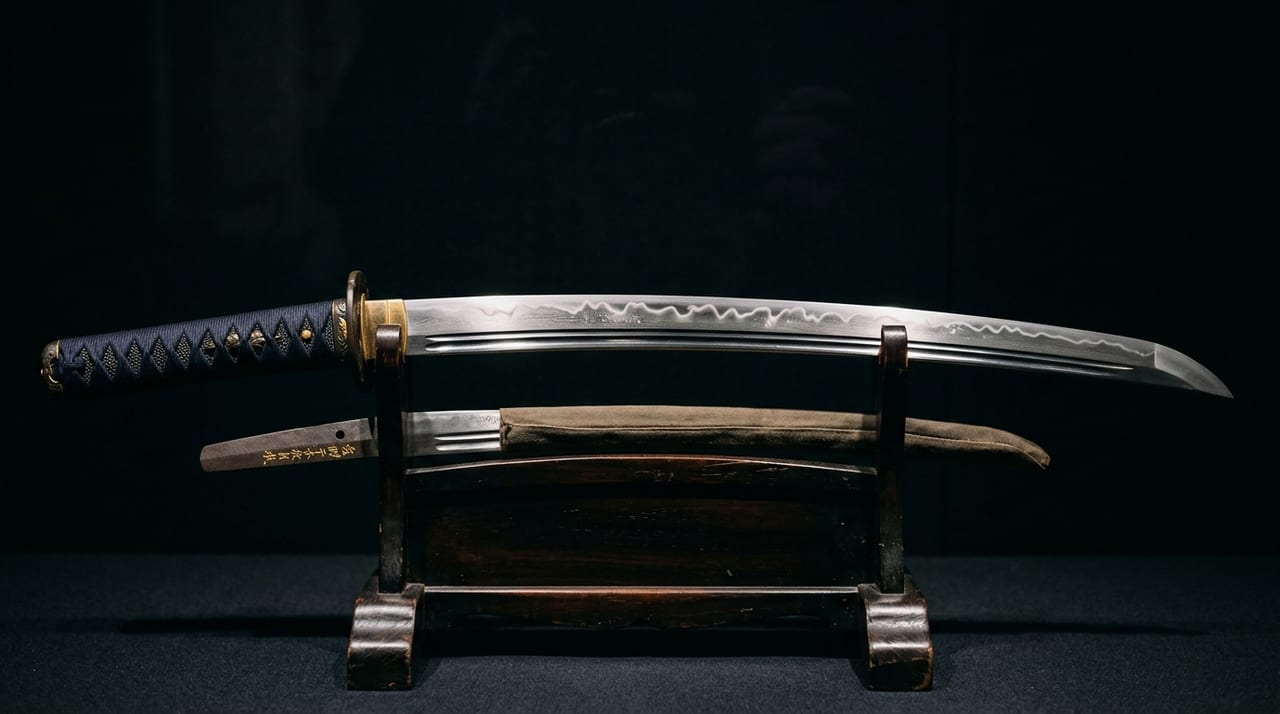
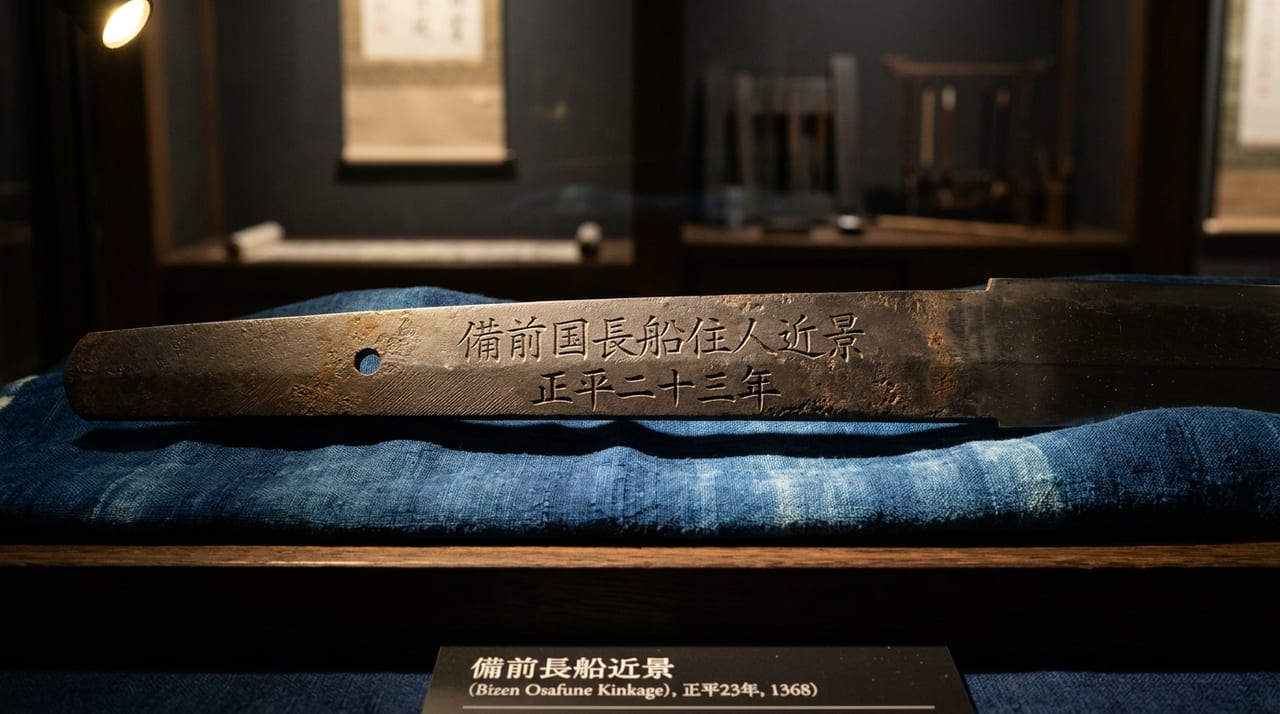
Koryū Kagemitsu — The Kokuhō Tachi of Osafune Kagemitsu and the Legend of Kusunoki Masashige
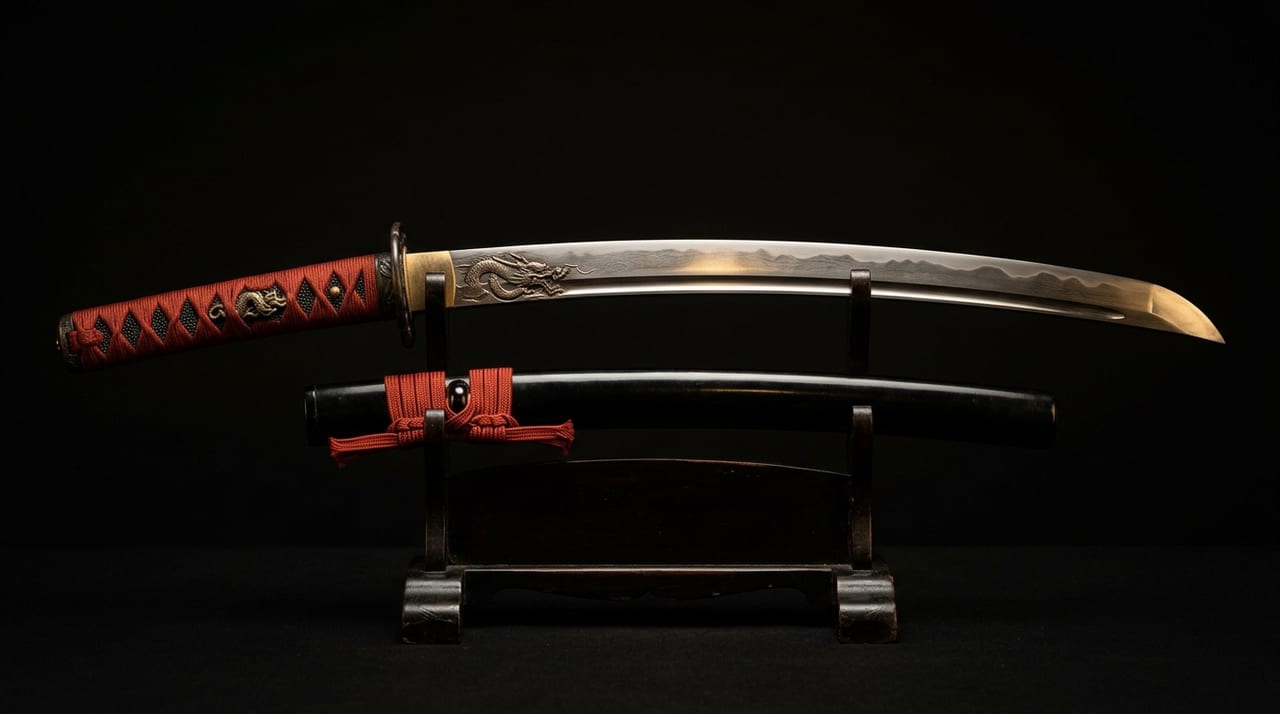 * Image is for illustrative purposes only.
Table of Contents
What Is the Koryū Kagemitsu — A Kokuhō Tachi Forged in the Late Kamakura Period by Osafune Kagemitsu
The Koryū Kagemitsu is a tachi made in the fifth month of the second year of Gen'ō (1322) by Kagemitsu, one of the foremost tōkō of the Osafune school of Bizen Province. It has been designated kokuhō (National Treasure) and is held in the collection of the Tokyo National Museum. The nakago (tang) bears the mei (signature) "Bizen no Kuni Osafune-jū Kagemitsu" along with a date inscription, making it one of the benchmark works in Japanese sword research through which the date of production can be confirmed with certainty.
In terms of length, sori (curvature), and overall form, this sword is an excellent example of the characteristics of late Kamakura-period Bizen blades. Its generous sori and well-proportioned body combine the functional beauty of a weapon with the sculptural beauty of a craft object, conveying to the present day the level of forging technique attained at the time. The circumstances of its designation as kokuhō can also be confirmed through the Cultural Heritage Online database (Cultural Heritage Online 203669).
The Origin of the Name "Koryū" — The Kurikara Dragon Carved at the Habaki
The name "Koryū" derives from a carving of a Kurikara dragon executed at the habaki (blade collar). The Kurikara dragon is an iconographic motif depicting a dragon — considered an avatar of Fudō Myōō — coiled around a sword, and it is emblematic of the medieval Japanese sword culture in which weapons and religious belief intersect. The dragon carved on this sword is small in scale, and it is said that this is why the blade came to be called "Koryū" (small dragon).
The carving opens a dimension of appreciation separate from the beauty of the blade itself. The Kurikara dragon carving on this sword is the gateway through which one engages with a single blade from the angles of faith, talismanic meaning, and design — a perspective distinct from the eye that reads the hamon (temper line) and the forging of the jigane (steel of the blade surface). Among Kagemitsu's works, it is this carving that has etched the Koryū Kagemitsu so deeply into the memory of celebrated swords.
The sword is also known by the alternative names "Nankō Kagemitsu" and "Nanako-ryū no Tachi," both of which derive from the legend concerning Kusunoki Masashige described below.
The Legend of Kusunoki Masashige Wearing This Sword — Between Historical Record and Narrative
A legend long handed down holds that Kusunoki Masashige — the warrior who fought in support of Emperor Go-Daigo during the Nanbokuchō period — wore the Koryū Kagemitsu at his hip. This tradition is the basis of the alternative name "Nankō Kagemitsu."
However, no document has been confirmed that directly corroborates the sword's having been worn by Masashige. The sword was made in the second year of Gen'ō (1322), a period close to the Gen'kō and Kenmu years during which Masashige was active, but that alone does not constitute evidence. While the tradition of this account being passed down is acknowledged, the reading that stays close to the sources is that grounds sufficient to establish it as historical fact have not been demonstrated at this time.
The phenomenon of celebrated swords becoming linked with heroic narratives is not unusual in the cultural history of Japanese swords. What matters in sword appreciation is an approach that layers the confirmable facts with the stories added by later generations while remaining conscious of where the reliable record ends and where the tradition begins. Tradition also has an aspect that functions as a mirror reflecting the values and conception of bushidō of its age. In the case of the Koryū Kagemitsu as well, the spiritual climate of the Edo and Meiji periods — when reverence for Masashige intensified — is considered one of the backgrounds that nurtured this legend.
Provenance — From Yamada Asaemon to the Imperial Household and the Tokyo National Museum
The provenance of the Koryū Kagemitsu as it has been transmitted is roughly as follows.
- In the late Edo period it was owned by the Yamada Asaemon family, whose hereditary occupation was tameshigiri (test cutting)
- For a time it passed into the possession of the Ii family, but following the upheavals of the Bakumatsu period it returned to the Yamada family
- During the Meiji period it was presented to the Imperial Household, and after the war it was transferred to the Tokyo National Museum
The Yamada Asaemon family was a lineage of sword appraisers involved in the compilation of the blade-quality ranking system (wazamono ranking) under the authorization of the shogunate, and their involvement in the provenance of a celebrated sword fits naturally within the context of the family's history. The provenance record shows that the sword is not a mere weapon but a historical artifact handed down as a cultural property from owner to owner.
The Tokyo National Museum does not display the sword as a permanent exhibit; a rotation display format is adopted from the standpoint of cultural property preservation. To avoid missing the opportunity to see it in person, it is advisable to check the museum's exhibition schedule in advance.
Kagemitsu as a Tōkō — His Place within the Osafune School
Kagemitsu was a tōkō of the Osafune school active from the Kamakura period through the Nanbokuchō period. Even within the same lineage of the Osafune school, the era and artistic style changed as the generations passed from Nagamitsu to Kagemitsu to Kanemitsu, and Kagemitsu's works are sometimes described as bearing transitional elements bridging the late Kamakura and the Nanbokuchō.
The Osafune school was rooted in Bizen Province (present-day Okayama Prefecture) and flourished as Japan's largest sword-producing center from the late Heian period through the Edo period. The Gen'ō years during which Kagemitsu was active correspond politically to the period when Emperor Go-Daigo's movement to overthrow the shogunate was beginning to stir. Amid this era of social upheaval, the beauty of swords that had blossomed within Kamakura's warrior culture still maintained a high standard, and the Koryū Kagemitsu is positioned as one of the achievements of that peak.
Perspectives for Appreciation That the Koryū Kagemitsu Opens Up
When using the Koryū Kagemitsu as an entry point for appreciating Japanese swords, the following perspectives will considerably deepen how a single blade appears.
- A tachi with a date inscription becomes a benchmark work — A sword whose date of production is explicitly recorded functions as a comparative reference when evaluating other works from the same period. Dated works also carry value as documentary records.
- Carvings are an intersection of faith and design — Reading carvings such as the Kurikara dragon is enriched by knowledge of Buddhist iconography. The aspect of the sword as a talisman opens a dimension of appreciation distinct from viewing it as a weapon.
- What provenance records tell us — The record of who handed the sword to whom lends it, apart from the beauty of the blade itself, the weight of a history as a cultural property passed down through time.
- Distinguishing tradition from historical fact — The stories linking celebrated swords with heroes are compelling, but layering them with a conscious awareness of where the confirmable record ends and where later retellings begin cultivates the ability to read a sword as a historical source.
Opportunities to view in person a kokuhō blade of this distinction are limited, but approaching the experience with these perspectives naturally sharpens one's focus on what to look for in the sword. TOUKENZA's online catalog allows users to browse swords from a wide range of periods and schools, enabling them to refine the eye for appreciation cultivated through celebrated blades by comparing it against actual listed works.