What Is Nenkimei — Reading a Tōkō's Active Period from the Date of Production Inscribed on the Nakago
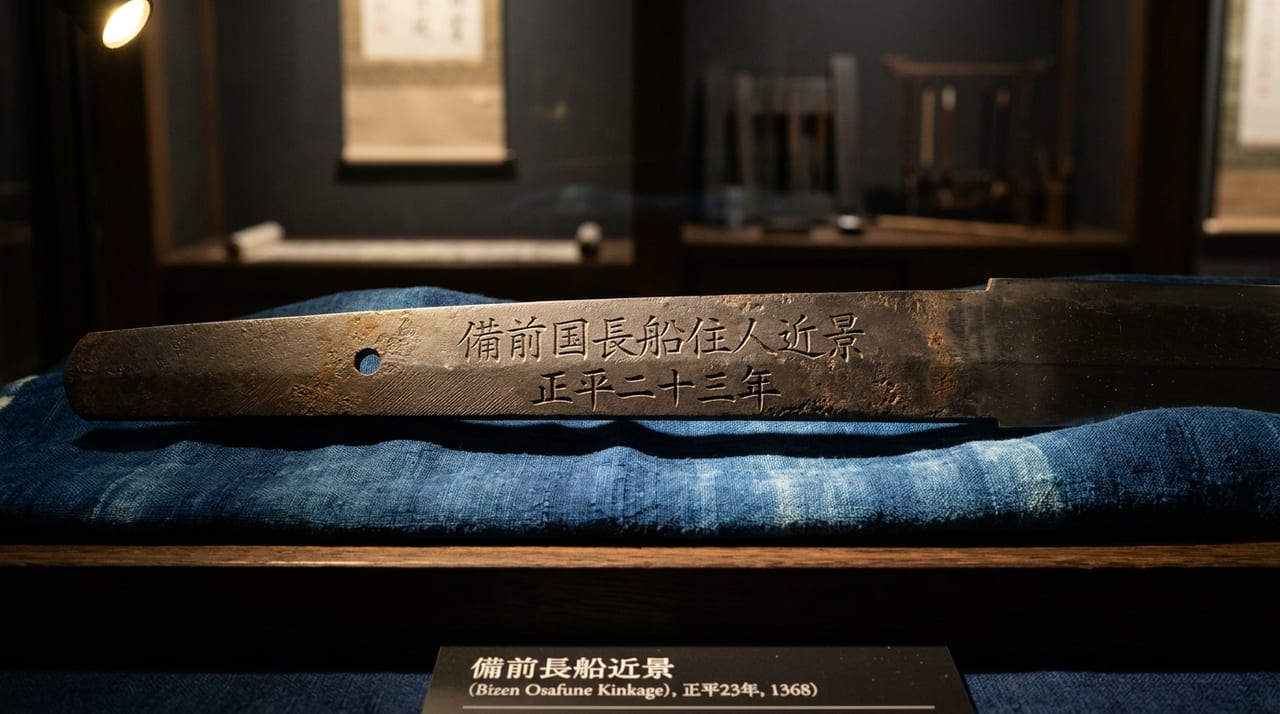 * Image is for illustrative purposes only.
Table of Contents
On the nakago of a nihontō, a mei inscribed with the tōkō's name is cut. Among these, those that also inscribe the year and month of creation are called nenkimei. In general usage, the term for an inscription indicating the year of production is kinenmei, but in the world of Japanese swords, the terms "nenki" and "nenkimei" have long been the established usage.
Nenkimei are records that directly indicate the period in which a tōkō was active. This article sets out how nenkimei are inscribed, what the conventions of "nigatsu-bi" and "hachigatsu-bi" are, how they are useful in appreciation and research, and points to keep in mind.
What Is Nenkimei
Mei is what a maker inscribes on their work, typically a name. Most swords bear only the maker's name, but those that add a nengō (era name), eto (cyclical sign), or year and month are nenkimei. Some are carefully inscribed with the nengō and the month and day, while others simply add a month and day to the nengō.
Swords bearing a nenki are not numerous among the whole. For this reason, works with nenkimei have long been valued as clues for understanding the changes in a tōkō's style and their period of activity. With a mei bearing only a name, it can be difficult to narrow down which generation made a given work when a school continued under the same name across successive generations. With a nenki, it is possible to determine approximately when the work was made and to place it against the tōkō's career and the evolution of their style.
The Conventions of "Nigatsu-bi" and "Hachigatsu-bi"
An important convention to understand when reading nenkimei is the way months and days are written. While there are cases where the date is inscribed precisely, in many nenkimei the month is written as "second month" (nigatsu) or "eighth month" (hachigatsu), with the day rendered by the single character for "day."
This convention is said to have been established toward the end of the Kamakura period. The idea was to inscribe "second month" for swords made between the winter solstice and the summer solstice, and "eighth month" for those made between the summer solstice and the winter solstice, regardless of the actual month, using the notation as an indication of seasonal division. For this reason, "nigatsu-bi" and "hachigatsu-bi" are described as overwhelmingly common in nenkimei.
This notation is often discussed in connection with kaji beliefs about the most suitable seasons for yaki-ire (quenching). However, there are various theories regarding its detailed origins, and here it suffices to note that it was a widely observed convention.
- "Nigatsu-bi": the convention of inscribing this for works made between the winter solstice and the summer solstice
- "Hachigatsu-bi": the convention of inscribing this for works made between the summer solstice and the winter solstice
- There are also examples where the actual date is inscribed precisely, and not all nenkimei follow this format
How to Read Nenkimei and Key Points for Appreciation
Nenkimei are read as part of the mei cut into the nakago. In appreciation, it is standard practice to observe the nakago after examining the shape of the blade and the hamon. The nakago contains, besides the mei, yasurime and the shape of the nakago itself, all of which tell the history of the sword. The nakago is also discussed in The Craft of Cutting Mei and A Cultural History of Nakago Mei on Uchigatana, and reading both will deepen understanding.
The following are points of view when examining nenkimei.
- Confirm which era the nengō corresponds to, and compare against the style of that period.
- Compare with other dated works by the same tōkō to see how the style changed.
- Confirm that the lettering and cutting style of the mei are not inconsistent with the tōkō's other works.
- Check whether suriage has shortened the nakago or cut off any part of the mei.
Comparing nenkimei against style is one of the pleasures of appreciation. Even within the same school, the shape and jigane can change as the period changes, and the nenki serves as a marker for tracing that evolution.
Points to Keep in Mind
The presence of a nenkimei does not guarantee that the sword is authentic. It is well known in the world of Japanese swords that mei added by carving at a later period exist. Precisely because nenkimei are considered valuable, one must be alert to examples in which they were added after the fact.
Authenticity is judged by combining not only the mei but also the jigane, hamon, shape, and condition of the nakago. The principle is not to rely on the mei alone, but to confirm the consistency of multiple elements. For swords that raise questions, the results of specialist appraisal or assessment are worth consulting. NBTHK holds study and appreciation meetings at its branches across the country, providing opportunities to learn while handling actual swords.
Knowing Nenki Is the First Step to Appreciating a Sword More Deeply
Nenkimei are among the few records in which a sword itself speaks of "when and by whose hand it was made." The mei itself is no more than a series of small characters, yet from it one can discern the maker's period of activity, the spirit of the age, and the evolution of their style.
When appreciating a sword, one's eye tends to go to the hamon and the shape, but please also turn your attention to the nakago mei. The presence or absence of a nenki is an element that cannot be overlooked when considering the documentary value of a sword. For those who wish to know more about the relationship between tōkō and mei, Mei-kiri Technique — How Mei is Chiseled into the Nakago of a Nihontō is also a useful reference.
References: Types of Mei (Touken World), Meitō Gensō Jiten "Mei"