The Cultural History of Uchigatana Nakago Signatures: Evolution and Meaning of Smith Inscriptions from Muromachi to Bakumatsu
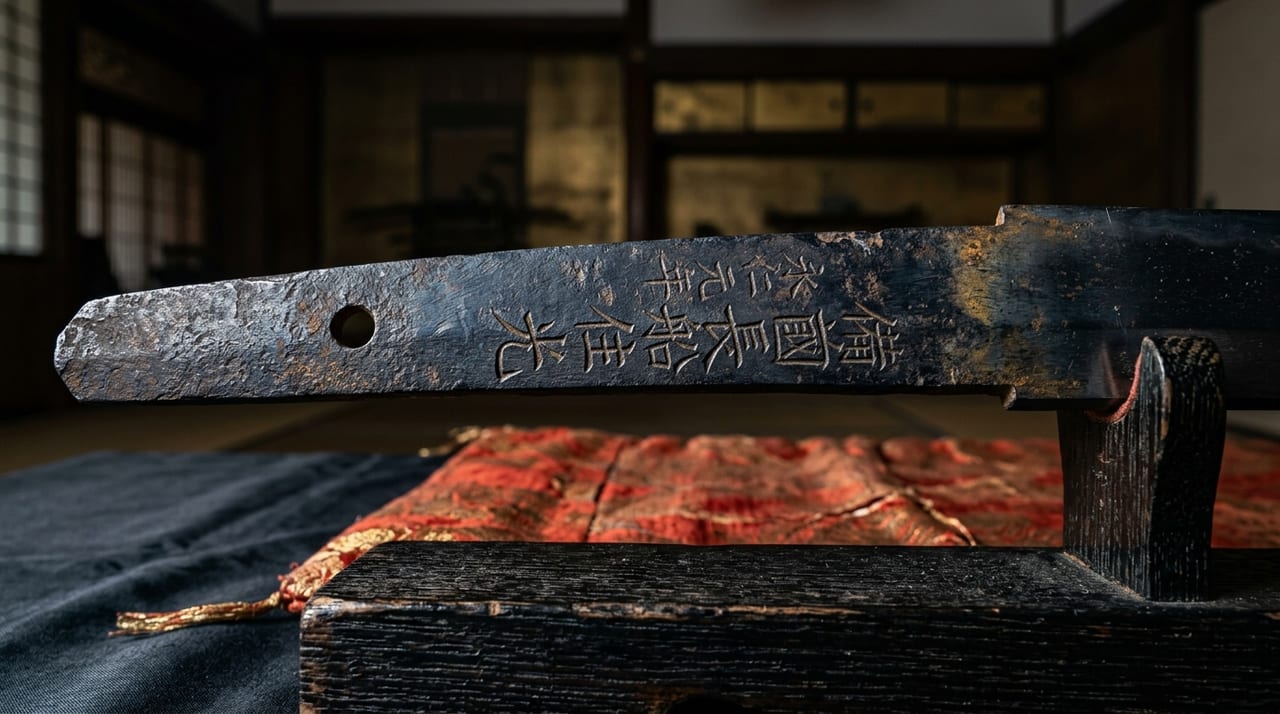 * Image is for illustrative purposes only.
Table of Contents
What is Nakago-mei—Signature as Self-Expression of Sword Smiths
The nakago of a Japanese sword is the portion that fits inside the hilt, and serves as the base of the blade with a structurally important role. More than that, the nakago functions as an inscription plate on which the sword smith engraves their name and information about creation. This culture of nakago-mei is deeply connected to the establishment of the uchi-katana sword style and serves as a mirror reflecting the transformation of sword culture across time.
During the Koto period (Heian through Muromachi), the nakago of tachi was deeply embedded within the hilt, and the signatures were often concise. Combinations of the smith's name and place of origin, such as "Bizen no Kuni Osafune Sumi Kanemitsu," were standard. However, from the late Muromachi period onward, when the uchi-katana became the primary portable weapon of the samurai, the culture of nakago-mei became remarkably enriched.
Muromachi Period Uchi-katana Nakago-mei—Emphasis on Place Names and School Names
In the late Muromachi period, as the uchi-katana became widespread, sword smiths added new elements to their nakago-mei. Place names functioned not merely as records of origin, but as brands indicating membership in a group carrying specific technical traditions.
- Bizen no Kuni Osafune
- Mino no Kuni Seki
- Yamashiro no Kuni Nishi-jin
The sword smiths of Mino no Kuni Seki (present-day Seki, Gifu Prefecture) developed a particularly active culture of signature inscription. By sharing specific characters in their names, groups of sword smiths demonstrated unity as a school and the continuity of their lineages.
- Mino no Kuni Seki—Sword smith groups whose names included the character kane (such as Kanemoto, Kanesada, Kanefusa) demonstrated their unity as Seki smiths through sharing this character
- Bizen no Kuni Osafune—A tradition of inheriting specific characters across generations, such as "Sukesada," "Tadamitsu," "Katsumitsu," was evident, declaring the continuity of the sword smith lineage and the legitimate transmission of technique
The Position of the Signature—The Difference Between Haki-omote and Sashi-omote
What is often overlooked in interpreting nakago-mei is that there were traditional rules governing the very face on which the signature was engraved. Because tachi was carried in the hai-yo style—suspended from the waist with the edge facing downward—the convention was to cut the signature on the face that faced outward from the body when worn, called haki-omote.
In contrast, the uchi-katana employs the sashi-yo style—thrust through the sash with the edge facing upward. Because the orientation of the blade's surface is reversed between hai-yo and sashi-yo, the signature on the uchi-katana is cut on the face called sashi-omote. Even when the same sword smith cut signatures in the same calligraphic style, the face on which the signature was engraved differed depending on whether it was made as a tachi or an uchi-katana. When examining the nakago of extant swords, the distinction between haki-omote and sashi-omote becomes one of the basic clues for inferring its original purpose and configuration.
The Transformation in Early Edo—Dated Signatures and Detailed Creation Information
The arrival of the Edo period brought significant transformation to the culture of nakago-mei. Sword smiths began engraving not merely the smith's name, but also the date of creation, place of manufacture, and information about the patron on the nakago. The characteristic feature of this period was an increase in detailed inscriptions such as "Kanei 12, Eighth Month" (date), "Made with Nanban Iron," and "Dedicated to the Grand Shrine of Ise."
The proliferation of dated signatures—signatures indicating the year of creation—deserves attention. Swords from the Edo period onward frequently bear accurate dates of production, providing invaluable information for modern researchers. Sword smiths such as Echizen Yasutsugu, who served as official smiths to the Tokugawa shoguns, added material designations like "Made with Nanban Iron" to their signatures. This use of material signatures—proclaiming the use of nanban iron (foreign iron materials)—was an innovation of the Edo period and beyond.
Dedications and Commissioned Signatures—Making Social Relationships Visible
The inscriptions with the greatest social significance in Edo-period nakago-mei are those that developed as follows:
| Type of Signature | Content |
|---|---|
| Dedication Signature | Indicated a sword dedicated to a shrine or temple, taking forms such as "Dedicated to the Grand Shrine of Ise" or "Before the Sacred Treasure of the Hachiman Shrine." It explicitly declared that the sword was created not merely as a weapon but as an offering to a deity or Buddha. |
| Commissioned Signature | Engraved when a daimyo or bannerman commissioned a specific sword smith, taking expressions like "Commissioned by [a certain lord]." It incorporated complex social relationships and served as important provenance information for posterity. |
| Authentication Signature | A form developed in the late Edo period, in which authentication specialists such as the Hon'ami family sometimes added authentication results marked "Authentic" to the reverse side of the nakago. The nakago-mei thus functioned as the equivalent of modern certificates of authenticity. |
Ubu-nakago and Suriage—Why Signatures Are Lost and Efforts to Preserve Them
A nakago that remains exactly as it was when made and has never been shortened is called ubu-nakago. In contrast, when a long sword originally made as a tachi was later remounted to a more practical length for use as an uchi-katana, the process of trimming the nakago itself was called suriage. From the late Muromachi period through the Edo period, it was not uncommon to suriage old tachi and remount them as uchi-katana in response to changes in combat styles and methods of carry.
When the original portion of the nakago is lost through suriage, the signature engraved upon it is also cut away. Particularly when a major suriage was performed, trimming much of the nakago, the signature is completely lost, leaving the blade unsigned. The reason that many swords by great masters remain unsigned is largely due to this ancient practice of suriage.
To avoid losing valuable signatures, a technique called ori-kaeshi-mei was also employed. This method intentionally preserved the tip portion of the nakago—the part where the signature was engraved—that would normally be cut away during suriage, and folded it back to be refastened at the end of the newly fitted nakago. Through this procedure, the original smith's signature could be physically preserved even after the blade was remounted to a shorter length.
Individualization in the Late Edo Period—Diversification of Sword Smiths' Self-Expression
During the late Edo period (early 19th century through the Meiji Restoration), the culture of nakago-mei evolved in increasingly individual directions. Sword smiths influenced by the New Swords revival movement that began with Suishinshi Masahide began inscribing philosophical concepts such as "Revival of Ancient Swords" and "Method of Restoration" in their signatures. These expressed their philosophical stance toward sword-forging technique publicly.
There were also instances where sword-making became linked to the political context of the anti-shogunate movement and the sonnō jōi doctrine. Sword smiths appeared who added spiritual words such as "Service to Country" and "Destroy Evil and Reveal Righteousness" to their signatures, and in the signatures of late-Edo masters such as Minamoto Kiyomaro and Koyama Munetsugu, the tension and aesthetic sensibility of the era were concentrated.
Reading Nakago-mei—Modern Authentication Practice
In modern Japanese sword authentication, nakago-mei is one of the most important diagnostic tools. By comprehensively examining multiple factors—the character style of the signature, the depth of engraving, the integration with the blade, and the patina—authenticators determine whether the signature is original or later.
The existence of forged signatures—later signatures falsely engraved with the names of famous sword smiths—has long been a social problem and was one factor behind the Hon'ami family's development of an authentication business. For unsigned swords, efforts by authenticators to determine period, school, and smith based on characteristics such as grain and hamon have been practiced since ancient times. In particular, the Hon'ami family's authentication practice included the custom of engraving results directly on the nakago in a format called kin-zougan-mei—using gold inlay to form characters—which functioned as an authentication record engraved on the blade itself before paper certificates of authenticity became widespread.
Modern researchers have conducted detailed analysis and record-keeping of signature formats across different eras, schools, and individual smiths, building databases for authentication. The cultural history of nakago-mei demonstrates the rich history of how the Japanese sword has functioned as a medium for record-keeping, authentication, self-expression, and social relationships that transcends its role as a weapon.