The Beauty of Lacquer Artists and Sword Mountings — Lacquer Techniques That Adorn Koshirae and the Transmission of Lacquer Craft in Modern Tōsōgu
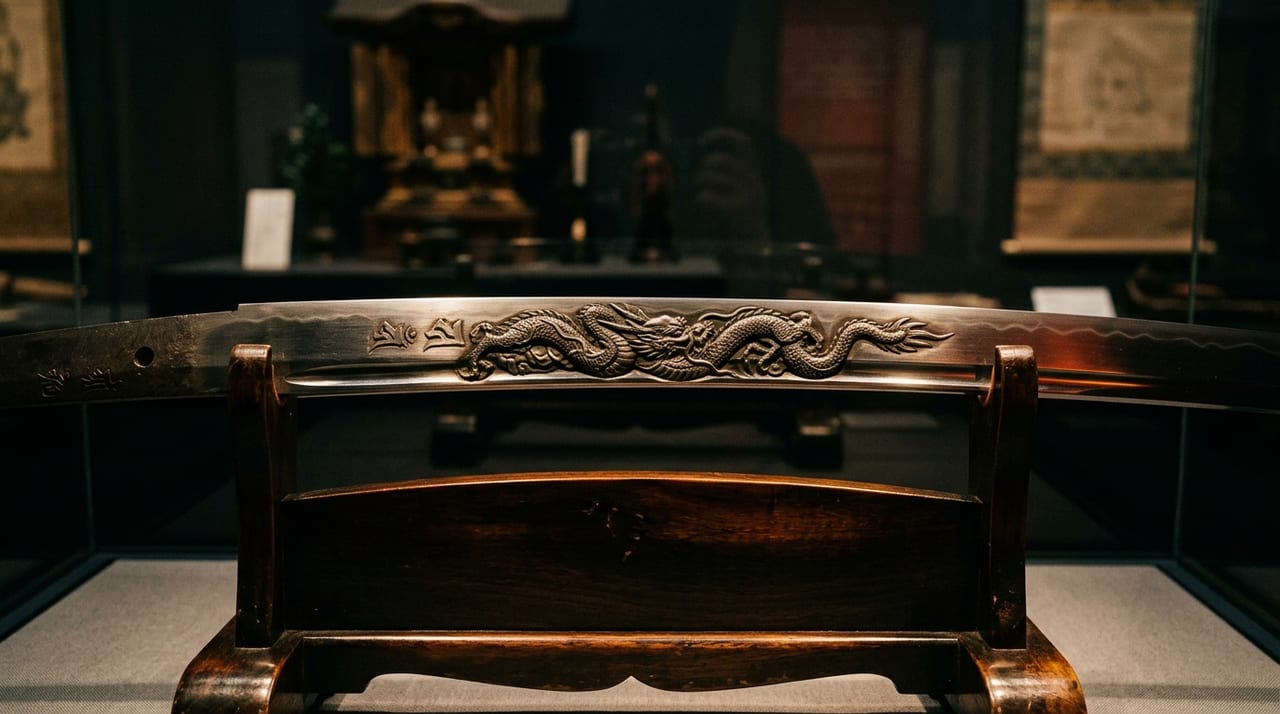 * Image is for illustrative purposes only.
Table of Contents
Lacquer and Nihontō — The Invisible Craftsman's Work
When speaking of the beauty of nihontō, most people turn their eyes to the brilliance of the forged blade and the intricate patterns of the hamon. However, the beauty of a sword does not end with the blade alone. Only when the "koshirae" — the complete exterior assembly comprising the tsuka, tsuba, and saya — is added does the beauty of a sword become complete. And the material that forms the core of koshirae is "urushi" (lacquer).
Lacquer artists (urushi-shi) can be called the most inconspicuous yet indispensable figures in the world of sword craft. Specialist craftsmen such as nuri-shi (lacquer coating specialists), maki-e-shi (maki-e artists), and raden-shi (raden artists) each breathe life into koshirae with their respective techniques.
The Role of Lacquer in Tōsōgu
Lacquer is not merely a decorative material. In tōsōgu, lacquer fulfills multiple functions.
- Protection: Applying lacquer to a wooden saya protects the wood from water, moisture, and impact. Once dried, lacquer forms an extremely hard film while simultaneously retaining moderate elasticity.
- Adhesion: Lacquer is used to join saya components together and secure metal fittings. In the process known as "honkataji," "sabi-urushi" — a mixture of lacquer and tonoko (polishing powder) — is used as a ground material.
- Decoration: The most visible function of lacquer is decoration. The differences in application — lustrous kuro-nuri (black lacquer), shu-nuri (red lacquer), and tame-nuri (amber lacquer) — speak to the rank and period of the koshirae.
The Work of Nuri-shi — Specialists in Saya Finishing
Nuri-shi are lacquer specialists responsible for everything from ground preparation of the saya to the final coating, and the process is more complex and labor-intensive than one might imagine.
- Ground preparation: First, "sabi-urushi" is applied to the raw wooden saya made by the saya-shi to fill surface irregularities. This process is repeated several times to create a smooth ground, and after drying, it is rubbed flat with a whetstone.
- Middle coating: Middle-coat lacquer is applied in multiple layers over the ground. Each layer is fully dried and polished before the next is added — this repetition produces the final deep luster.
- Top coating: Finally, the top coat lacquer is applied. For the finest saya, lacquers suited to the purpose — such as bengara-urushi (red iron oxide lacquer) and nama-shōmi-urushi (raw refined lacquer) — are chosen to achieve a perfect mirror finish free of "brush marks" (hakeme).
Among the techniques for which nuri-shi are known is "kawari-nuri" (varied lacquer). This involves mixing gold powder, silver powder, tin powder, powdered shell, or other materials into lacquer, or deliberately creating patterns during the drying process; there are many varieties, including nashi-ji, kin-nashi-ji, gin-nashi-ji, ishi-me, and kin-ishi-me.
Maki-e-shi — Painting a Golden World in Lacquer
Maki-e is a distinctly Japanese lacquer technique in which gold or silver powder is sprinkled over a design drawn in lacquer and then fixed with lacquer. Maki-e on tōsōgu was one of the most eloquent indicators of a sword's status.
Maki-e can broadly be classified into three types.
| Technique | Features |
|---|---|
| Hira maki-e | The basic technique. After drawing a design in lacquer and sprinkling gold or silver powder, the design is fixed with lacquer and polished. Though flat in finish, it can express intricate designs. |
| Togidashi maki-e | A technique in which additional layers of lacquer are applied over hira maki-e and then polished down, creating a sense of depth as if the gold and silver were embedded within the lacquer. |
| Taka maki-e | A technique in which the design areas are built up with lacquer, charcoal powder, or similar materials to create a three-dimensional effect, over which maki-e is applied. Motifs such as flowers, birds, and dragons appear in relief, and it was widely used in daimyo koshirae of the Edo period. |
Raden-shi — Embedding the Brilliance of Shell in Lacquer
Raden is a technique in which thin pieces are cut from the lustrous inner portions (nacre) of shells such as yakokai (turbo marmoratus), abalone, and chōgai (pearl oyster), and inlaid into the surface of lacquerware. In tōsōgu, it is often used for saya decoration.
Raden-shi begin with shell preparation. Thin slices are cut out, trimmed, and shaped into pieces suited to the design. These are fixed with lacquer, the surrounding area is filled with lacquer, and the whole is polished, producing a finish in which the luster of the shell appears to float within the lacquer.
Raden, which shimmers in seven colors depending on the angle of light, is especially popular among overseas collectors. The raden technique, which originated in the furnishings of Heian period aristocrats, is said to have been incorporated into tōsōgu from the Muromachi period onward.
Modern Lacquer Artists and the Crisis in Tōsōgu Craft
Modern tōsōgu craft faces a serious succession crisis. Craftsmen who once specialized in making koshirae for swords were concentrated in major cities such as Tokyo, Osaka, and Kyoto, but many workshops closed following the decline in demand after the high-growth period.
Today, there are said to be only several dozen nuri-shi nationwide who specialize in lacquer-coated tōsōgu. Maki-e-shi are even fewer in number, and craftsmen capable of applying maki-e for tōsōgu are limited.
Amid this situation, some tōshō and koshirae craftsmen are exploring collaboration with other industries. Cases have emerged of lacquer artists specializing in cultural property restoration taking on tōsōgu restoration work, and of university or vocational school graduates in lacquer craft making a career change into tōsōgu craft.
The growing interest in Japanese lacquer art overseas has also contributed to raising the international profile of tōsōgu craft. There are increasing numbers of Japanese lacquer artists taking on restoration commissions for daimyo household items and tōsōgu held by art museums and museums in Europe and America, and in some cases the skills cultivated there are fed back into domestic tōsōgu craft.
Deepening Sword Appreciation by Understanding the Work of Lacquer Artists
When appreciating the koshirae of nihontō, knowing the respective techniques of nuri-shi, maki-e-shi, and raden-shi deepens one's perspective enormously. The dozens of layers of lacquer built up within a seemingly simple kuro-roiro-nuri (black gloss lacquer) saya, the meticulous gradation of gold powder in maki-e, the precision of raden cutting — in all of these, the invisible craftsman's skill and time are concentrated.
Sword appreciation does not end with the blade. When nihontō is regarded as a whole including the koshirae, what emerges is the form of a true comprehensive work of art — one in which multiple craftsman arts of kaji, polishing, saya-making, metalwork, and lacquer art are integrated.