Tobi yaki (飛び焼き), Yu hashiri (湯走り), Kinkei (金筋), and Inazuma (稲妻)—Occurrence Mechanisms of Special Hamon (刃文) Features and Methods of Appreciation
 * Image is for illustrative purposes only.
Table of Contents
What is the "Landscape" in the Blade Pattern?
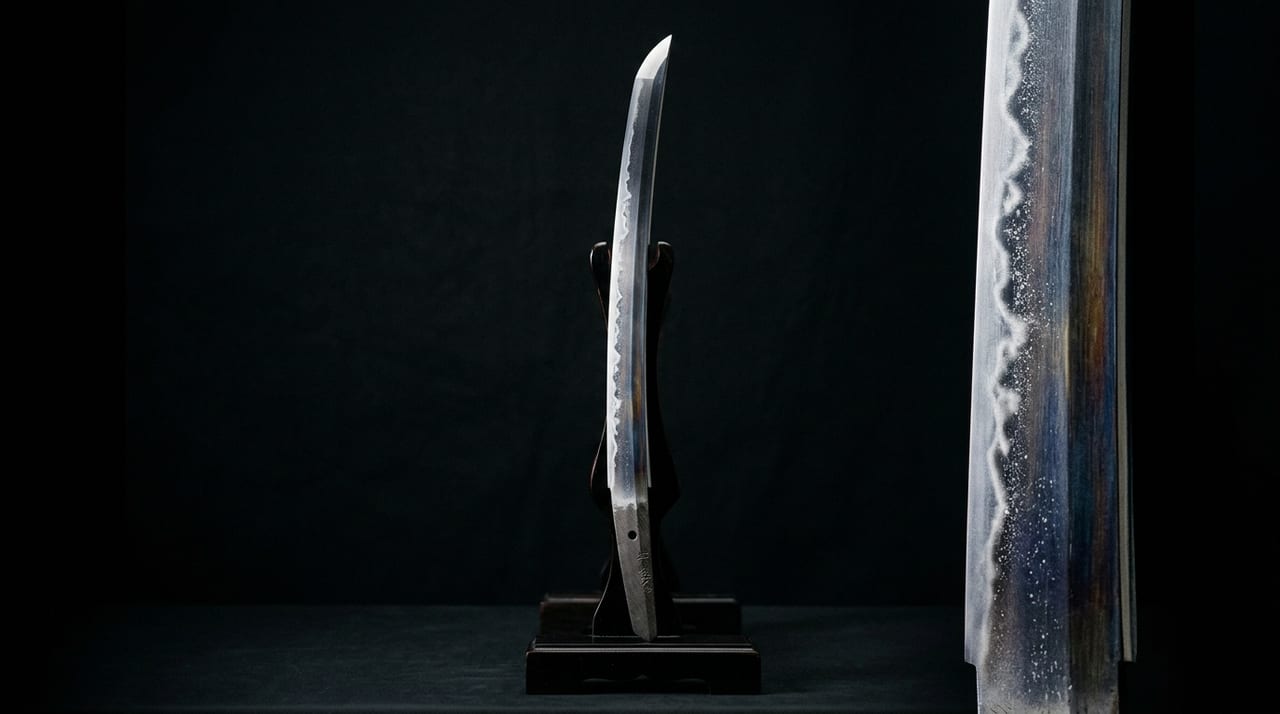
When observing the hamon of a Japanese sword in detail, you can see not just the simple wavy outline, but various accompanying phenomena. In the world of sword appraisal, such fine expressions appearing in the hamon are called "kesiki" (landscape). Among these kesiki, four types are particularly valued for their aesthetic appreciation: "tobiyaki" (flying hardness), "yubasiri" (hot steam run), "kinsuji" (gold lines), and "inazuma" (lightning). These are visualizations of complex metal microstructure changes during the hardening process, and are products of both chance and inevitability created by the sword smith's skill and the quality of tamahagane.
The four types of kesiki differ in their appearance location, form, and the schools/periods in which they are commonly seen.
| Kesiki | Place it appears | Form | Schools/periods where commonly seen |
|---|---|---|---|
| Tobiyaki (flying hardness) | Ground steel separated from the main hamon outline | Island-like, scattered as points | Soshu school (especially Masamune/Sadatsugu lineage) |
| Yubasiri (hot steam run) | In the ground (flat surface) | Band-like, flowing white haze | Koto period (famous Kamakura-era blades) |
| Kinsuji (gold lines) | Within the hamon | Fine line-like, golden or silvery-white | Soshu school, Yamato school (Masamune, etc.) |
| Inazuma (lightning) | Crossing the hamon | Line-like but bent/zigzagging | Soshu school (Masamune, Go no Yoshihiro, Sadatsugu, etc.) |
The kesiki of the hamon serve as important clues for determining the school, period, and maker in sword appreciation. Even with the same kesiki, the manifestation differs between Soshu school swords and Bizen school swords, and trained appraisers can discern these differences. While many of these kesiki can be created to some degree intentionally, they cannot be completely controlled, and they also possess an aspect of natural phenomena born from the overlap of subtle variables such as hardening conditions, steel composition, and water temperature.
Tobiyaki (Flying Hardness) — Flames Flying from the Blade Pattern
Tobiyaki is a phenomenon in which areas of hardening appear scattered in island-like or point-like patterns on the ground steel separated from the outline of the main hamon. As its name suggests, it creates a visual effect as if the hamon has "flown" and scattered within the ground steel.
The mechanism of occurrence lies in the uneven transmission of heat during hardening. When the clay coating is not completely uniform, or when the blade sways slightly in water during the quenching process, parts of the ground steel that should not have been hardened locally reach hardening temperature, and martensite structure is generated. The tobiyaki appears as bright white dots and islands after polishing.
Tobiyaki is commonly seen in Soshu school swords (especially Masamune/Sadatsugu lineage) and is valued as a "characteristic of the Soshu school." However, uneven or scattered tobiyaki may be considered a defect indicating technical failure by the sword smith, and the quantity, size, and beauty of distribution of tobiyaki become points of appreciation and evaluation. While lacking orderly uniformity, tobiyaki with a specific rhythm and visual unity are highly valued as "excellent kesiki."
Yubasiri (Hot Steam Run) — White Haze Flowing from the Blade Pattern
Yubasiri is a type of activity that appears in the ground (flat surface), where the nie and nioi from the blade edge flow into the ground direction and the strongly condensed state appears as white haze. It is characterized by appearing on the ground steel side rather than within the hamon, and is named because it looks as if the heat (hot water) from hardening has run toward the ground. In contrast to tobiyaki's point and island-like form, yubasiri often exhibits a band-like or flowing form.
Metallurgically, yubasiri results from the stepwise and continuous progression of martensite transformation near the hardening boundary. A white hazy region is formed by the expansion of transitional structures such as "troostite" and "sorbite," which are intermediate between fully hardened structure (martensite) and non-hardened structure (pearlite and ferrite).
Yubasiri is particularly often observed in koto period swords, and many famous Kamakura-era blades display beautiful yubasiri as kesiki. In the hardening of that era when hardening techniques were not as precise as today, microstructure changes at the boundary tended to be more uneven, which manifested as yubasiri. Paradoxically, yubasiri shows an interesting aspect of Japanese sword aesthetics in that technical "imperfection" creates aesthetic "kesiki."
Kinsuji (Gold Lines) — A Single Line of Light
Kinsuji is a phenomenon in which fine line-like glowing parts are seen within the hamon, and when a polished blade is observed under light, thread-like streaks of golden or silvery-white light can be seen crossing the hamon. Its name comes from "lines of gold," and when it appears in the hamon of a famous blade, it is treasured as one of the finest kesiki.
The mechanism of kinsuji formation is due to the steel's microstructure transition at the hamon boundary being formed into an especially fine, clear line. When carbon concentration differences change rapidly within an extremely small width near the hardening boundary, the boundary appears as a delicate line. After polishing, this line emits a characteristic luster and shines gold or silver depending on the observation angle.
Kinsuji is commonly seen in Soshu school and Yamato school swords, and is said to appear frequently in the works of certain sword smiths—particularly master craftsmen from the late Kamakura period to the Nanboku-cho period. The kinsuji seen in Masamune's swords is particularly famous and is sometimes expressed as "Masamune's kinsuji." The presence, quality, and number of kinsuji influence the grading of swords, and blades with fine kinsuji are highly valued for their appreciation.
Inazuma (Lightning) — Flash Running through the Blade Pattern
Inazuma is a line-like kesiki similar to kinsuji, but is characterized by a form that crosses the hamon while bending and zigzagging rather than running straight. As its name suggests, it is called this because it resembles the shape of lightning running across the sky. It has more movement than kinsuji and is a kesiki that gives a visually dynamic impression.
The mechanism of inazuma formation is basically the same as kinsuji, but differs in that the boundary of the microstructure transition traces a more complex shape. Bent-form inazuma tends to form when the stress distribution within the blade during hardening is complex, or when the boundary passes through regions of uneven carbon distribution within the steel.
Inazuma is said to appear especially frequently in Soshu school swords, and is known to appear brilliantly in the blades of Masamune, Go no Yoshihiro, and Sadatsugu, among others. However, inazuma is not limited to specific regions or schools, and is a kesiki that can appear in various swords depending on sword-making conditions. The quality, beauty of form, and density of inazuma are points of appreciation, and the expression "there is inazuma that captivates one's heart" is considered one of the highest compliments for a famous blade.
How to Appreciate the Four Kesiki — Angle of Light and Viewing Perspective
None of the four kesiki—tobiyaki, yubasiri, kinsuji, and inazuma—can be seen without proper lighting and observation angle. The basic method in sword appreciation is oblique lighting called "oshidashi," in which light is directed from the side of the blade to bring out the texture of the ground steel and the fine details of the hamon.
Especially kinsuji and inazuma, due to their extremely fine structure, become washed out and disappear under too-bright light, and are completely invisible under too-dim light. By using natural light (uniform light coming from a north-facing window) or a dedicated sword appreciation light and slowly changing the angle while observing, there are moments when these kesiki emerge.
In the world of sword appraisal, the observation of these kesiki serves not merely as aesthetic appreciation but as important data for identifying sword smiths, determining regions of origin, and estimating periods. Even with the same tobiyaki, there is a tendency for its form, density, and distribution pattern to differ from sword smith to sword smith, and trained appraisers can discern these differences. Feeling the breath of the sword smith through special blade pattern kesiki and engaging in dialogue with the sword master across centuries of time can be said to be one of the greatest pleasures of Japanese sword appreciation.