Rai Kunitoshi: The Second Generation Master of the Rai School and His National Treasure Tachi
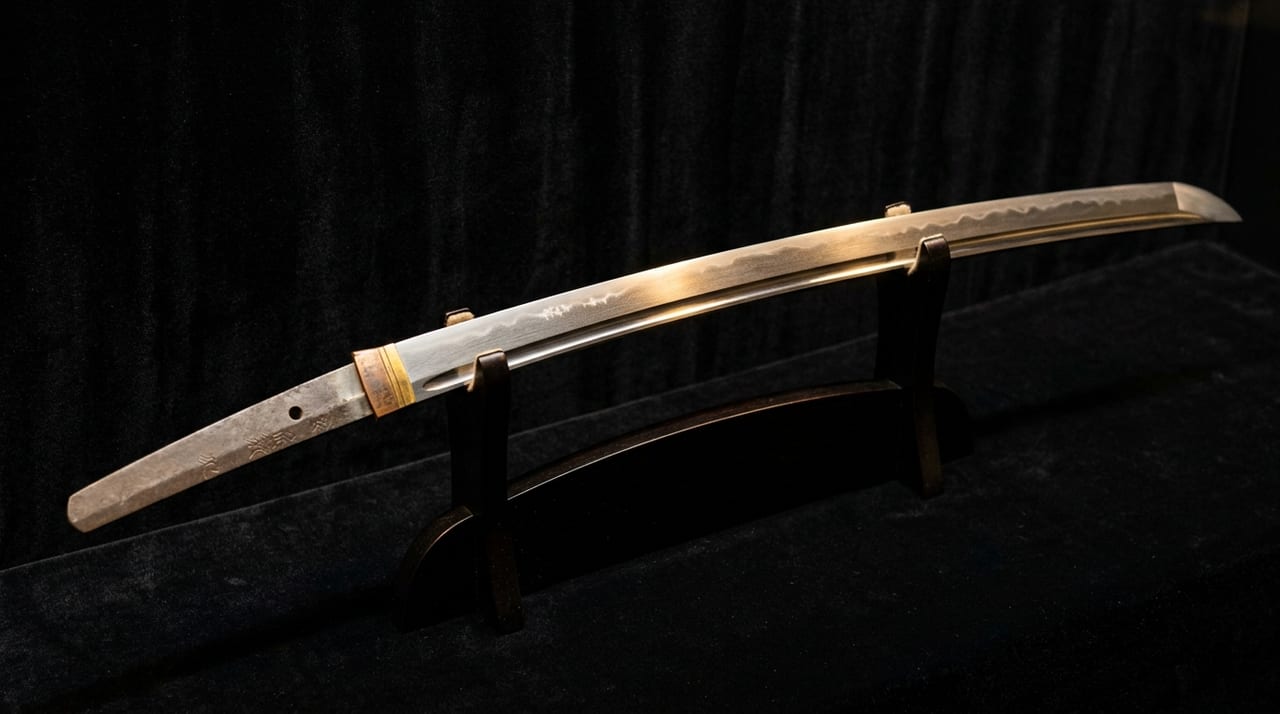 * Image is for illustrative purposes only.
Table of Contents
Rai Kunitoshi: His Place in the Rai School Genealogy
The Rai school, which was active in Yamashiro Province (the southern part of present-day Kyoto), was a group of swordsmiths representing the Yamashiro tradition, one of the five traditional schools of Japanese sword-making. Among this school, founded by Rai Kuniyuki, Rai Kunitoshi (来国俊) was renowned as an exceptionally skilled craftsman. He is believed to have been active in the late Kamakura period (late 13th to early 14th century) and was a central figure in the school's golden age.
According to conventional accounts, Rai Kunitoshi was either the son or closely related successor of Rai Kuniyuki, and Rai Kunitoshi's son was Rai Kunimitsu. In other words, the father-to-son transmission from Rai Kuniyuki to Rai Kunitoshi to Rai Kunimitsu forms the main axis of the Rai school's genealogy. Rai Kunitsugu is said to have been Rai Kunitoshi's disciple and son-in-law, and because he went to Kamakura and studied under Masamune, he was also called the "Kamakura Rai." It would be inaccurate genealogically to place Rai Kunitoshi, Rai Kunimitsu, and Rai Kunitsugu simply as the same generation; it is more appropriate to position Rai Kunimitsu as a swordsmith of one generation after Rai Kunitoshi.
The genealogy of the Rai school can be summarized as follows.
- Rai Kuniyuki: The founder of the Rai school
- Rai Kunitoshi: Either the son or closely related successor of Rai Kuniyuki, a master craftsman of the second generation of the Rai school
- Rai Kunimitsu: Said to be the son of Rai Kunitoshi, a swordsmith of one generation after Rai Kunitoshi
- Rai Kunitsugu: Said to be Rai Kunitoshi's disciple and son-in-law, also called the "Kamakura Rai" because he went to Kamakura and studied under Masamune
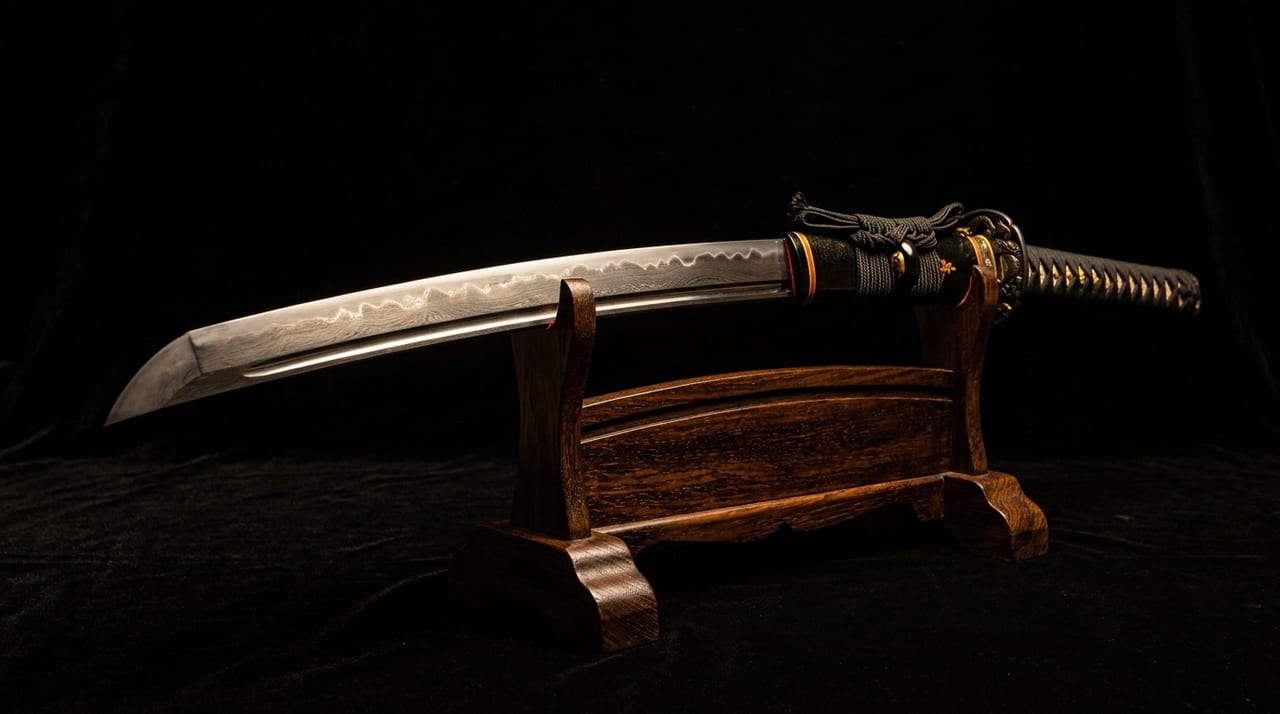
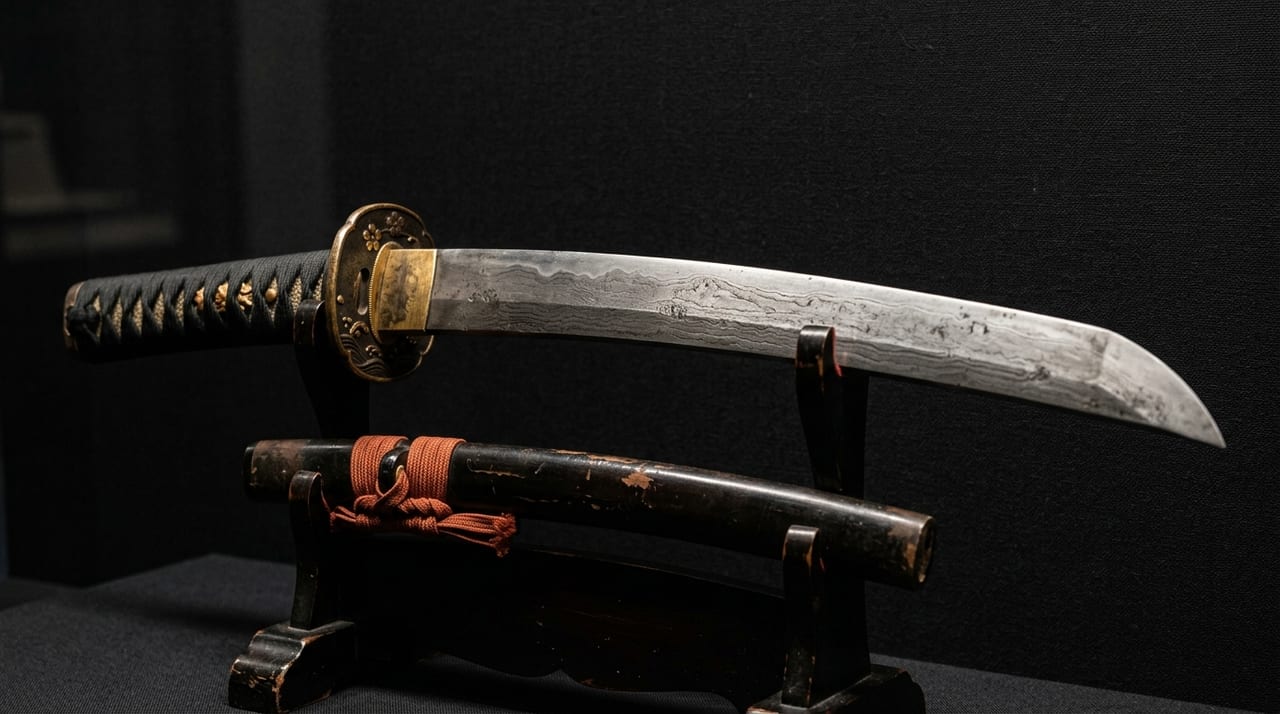
The first characteristic to note about Rai Kunitoshi's work is the elegant and refined blade shape characteristic of the Yamashiro tradition. In tachi, while maintaining a softly curved waist section (koshi-zori) at the base, the blade tapers gracefully toward the point in an exquisite silhouette. This differs both from the robust style of the contemporary Bizen tradition and the linear strength of the Yamato tradition—it represents the expression of an aesthetic sensibility unique to Yamashiro. A characteristic shared across the entire Rai school is the fusion of refinement and delicacy that was nurtured in the cultural milieu of Kyoto's nobility and Buddhist temples. Rai Kunitoshi's works have been valued by later connoisseurs as representing the culmination of this aesthetic.
The Hamon and Jihada Characteristics of Rai Kunitoshi
The hamon is based on a gentle suguha (straight blade pattern), often incorporating small choji and minor irregular patterns. The nioiguchi (fragrance mouth—the margin of the hardened edge) has a somewhat tight appearance and a refined impression, containing fine nie in the blade. This is called "nioi-deki," and the overall style of the Rai school is characterized by a soft, full appearance along the blade edge, distinctly different from the luxurious irregular patterns occasionally seen in the later work of Rai Kunimitsu.
The jihada is characterized by dense forging based primarily on itame (board grain pattern), with the surface finished beautifully in flowing, fine lines. Fine ji-nie (ground nie) is present, and subtle utsuri (reflection) patterns sometimes appear. While the high quality of jihada is common to the entire Yamashiro tradition, Rai Kunitoshi's works are particularly praised for their clear, pure iron character. The gentle glow of ji-nie and the beautiful, orderly grain pattern are among the most notable viewing points when appreciating Rai Kunitoshi's blades.
The mei (signature) on the nakago (tang) is most commonly engraved as "Rai Kunitoshi," and the calligraphy is clean and well-proportioned. Numerous signed examples survive, which is one reason why scholars have been able to understand Rai Kunitoshi's skill and style in detail when researching the Rai school. Because the signature is relatively easy to verify during authentication, Rai Kunitoshi is considered a comparatively accessible swordsmith for beginners.
Important Cultural Property and National Treasure Examples of Rai Kunitoshi's Work
Among Rai Kunitoshi's distinguished blades, particularly notable are the tachi designated as National Treasures or Important Cultural Properties. Many Rai Kunitoshi works are registered with the Society for the Preservation of Japanese Art Swords (NBTHK) as especially important swords or important swords. Multiple examples of Rai Kunitoshi's work are housed in public institutions such as the Tokyo National Museum, Kyoto National Museum, and Kyushu National Museum, as well as in various shrine treasure halls throughout the country.
The surviving tachi generally exhibit characteristics of the late Kamakura period and most are of a refined length of approximately 2 shaku 4 sun (around 73 cm) of blade. Many were originally transmitted through daimyo families and transferred to public institutions after the Meiji Restoration. Consequently, by tracing the provenance of surviving examples, we can catch glimpses of the history of sword distribution spanning from the medieval period through the early modern and modern eras.
Rai Kunitoshi and His Successors in the Rai School Compared
Rai Kunimitsu, who succeeded Rai Kunitoshi, was known for excelling in bold irregular patterns influenced by the Soshu tradition. In contrast, Rai Kunitoshi remained faithful to the Yamashiro tradition and consistently maintained a refined and dignified style. In sword authentication, comparing these two generations of father and son provides a key to understanding the breadth of the Yamashiro tradition. The differences in their styles can be summarized as follows.
| Swordsmith | Style Characteristics |
|---|---|
| Rai Kunitoshi | Faithful to the Yamashiro tradition, with a refined and dignified style |
| Rai Kunimitsu | Bold irregular patterns influenced by the Soshu tradition |
Rai Kunitsugu is said to have been Rai Kunitoshi's son-in-law and disciple, and was also called the "Kamakura Rai" because he later moved to Kamakura and studied under Masamune. By positioning Rai Kuniyuki as the first generation, Rai Kunitoshi as the second generation, and Rai Kunimitsu and Rai Kunitsugu as the third generation, we establish a framework for more accurately understanding the genealogical development of the Rai school.
- First generation: Rai Kuniyuki
- Second generation: Rai Kunitoshi
- Third generation: Rai Kunimitsu and Rai Kunitsugu, among others
Rai Kunitoshi is also said to have exerted an indirect influence on the establishment of the Enju school (a branch of the Higo Rai school), and he occupies a critical juncture in the history of how the Rai school's sword-making techniques spread from Yamashiro to Kyushu.
Collecting Rai Kunitoshi's Works and Important Considerations for Authentication
Works bearing Rai Kunitoshi's mei command high valuations in the sword market, but it is essential to be aware of the problem of "false signatures" (nisei-mei). Because Rai Kunitoshi's reputation is considerable, a certain number of swords with false signatures are said to have circulated from the Edo period into the modern era. Therefore, when making a purchase, it is essential to confirm that the work is accompanied by an authentication certificate from the Society for the Preservation of Japanese Art Swords (NBTHK), which assigns ratings in the categories of preservation, special preservation, important, and especially important. The NBTHK authentication certificate has the following ratings.
- Preservation
- Special Preservation
- Important
- Especially Important
When considering a work attributed to Rai Kunitoshi without an authentication certificate, it is recommended to have it authenticated through a sword dealer, polisher, or professional sword authenticator. Even if the provenance is clear, proceeding with confidence can be achieved through verification by multiple experts. Works authenticated as genuine Rai Kunitoshi are highly valued as exceptionally precious cultural properties that embody the traditional aesthetic sensibility of the Yamashiro school.
If you wish to experience the finest expression of the late Kamakura Yamashiro tradition, Rai Kunitoshi's works are an essential reference point to examine first. If you have the opportunity to encounter authentic examples at museum special exhibitions or sword appreciation gatherings, do experience directly the clarity of their softly gleaming jihada and the beauty of their gentle hamon.