Natsu-kaji and Fuyu-kaji — The Influence of Season on a Tōshō's Work Schedule and Steel Quality
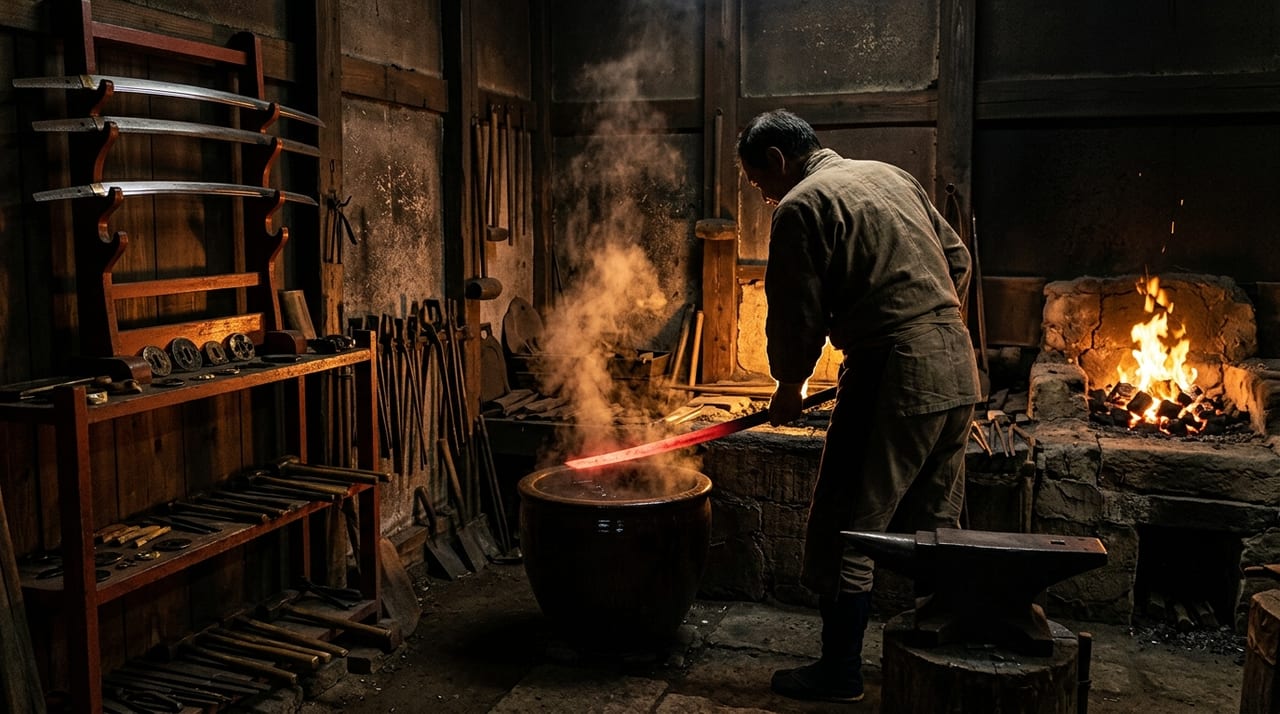 * Image is for illustrative purposes only.
Table of Contents
The Tradition of Fuyu-kaji — Why Winter Forging Was Preferred
In Japanese sword-forging tradition, winter (fuyu-kaji) has long been recognized as the most suitable season for making swords. In particular, the cool and dry working conditions of winter have long been considered advantageous to the tōshō in multiple respects.
The main reasons why winter sword-making is considered advantageous are the following two points.
- Water temperature stability during yaki-ire: Yaki-ire is the process of plunging the heated blade into water (or oil) for rapid cooling, which forms the hamon and gives the blade its hardness. The lower the water temperature, the greater the cooling rate, which promotes hardening of the steel. When the outside air temperature is low in winter, the temperature of the water bucket is naturally kept low, making it easier to achieve a more stable yaki-ire effect. In summer, by contrast, the water temperature tends to rise, and there is a risk that the cooling effect becomes uneven.
- Visibility of the hi-iro of the furnace: When heating the blade to the appropriate temperature (approximately 800–900°C) before yaki-ire, the tōshō judges the temperature by observing the color of the flame and the brightness of the blade with the naked eye. Compared to the bright conditions of summer, winter — when it is still dark in the early morning and darkness falls sooner — is said to make the hi-iro appear more clearly, allowing the tōshō to read subtle temperature changes more easily.
Fuyu-kaji in Practice — The Practical Advantages and Disadvantages of a Cold Environment
The working conditions of winter affect the tōshō in various ways. Since the heat of the furnace warms the entire workshop, the drop in outside temperature is partially offset in terms of perceived temperature. However, performing precision work with cold hands, feet, and face presents a challenge to maintaining concentration, and in particular the stiffening of the hands from the cold can become a problem in delicate processes such as tansetsu and finish forging.
From the perspective of steel behavior, it is said that in winter the detachment of oxidation scale during forging can be more uniform than in summer. This is because temperature and humidity affect the rate of surface oxidation of the steel, though this mechanism remains an area of ongoing research even from a modern materials science perspective.
On the other hand, winter also coincides with the agricultural off-season, and there is a practical background to this: it was easier for the tōshō to secure dedicated time in the forge. In traditional rural society, craftsmen often combined their trade with farming, and the schedule of devoting oneself to sword-making in winter — avoiding the busy farming seasons — naturally became established.
The Challenges of Natsu-kaji — The Effects of High Temperature and Humidity on Steel and the Worker
Summer sword-making is sometimes called natsu-kaji, but it has traditionally tended to be somewhat avoided. The greatest challenge is water temperature management during yaki-ire. When water temperature exceeds 20°C in summer, the cooling rate differs compared to winter, and this tends to affect the yaki-ire results and the formation of the hamon. Tōshō have devised the following measures to compensate for this.
- Adding salt to the water to adjust its boiling point and cooling characteristics
- Placing the water bucket in a cool location
The hot and humid conditions of summer also place a heavy physical burden on the worker. In the forge, furnace temperatures exceed 1,000°C, and work is carried out amid intense radiant heat and flying scale. When summer's temperature and humidity are added to this, the risk of heatstroke increases and the depletion of stamina and concentration becomes severe.
However, among modern tōshō there are many who do not shy away from summer forging, and improvements in furnace design, ventilation equipment, and water temperature management technology have made it possible to control seasonal influences more effectively than before.
Season and the Tōshō's Skill — Japanese Swords as a Dialogue with the Natural Environment
From a modern materials science perspective, the influence of water temperature, air temperature, and humidity on the outcome of yaki-ire does indeed exist, but a skilled tōshō is able to make adjustments adapted to those changes. The advantage of fuyu-kaji is not absolute, and it is considered that the greater part of it can be absorbed by the tōshō's skill and experience.
The understanding of the Japanese sword as "a craft born from the fusion of the natural environment and the craftsman's skill" is well reflected in this relationship with the seasons. In every process from the collection of iron sand through tatara, tanren, yaki-ire, and polishing, the changes of Japan's four seasons exert a subtle influence. The tōshō continues to make swords by reading those changes, correcting for them, or making use of them. When appreciating a Japanese sword with an awareness of the season, one's imagination expands toward the environment in which that single blade was born.
The Sword-Making Calendar and Shinto Observances — The Tōshō's Annual Cycle Marked by the Seasons
The working cycle of a traditional tōshō often incorporates customs linked to Shinto observances closely associated with swords and to the agricultural calendar. Observances venerating Kanayago-kami, the guardian deity of the forge, are held at forges throughout the country, and the timing of beginning work and completing swords carries ritual significance as well.
The sword-making schedule throughout the year traditionally follows a flow such as the one below.
| Period | Main Activities |
|---|---|
| Autumn through the following spring (cool season) | Concentrated forging |
| Midsummer | Repair and maintenance, or training and instruction |
Many modern tōshō also observe this basic seasonal rhythm, and the tradition of fuyu-kaji is passed down not as mere superstition but as practical wisdom.
From the perspective of the appreciator as well, it is interesting to be mindful of the "season in which a Japanese sword was made." When one researches the background behind the creation of a celebrated sword, one finds that the tōshō's working environment, technique, and beliefs are intricately intertwined with the natural environment. When browsing swords in the TOUKENZA online catalog, imagining the seasonal practices of the craftsman behind each blade is also one way to deepen the experience of sword appreciation.