Kinzōgan-mei and Ginzōgan-mei: Gold and Silver Inlaid Signatures That Mark Attribution on Unsigned Blades
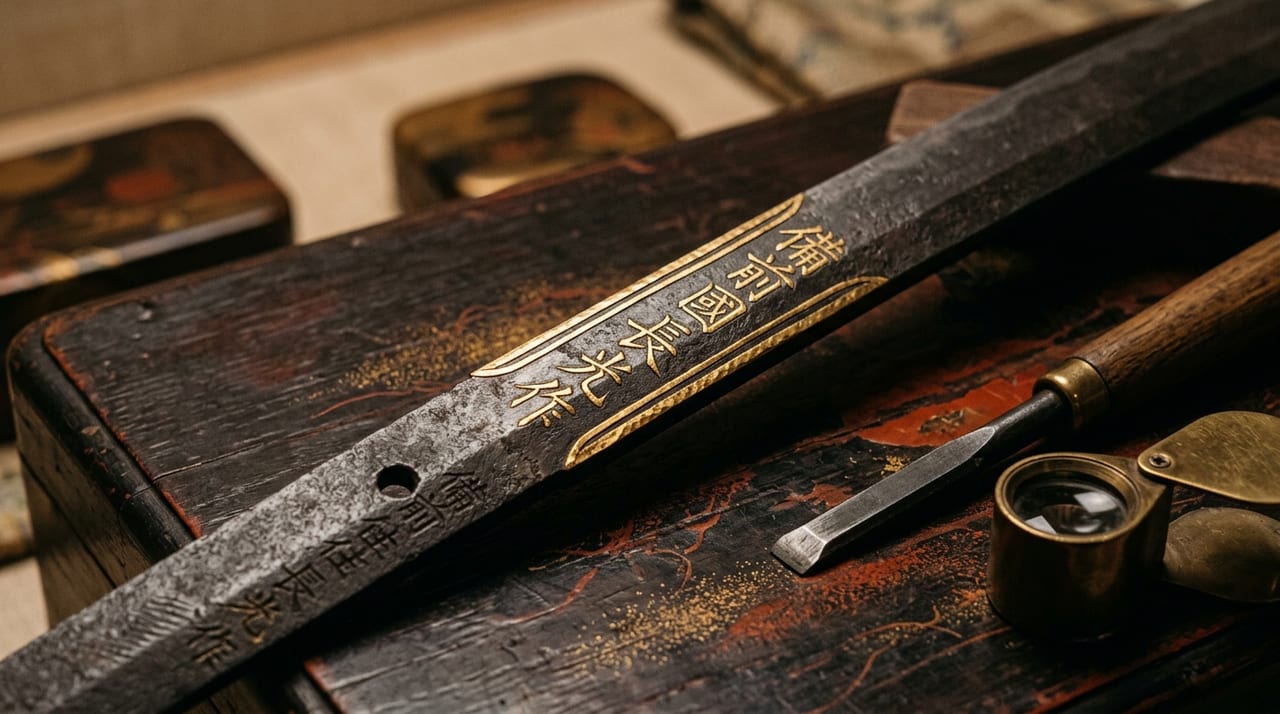 * Image is for illustrative purposes only.
Table of Contents
What Are Gold Inlay Signatures and Silver Inlay Signatures?
Gold inlay signatures (kinzogan-mei) and silver inlay signatures (ginzogan-mei) are techniques in which lines or characters made of gold or silver are inlaid into the nakago (tang) of a sword blade to record authentication information such as the smith's name. Unlike standard signatures engraved directly by the sword smith using a tagane (burin), inlay signatures refer to authentication assessments made by appraisers in later generations—their conclusion that "this sword is the work of such-and-such a smith"—marked onto the blade using inlay metalworking technique.
Why Were Unsigned Masterpieces Created?
Among famous swords from earlier eras, there were many that originally bore no signature, or whose signatures were lost when the tang was shortened during suriage (shortening) when converting a tachi into an uchigatana. Even if the blade itself was of first-rate quality, without a signature it was impossible to know who made it, and the means of transmitting the sword's provenance and value to later generations was lost. In response to such unsigned masterpieces, inlay signatures developed as a system by which appraisers could identify the maker and preserve that determination on the blade itself.
The Honami Family and the Establishment of Inlay Signatures
The Honami family, who made a profession of sword appraisal across generations, played a crucial role in the authentication of unsigned blades and the application of inlay signatures. The Honami family appraised swords at the request of samurai families and the imperial court, and when they had conclusively identified the maker of an unsigned masterpiece, they would issue the result as an origami (certificate of authentication) and sometimes inlay a signature in gold or silver on the tang. The inlaid signature served as a form of certification backed by the authority of the appraiser and became an important key to transmitting the sword's provenance to future generations.
The Technique of Inlay—From Groove Carving to Metal Wire Installation
The work of creating inlay signatures is delicate handwork by a metalsmith, distinct from the techniques used to forge the blade itself. The basic process can be outlined as follows:
- Thin grooves are carved into the surface of the tang following the shape of the characters, using a burin.
- Gold or silver wire or thin sheet is carefully fitted into the grooves.
- The inserted metal is struck with a hammer and firmly fixed in the grooves.
- The surface is polished smooth and finished so that it blends seamlessly with the underlying iron.
Rather than simply adhering gold or silver to the surface, the metals are mechanically fixed by being driven into carved grooves, which is why properly executed inlay signatures do not readily peel off. This durability is one reason why inlay signatures remain legible even after several centuries.
The Difference Between Gold Inlay and Silver Inlay
Gold inlay signatures and silver inlay signatures differed not only in the metals employed but also showed certain patterns in their use across different eras and in the weight assigned to authentication. Gold, being more resistant to tarnishing than silver, was sometimes positioned as a material for higher-ranking authentications; however, silver inlay was also widely practiced, and it would be inappropriate to view the difference between the two as a simple matter of superiority and inferiority. What is essential in either case is that the inlay signature itself is not the smith's own mark but rather a later appraiser's determination.
Appraisal Considerations
The presence of an inlay signature does not necessarily mean that the assessment is absolutely correct. It is necessary to make comprehensive judgments that take into account the possibility of the inlay itself having worn over time or having been added in later eras. Reconciling the quality of the blade, the inlay signature, and the documented provenance is the fundamental approach to engaging with unsigned masterpieces. Inlay signatures are not mere decoration; they represent a form of record unique to sword culture, in which the accumulated discernment of appraisers across many generations has been inscribed.
The Relationship with Certificates
The assessment results of the Honami family were not only preserved on the blade itself in the form of inlay signatures but were also issued as written certificates called origami. Origami were documents recording the sword's provenance and providing an estimate of its value, and when both inlay signatures and origami survived together, the sword's provenance was more thoroughly substantiated. However, cases where only the origami survived without an inlay signature, or conversely where only the inlay remained and the origami was lost, are not uncommon, and the two did not always survive as a pair. The very circumstances under which one or the other was lost during transmission can sometimes serve as a clue to the history the sword has undergone.
Differences from Modern Authentication Methods
Today, specialized institutions such as the public-interest incorporated association Japan Art Sword Preservation Society (NBTHK) conduct sword authentication and appraisal using scientific investigative methods. Inlay signatures are products of an older authentication culture that developed under the authority of the specific lineage of the Honami family, before the establishment of modern authentication systems. While modern certificates and inlay signatures differ in their methods of authentication and institutional framework, the fundamental posture of experts drawing on their expertise to identify the maker of an unsigned masterpiece and seeking to pass that determination to future generations is common across the ages.
The Provenance That Inlay Signatures Reveal
A sword bearing an inlay signature is not merely a blade whose maker has been identified; it is also a document that tells the story of its provenance—who owned and commissioned the authentication, and through what circumstances the sword came to be valued by the world. Behind samurai families' decision to seek authentication for swords they had preserved as treasured heirlooms lay the strong desire to transmit these blades correctly to future generations. Inlay signatures are a form of record unique to sword culture, established through the accumulated endeavors of multiple people—the skill of the smith, the discernment of the appraiser, and the intentions of the owner.