Shumei: what the red-lacquer attribution inscription on the nakago is, how to read it, and how it differs from kinzogan-mei
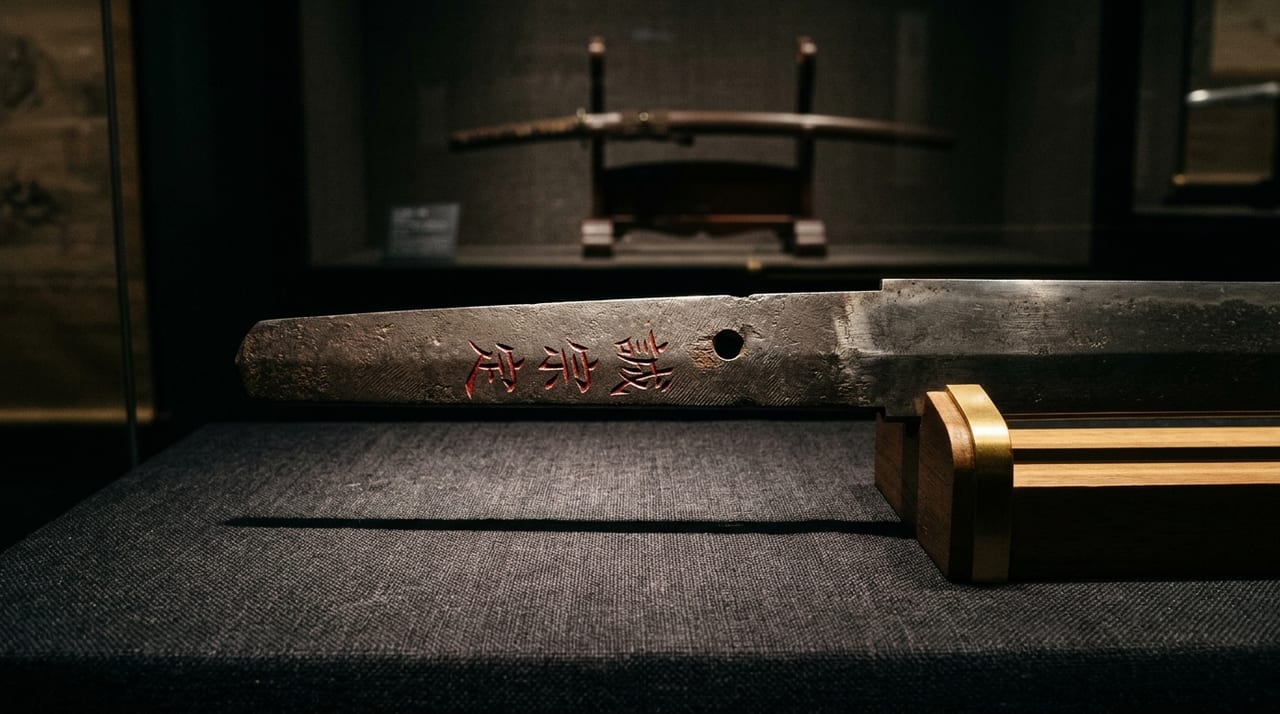 * Image is for illustrative purposes only.
Table of Contents
The nakago (tang) of a Japanese sword normally bears a mei (signature) carved by the tōkō (swordsmith) who made it. Yet some old swords carry no such inscription from the tōkō; instead, they bear characters written in red. This is shumei. Anyone who studies or considers purchasing a sword will encounter the term sooner or later in nakago photographs and catalogue descriptions. This article explains what shumei is, how to read it, and how it differs from kinzogan-mei and origami.
What shumei is
Shumei is an inscription in which the characters are written in red lacquer rather than chiselled into the nakago with a tagai (cold chisel). Explanations of sword terminology describe it as a method chosen in order not to damage the nakago (Nagoya Sword Museum basic knowledge of swords).
An ordinary mei is cut by the tōkō at the time of forging. Shumei, by contrast, was added by a later appraiser to record whose work that appraiser judged the sword to be. In other words, the person who wrote it is not the maker but the appraiser.
This is the key point for reading shumei. The characters represent the conclusion of an appraisal — "this sword has been attributed to such-and-such a maker" — not a signature left by the tōkō.
Why shumei comes to be written on a sword
Shumei becomes necessary when the nakago bears no inscription identifying the maker. Several reasons exist for this.
- The sword was made mumei (unsigned) from the outset.
- The original mei on the nakago wore away over the centuries and became illegible.
- Suriage (shortening) was performed to suit the physique of an owner or the tastes of the age, and the mei was lost in the process.
Suriage was especially widespread during the transition from tachi to uchigatana. The technique is explained in detail in a separate article; see Suriage technique and appraisal. Shumei was sometimes added to celebrated swords that had lost their mei, as a clue to their value.
The basics of reading shumei
Shumei is said to often pair the name of the attributed maker with the identity of the appraiser. Typically, one face of the nakago carries the maker's name as determined by the appraisal, while the other carries the appraiser's name or kaō (a stylized personal cipher used in place of a written signature).
Reading it in the following order makes the process easier.
- Confirm that no chiselled mei is present on the nakago (or that only part of one remains).
- Locate the characters written in red and read the portion that names the maker.
- Check the opposite face for the appraiser's name or kaō.
- Consider the reason the chiselled mei is absent — mumei, suriage, or wear — in light of the shape and condition of the nakago.
The script is brush-written in a cursive style, and kaō can be difficult to decipher. Where a catalogue or explanatory text provides a photograph alongside a transcription, cross-referencing the two is the most reliable approach.
How shumei differs from kinzogan-mei
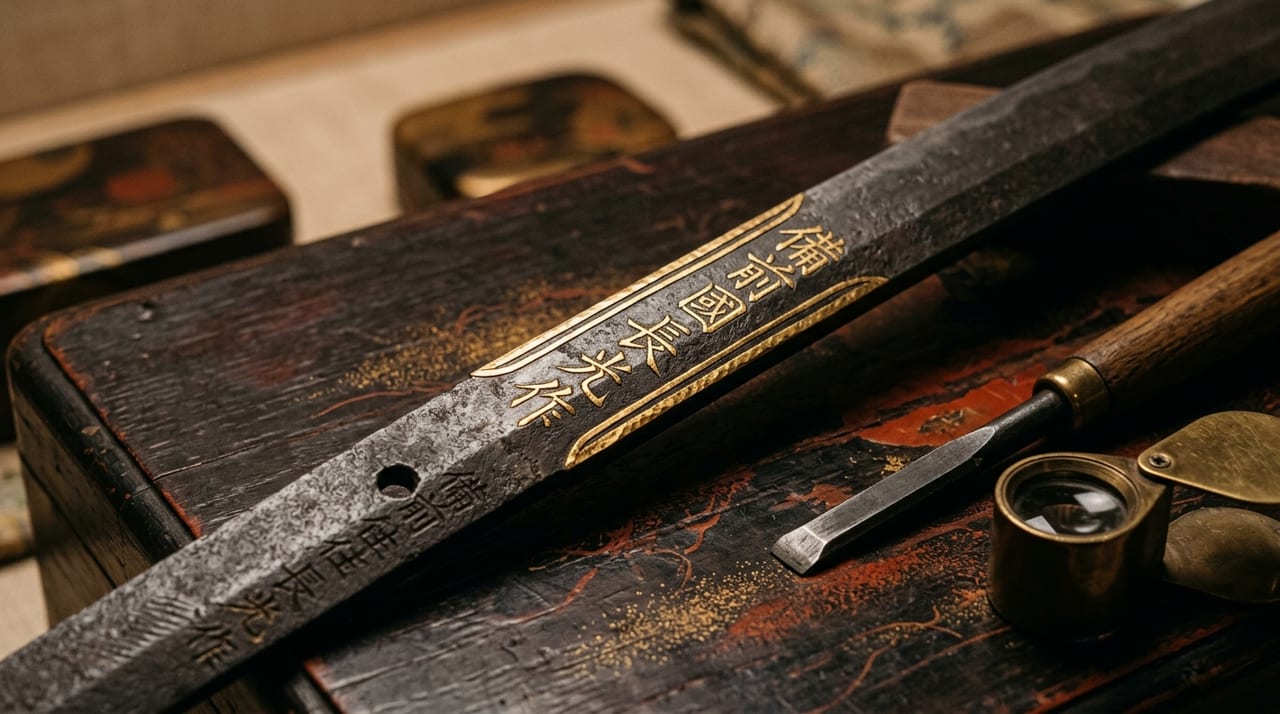
Another method of recording a later appraisal on the nakago is kinzogan-mei (gold-inlay inscription). Here, a groove is carved into the nakago and gold is inlaid to form the characters. The Agency for Cultural Affairs' Cultural Heritage Online database includes the kokuhō (National Treasure) "Katana with kinzogan-mei 'Bizen no Kuni Kanemitsu' (meibutsu Ōkanemitsu) / Hon'ami (kaō)," whose entry notes that the sword was originally an ōdachi that underwent suriage and was then given an attribution by gold inlay (Cultural Heritage Online).
The comparison can be set out as follows.
| Item | Shumei | Kinzogan-mei |
|---|---|---|
| Method | Written in red lacquer | Gold inlaid into a carved groove |
| Work done to the nakago | Not chiselled; nakago left undamaged | Groove carved into the nakago |
| Content | Attributed maker's name and the appraiser's name or kaō | Same: maker's name and appraiser's name or kaō |
There are explanations suggesting that the choice between the two depended on whether the original nakago survived, but no source has been confirmed that establishes this as a general rule. It is safer to avoid assuming, for example, that the presence of shumei always means the original nakago is intact.
Related inscription types are also covered in Orikaeshi-mei, kirizuke-mei, and saidan-mei: differences between nakago signature types and Kinzogan-mei and ginzogan-mei: the techniques of gold and silver inlay attribution.
How shumei differs from origami
A term often confused with shumei is origami (appraisal certificate). Origami is not an inscription written directly on the sword; it is a type of kanteisho (appraisal certificate) issued by appraisers such as the Hon'ami family (Nagoya City Hōsa Library exhibition list "Mekiki to Kantei"). The expression "origami-tsuki," meaning "certified" or "guaranteed," refers to having such an origami attached (Kotobank "Origami-tsuki").
In short, shumei and kinzogan-mei are attributions preserved on the sword itself (the nakago), while origami is a certification written on paper. However, no materials have been found that set out in detail the procedural rules governing how the two were used in practice. The distinction is therefore limited here to "the place and form in which the attribution is recorded."
Points to bear in mind when examining a sword with shumei
- Shumei is the "conclusion" of an appraisal, not a maker's guarantee. Whether a given attribution is correct can still be debated today.
- Avoid rubbing the nakago hard with cloth or handling it carelessly, as this risks damaging the written characters.
- The current presence or content of any mei also bears on whether the registration certificate matches the physical sword. The handling of registration certificates is covered in Complete guide to nihontō registration certificates.
The nakago is the "curriculum vitae" of a sword. Knowing how to read shumei gives you one more tool when examining a mumei sword.
When searching for swords
TOUKENZA is an online sword marketplace. Swords listed for sale can be browsed in the sword catalogue, and individual product pages often include photographs of the nakago with accompanying descriptions. Please use the contact form for any enquiries.