Japan's Sword Registration System: A Complete Guide to the Firearms and Swords Control Law and Prefectural Board of Education Notification Procedures
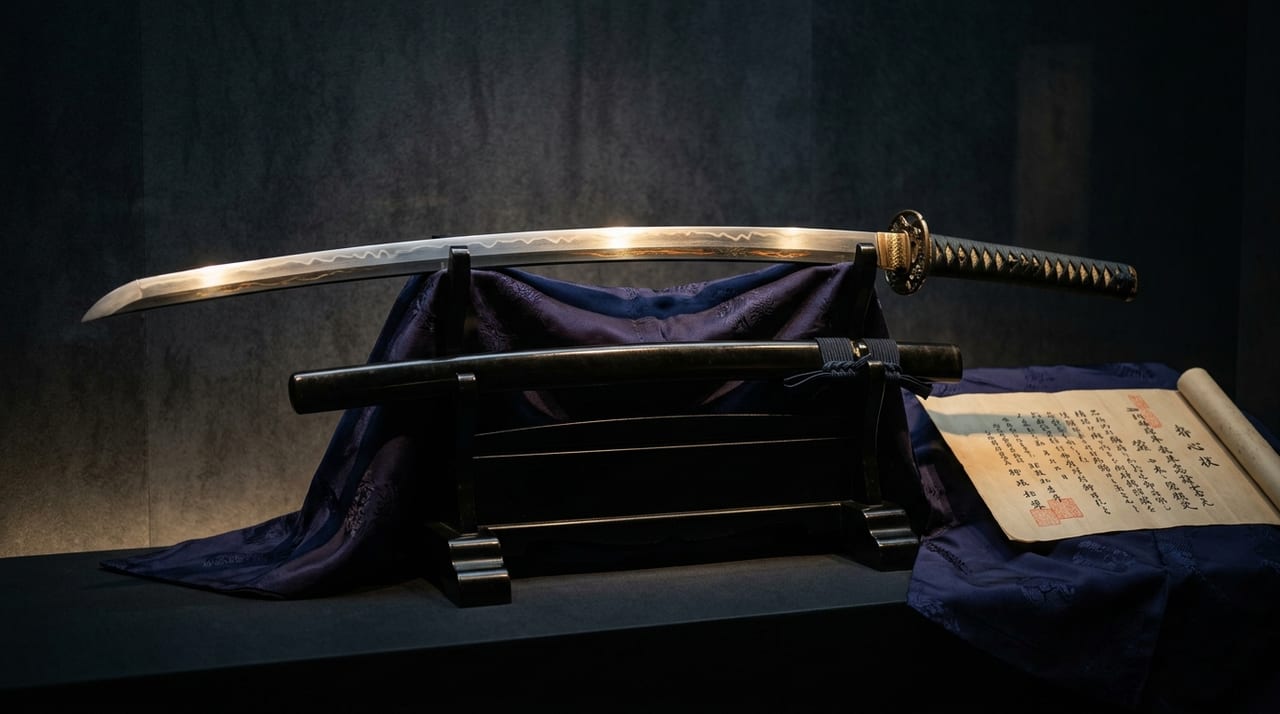 * Image is for illustrative purposes only.
Table of Contents
Why a Certificate of Registration Is Required for Japanese Sword Ownership
In Japan, the possession of swords with a blade length of 15 centimeters or more is prohibited in principle under the "Firearms and Swords Possession Control Law" (Firearms and Swords Law). However, Japanese swords recognized as having cultural value as art or crafts can be legally possessed if they have a "Certificate of Registration" issued by the prefectural board of education.
The Certificate of Registration system was introduced when the Firearms and Swords Law was enacted in 1958. It was designed as a system to protect and manage vast numbers of swords, including military swords manufactured before and during World War II, which were circulating in the private sector, while protecting them as cultural properties without uniformly confiscating them. Currently, the number of registered swords legally possessed within Japan is said to be estimated at over 2 million.
The Certificate of Registration is a document attached to the sword itself and is managed as an integral part of the sword. Even if the owner changes (through sale, inheritance, or gift), the Certificate of Registration transfers with the sword (Article 18 of the Jūtōhō). A sword that has not been registered may not, in principle, be possessed (Article 3, Paragraph 1 of the same law).
How the Certificate of Registration Works and Its Contents
The Certificate of Registration is a public document issued by each prefectural board of education, with the following information recorded on an A4-sized paper.
Main Items Recorded:
- Registration number (prefecture + unique number)
- Type of sword (katana, wakizashi, tanto, spear, naginata, sword, etc.)
- Blade length (length of the blade)
- Numerical value of the curve (curvature)
- Number of mekugi holes (number of holes in the nakago/tang)
- Signature (smith's signature; if unsigned, marked as "unsigned")
- Shape (blade construction, etc.)
- Date of issuance and issuing prefecture
The contents recorded on the Certificate of Registration describe the physical characteristics unique to the sword and do not guarantee its authenticity. The evaluation of the sword's value and authenticity is handled by separate appraisal institutions such as NBTHK (Japanese Sword and Art Preservation Society).
Reporting Procedures When Unregistered Swords Are Discovered
If an unregistered sword is discovered during estate cleanup, warehouse cleanup, or property inspection after purchasing real estate, the discoverer must promptly report it to the nearest police station. Reporting to the police is mandatory, and failure to do so may result in a violation of the Firearms and Swords Law.
Steps When an Unregistered Sword is Discovered:
- Report to the Police Station: Promptly (usually within a few days) after discovery, contact the Community Safety Division of the nearest police station and report the location or present the sword itself. Once the report is accepted, a "Certificate of Notification of Discovery of Firearms and Swords" is issued.
- Apply for Registration to the Board of Education: The discoverer must apply for registration with the prefectural board of education where they reside. The application requires the certificate of notification and the sword itself, which must be brought to the registration review meeting held periodically by the board of education.
- Registration Review (Appraisal Meeting): The sword is examined by the registration review meeting of the board of education. Swords that have a shape and sharpness suitable for use in swordsmanship with a blade length of 15 centimeters or more are eligible for registration.
- Issuance of Certificate of Registration: A Certificate of Registration is issued for swords that pass the examination.
Swords judged as ineligible for registration during the examination (military swords without artistic value, poor-quality products, swords with edge-blunted processing, etc.) may be disposed of. For this reason, it is recommended to consult with experts (sword dealers, lawyers) before handling unregistered swords.
Procedures for Changes, Loss, and Name Changes of Certificate of Registration
Loss of Certificate of Registration: If the Certificate of Registration is lost, apply for "reissuance of the Certificate of Registration" to the prefectural board of education that issued it. Reissuance requires an on-site inspection of the sword itself at an examination session, and the time it takes depends on the session schedule. In Tokyo, the reissuance fee is 3,500 yen (Tokyo Metropolitan Board of Education, "Procedures for Reissuing the Certificate of Registration").
Change of Owner (in case of sale or gift): A person who acquires a registered sword must report this to the prefectural board of education that handled the registration of the sword within 20 days (Article 17 of the Firearms and Swords Law, Firearms and Swords Possession Control Law (e-Gov Legal Search)). The procedure is relatively simple and is completed by simply mailing or submitting a copy of the certificate and notification form to the office.
In case of inheritance: Similarly, if the deceased dies, the heir must submit a notification of change of possession within 20 days from the date of acquisition. Regarding inheritance tax valuation, registered art swords are valued as "general movable property," and special treatment applies in the case of important cultural property designation.
Export Procedures and Taking Swords Abroad
When taking a sword with a Certificate of Registration from Japan abroad, procedures based on the Cultural Properties Protection Law are required.
Export as art or craft (including temporary export): It is necessary to obtain the "Certificate of Export Inspection for Antique Art Objects" from the Agency for Cultural Affairs. The export of National Treasures, important cultural properties, important art treasures and similar items is prohibited in principle, and this certificate is issued by the Agency for Cultural Affairs after confirming that the sword to be exported is not one of them (Agency for Cultural Affairs: Certificate of Export Inspection for Antique Art Objects). Taking a sword abroad for a short period, such as for an exhibition, also counts as "export." Because the Certificate of Registration becomes invalid the moment the sword is taken out of Japan, it must be returned to the prefectural board of education where the sword was registered, and a sword brought back to Japan must be registered again with the board of education of the prefecture where the owner lives (Tokyo Metropolitan Board of Education: When Exporting Firearms and Swords). Issuance of the certificate may take some time.
Customs Declaration: When filing the export declaration with customs on departure, submit the original Certificate of Export Inspection for Antique Art Objects to customs. A sword that has not been registered may not, in principle, be possessed (Article 3, Paragraph 1 of the Firearms and Swords Law) and so cannot be taken out of the country either, and when transporting a registered sword you must carry its registration certificate (Article 24, Paragraph 1 of the same law).
Laws and Regulations of Importing Countries: When exporting swords, it is necessary to confirm the laws and regulations of the importing country as well. In the United States, blade length regulations vary by state, and permit conditions also differ among EU countries, so it is essential to check in advance with the embassy or consulate of the importing country or with professionals.
Certificate of Registration and Sword Valuation—Relationship with NBTHK Appraisal
The Certificate of Registration is proof that possession is legal and does not guarantee the quality, authenticity, or value of the sword. Separately, the appraisal certificate issued by NBTHK (Japanese Sword and Art Preservation Society) serves to evaluate the artistic value and authenticity of the sword.
NBTHK appraisal certificates have four levels: "Preserved Sword," "Special Preserved Sword," "Important Sword," and "Special Important Sword." Swords with appraisal certificates of "Important Sword" or higher are significantly higher in market evaluation. For collectors and sword acquisitions for investment purposes, confirming the presence or absence of NBTHK appraisal certificates and their level, after verifying the presence or absence of the Certificate of Registration, becomes basic due diligence.
The Certificate of Registration system is a unique mechanism that "protects Japanese swords as cultural properties while allowing private circulation," and the existence of this system ensures the transparency and legal stability of Japan's sword market. When acquiring a sword for the first time, the first step is to verify the contents of the Certificate of Registration against the sword itself and confirm that there are no discrepancies in the recorded information.