What Is "Kokon Kaji Bikō"? — An Edo-Period Sword Reference for Looking Up Tōkō Signatures and Wazamono Rankings
 * Image is for illustrative purposes only.
Table of Contents
Looking Up Tōkō Signatures and Cutting Performance in One Volume — The Origins of "Kokon Kaji Bikō"
Even if you can read the mei (signature) engraved on a sword's nakago (tang), the mei alone does not tell you which era the tōkō (swordsmith) lived in or what kind of reputation he held. As interest in swords grew during the Edo period, several books were compiled for systematically researching tōkō signatures. One of the most representative of these is "Kokon Kaji Bikō."
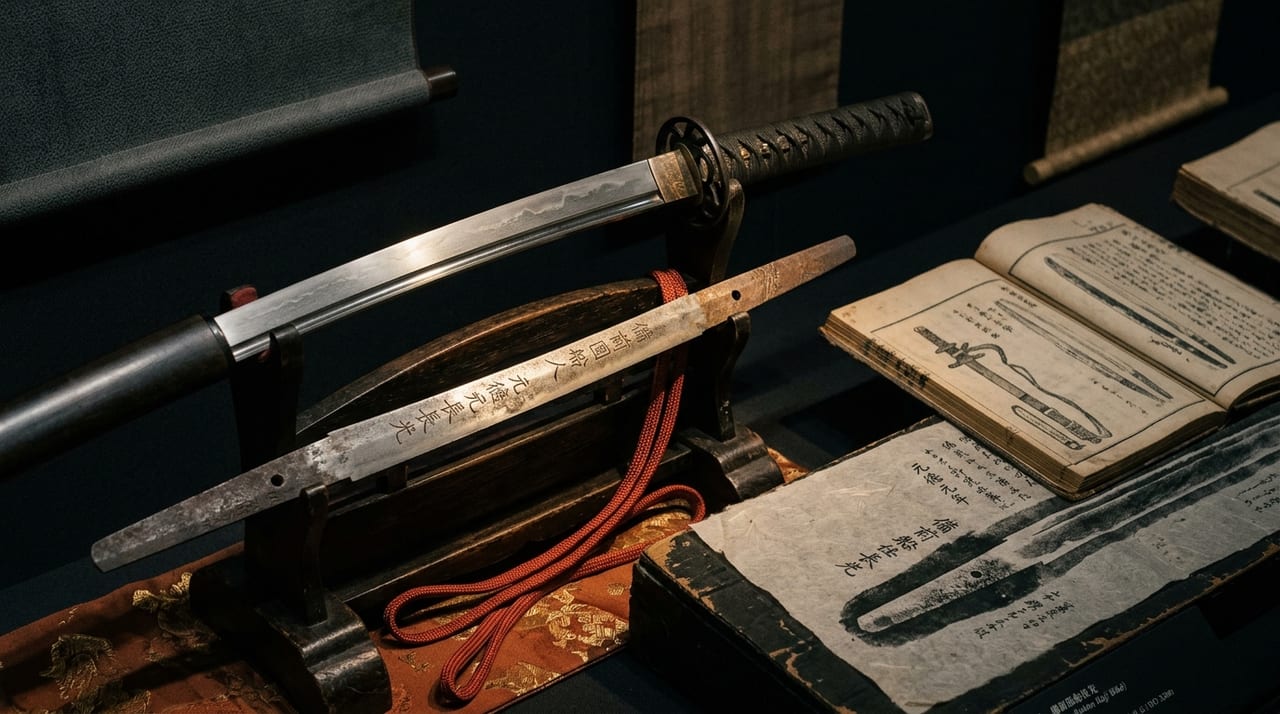
What sets this work apart is that it goes beyond a mere list of signatures. It includes nakago oshigata — rubbings made by pressing paper against the nakago — organized by region, and also appends the evaluation of "wazamono" — the ranking of tōkō based on cutting performance. As a work that combined the functions of a meikan (signature reference) and a wazamono book, it was widely used by sword enthusiasts in Edo.
The Seven-Volume Structure and the Role of Oshigata
According to the bibliographic record of the National Archives of Japan (Naikaku Bunko), "Kokon Kaji Bikō" is a printed work in 7 volumes, described as consisting of a section listing the mei of tōkō from all periods in iroha order and nakago oshigata organized by region. The explanation from the Nagoya Japanese Sword Museum likewise states it comprises 7 volumes in total, noting that it includes tōkō biographies.
The iroha arrangement was a device to make it function as an index. Just as modern dictionaries use the fifty-sound order, the structure allows one to look up entries using the reading of a tōkō's mei as a guide. The oshigata serve as visual reference material for confirming the form of the characters in a mei. Even the same mei, such as "Kunihiro," can differ in the shape and arrangement of the characters depending on the era and school, so comparison with oshigata is an important clue for identification.
The procedure for using this work can be broadly summarized as follows.
- Read the mei on the nakago and look up the tōkō name in iroha order.
- Compare the oshigata for that tōkō with the actual mei to verify the character forms and arrangement.
- Consult the tōkō's biography and place of origin to narrow down the era and school.
- If a wazamono ranking is recorded, confirm the Edo-period evaluation as well.
The entries in this work do not serve as definitive "answers" in modern appraisals or examinations, but it is still consulted as a starting point for comparison.
The Four Grades of Wazamono and the "Supplementary Section"
One of the reasons "Kokon Kaji Bikō" stands out as a sword reference is that it systematically records wazamono rankings. According to the Nagoya Japanese Sword Museum's explanation, the work divides the evaluation of tōkō by cutting performance into the following four grades.
- Saijō ōwazamono: the highest grade
- Ōwazamono: the second-highest evaluation
- Yoki wazamono: the mid-level grade
- Wazamono: the general term for those that meet the standard for grading
Furthermore, the work includes a "supplementary section," which addresses differences in grading compared to earlier wazamono books. The museum's page also explains that there are examples of tōkō who had been rated ōwazamono in the earlier work "Kaihō Kenjaku" being re-evaluated to saijō ōwazamono, and conversely, examples of tōkō being downgraded from saijō ōwazamono to ōwazamono. This shows that rankings were not fixed but were reviewed through successive editions of the work.
The wazamono evaluation axis is a different measure from the artistic value of a sword. It must be read with the understanding that it is an evaluation based on actual cutting performance — primarily the results of tameshigiri — rather than the quality of the hamon (temper line) or the beauty of the jigane (steel of the blade surface).
Various Theories on the Author and Year of Publication
The author and date of compilation have not been definitively established to this day. The main theories can be summarized as follows.
The bibliographic record of the Naikaku Bunko copy at the National Archives of Japan lists the author as Yamada Koboku, and cites the name of the fifth-generation Yamada Asaemon as a related item. The National Diet Library's bibliography, on the other hand, records the author of the facsimile edition published by Yūzankaku Shuppan as "attributed to Tsuge Heisuke," with Yamada Asaemon listed alongside as editor-compiler. Given that "attributed" precedes the name, the theory that Tsuge Heisuke was the author does not go beyond the realm of tradition and cannot be considered definitive.
Regarding the year of publication, the Nagoya Japanese Sword Museum gives the Kansei era (1789–1801), but other explanations cite different years. The existence of multiple editions and the complex history of the work's circulation are thought to be the background of these various theories.
The uncertainty about the author and date is also a point to bear in mind when reading this work. It is advisable to approach with caution any explanation that makes definitive claims about "who wrote it and when."
The Relationship with the Earlier Work "Kaihō Kenjaku"
To position "Kokon Kaji Bikō," it is necessary to understand its relationship with the earlier work "Kaihō Kenjaku." The Nagoya Japanese Sword Museum's explanation introduces "Kokon Kaji Bikō" as a sword evaluation work constituting an expanded edition of "Kaihō Kenjaku."
"Kaihō Kenjaku" is known as the work that popularized wazamono rankings, and it was "Kokon Kaji Bikō" that inherited this framework while adding and revising the evaluation of tōkō. The fact that it does not simply follow the earlier work's rankings but re-evaluates and downgrades entries in the supplementary section gives it an originality that goes beyond a mere expansion.
In the Edo period, sword reference books were not self-contained works; knowledge was updated in a cumulative manner by referring to, critiquing, and supplementing earlier works. Reading "Kokon Kaji Bikō" as one work positioned within that flow makes it easier to see the significance embedded in the changes to individual rankings.
Reading It as a Meikan, Reading It as a Wazamono Book
"Kokon Kaji Bikō" has two faces: as a reference for researching tōkō by looking at the mei on the nakago, and as a wazamono book for understanding sword evaluations in the Edo period. In modern appraisals, the examinations of NBTHK (Society for the Preservation of Japanese Art Swords) serve as the standard, and national designation categories such as kokuhō (National Treasure), jūyō bunkazai (Important Cultural Property), and jūyō bijutsuhin (Important Art Object) operate under a separate system. Therefore, the rankings in this work do not directly correspond to modern evaluations.
Nevertheless, it remains a work with reference value today, from three perspectives: comparing with nakago oshigata, confirming the tōkō's place of origin and era, and understanding the evolution of wazamono evaluations. The National Archives of Japan's digital archive makes images of the Naikaku Bunko copy publicly available, allowing one to directly verify the character forms in the original. The facsimile edition can also be confirmed in the National Diet Library's bibliography.
Related columns cover in detail how Edo-period sword reference books broadened the base of sword culture through publication and circulation, as well as Yamada Asaemon and the evaluation system of tameshigiri. To actually see and handle swords bearing mei, you can browse listed items from the sword catalog in the online catalogue.