Types of Iron Sand: Masa and Akome, and How Titanium Content Determines the Outcome of Tatara Smelting
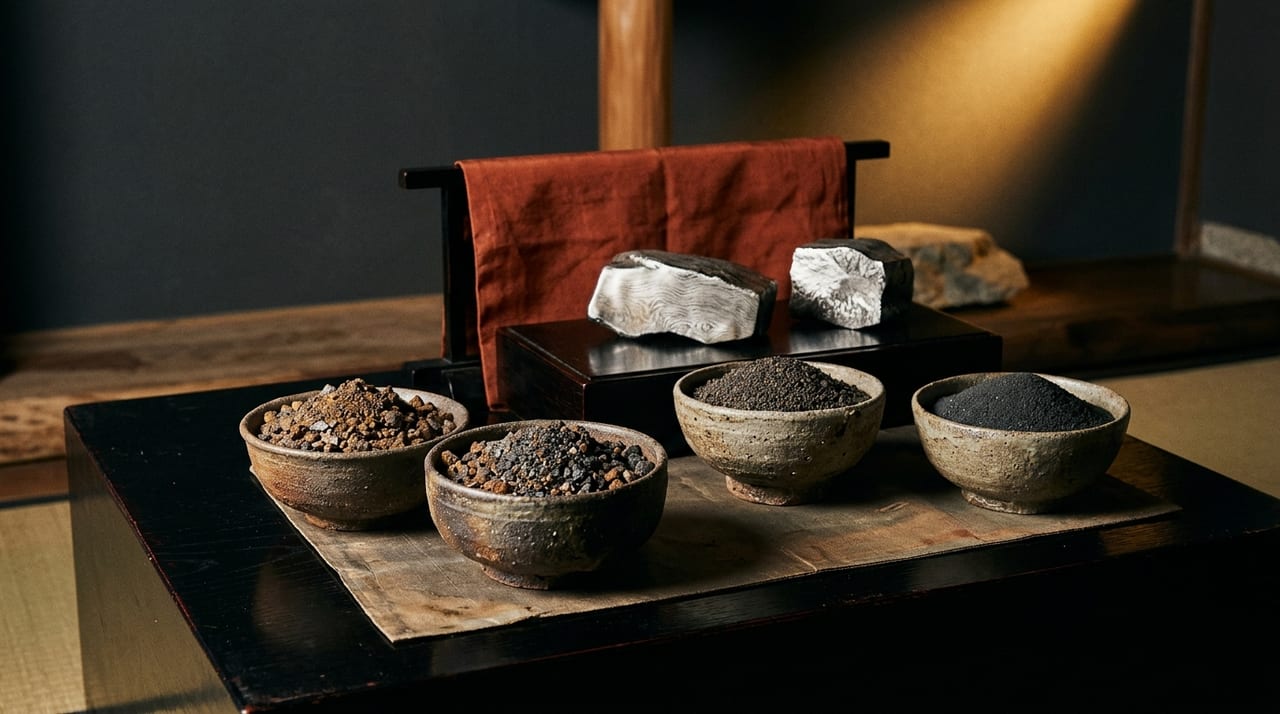 * Image is for illustrative purposes only.
Table of Contents
Iron Sand Is the Source of Tamahagane: Tracing the Raw Material of the Sword
Tamahagane, known as the material of the Japanese sword, is produced through tatara smelting using iron sand as its raw material. When discussing the jigane or hamon of a sword, the conversation tends to turn toward tanren and yaki-ire, but before all of that lies the starting point: what kind of iron sand to use. Here we organize, within what can be confirmed, the differences between the two types of iron sand commonly discussed: "masa iron sand" and "akome iron sand." For an overview of the entire process through to the production of tamahagane, the article Tamahagane and the Tatara Ironmaking Process is also helpful.
What Distinguishes Masa Iron Sand from Akome Iron Sand
Masa iron sand and akome iron sand are distinguished by their titanium content (titanium dioxide, TiO2). The Nationwide Archaeological Site Report Archive of the Nara National Research Institute for Cultural Properties lists the bibliographic information of a research paper (Kubo Yoshihiro and Kubota Kunichika, Tatara Kenkyū, 2010) that takes this classification as its subject, with the role of ilmenite as its main theme. However, that page contains only the bibliographic entry and keywords, so the definitions and specific figures cannot be confirmed.
- Masa iron sand: iron sand said to be low in titanium, from which steel is readily produced
- Akome iron sand: iron sand said to be high in titanium, from which pig iron (zuku) is readily produced
Zuku is cast iron with a high carbon content. Its properties differ from those of the steel that becomes sword material, and the key point of this classification is that which of the two is produced more readily in the same furnace depends on the properties of the iron sand.
Titanium Content and Furnace Outcomes as Shown by Experiments
The abstract of an experimental paper by Kubo Yoshihiro (Tetsu to Hagane, vol. 109, no. 1, 2023) presents the following results using iron sand from the Chūgoku region.
- Iron sand obtained by traditional gravity separation had a TiO2 content of 8–12%.
- Iron sand obtained by modern magnetic separation had a TiO2 content of less than 5%.
- When iron sand with high TiO2 content was used under strong reducing conditions, zuku flowed out.
- With low-TiO2 iron sand, no zuku appeared; instead, a mass of steel (kera) formed at the bottom of the furnace.
- When ilmenite was added to low-titanium iron sand, zuku was produced.
It should be noted that these are values for the iron sand used in the experiments, not standard content figures for akome or masa respectively. Nevertheless, it can be clearly read that titanium content affects the outcomes inside the furnace.
Did Pre-Modern Tatara Operators Select Iron Sand Deliberately?
The same abstract states that the experimental results are consistent with historical accounts describing how pre-modern tatara operators added titanium-rich iron sand from specific sources to masa-type iron sand in order to obtain zuku. In other words, iron sand was not simply chosen for quality alone, but was also a material to be combined according to what was to be produced — steel or zuku.
Tamahagane, on the other hand, is understood to be the steel obtained from low-titanium masa-type iron sand. What is sought as sword material is steel with few impurities and consistent carbon content. For this reason, low-titanium iron sand has been valued on the raw-material side of sword making.
What Has Not Been Confirmed
We also note here the points that could not be confirmed in this investigation.
- The classification and use of iron sand in official NBTHK materials
- The titanium content of tamahagane itself
- Standard values for the mineral composition of akome and masa respectively
Explanations that state these things definitively can be found, but as they are not supported by publicly available sources, we do not address them here.
Contemporary Sword Making and Iron Sand
The production of materials for contemporary Japanese swords is carried on in a limited number of settings, including the Nittoho tatara. The work of those who carry on this tradition is covered in Contemporary Tatara Ironmaking and Its Practitioners, and how tōkō select and split the finished tamahagane is covered in Selecting and Splitting Tamahagane.
When looking at a sword, remember that behind the beauty of the hamon and jigane lies the story of the material — the properties of the iron sand and the conditions of the furnace. Swords of interest can be browsed in the online catalog (sword listing).