Tamahagane Selection and Splitting: How Sword Smiths Evaluate and Process Raw Materials
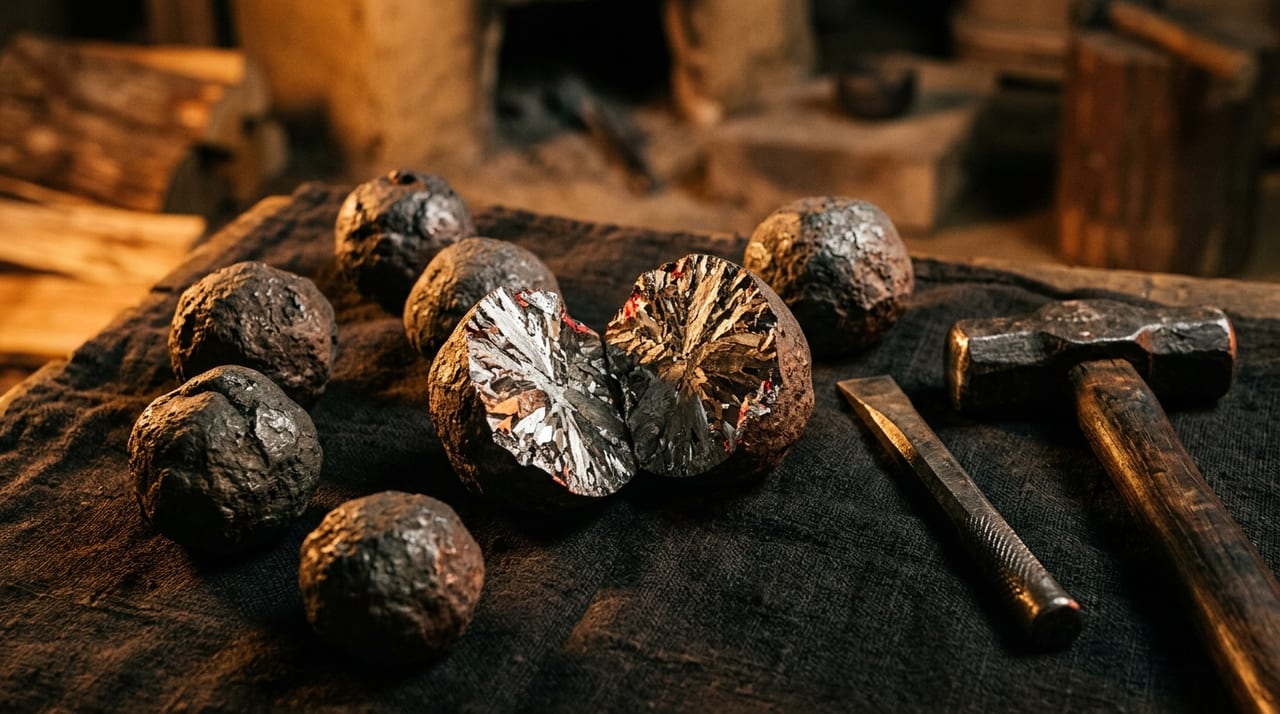 * Image is for illustrative purposes only.
Table of Contents
What is Tamahagane?
Tamahagane is a unique Japanese iron product produced through tatara steelmaking, in which iron sand is smelted in surface furnaces. From ancient times through the Edo period, Japanese sword makers have used tamahagane as a primary raw material. Tamahagane received its name from its nearly spherical shape. Individual tamahagane typically weighs several kilograms to several tens of kilograms.
The greatest characteristic of tamahagane is its heterogeneity. Because tatara steelmaking involves extremely complex chemical reactions, tamahagane produced from the same furnace varies in carbon content, type and quantity of impurities, and crystal structure from place to place. This heterogeneity was both the greatest challenge and the greatest opportunity for sword makers.
Sword Makers' Criteria for Selecting Tamahagane
The criteria sword makers use when selecting tamahagane can be organized into three categories.
- Visual Inspection: Careful examination of the surface color and luster of tamahagane, as well as the presence or absence of scratches and cracks. High-quality tamahagane has a distinctive luster on its surface with finely granular structure distributed uniformly. Lower-quality tamahagane often shows numerous cavities and large cracks.
- Fracture Testing: Sword makers observe internal structure by test-breaking tamahagane. From the color, luster, and crystal size of the fractured surface, they infer carbon content and the amount of impurities. High-carbon tamahagane tends to have a whitish luster, while low-carbon tamahagane appears dark. This empirical judgment is an extremely advanced craftwork technique.
- Weight Feel: Even tamahagane of the same size varies in density. Tamahagane with high density and a solid, weighty feel tends to have good structure. This is a subtle difference that sword makers can discern from the feel when holding it in their hands.
The Process of Splitting Tamahagane
The process by which sword makers split (waku) tamahagane is extremely dangerous and requires advanced technique. The process generally proceeds in the following order.
- Heat tamahagane until it glows red (annealing). Heating to an appropriate temperature relieves internal stress, making it easier to split. Temperature control is extremely difficult—if too low, it won't split; if too high, it will deform.
- Mark the location to be split. While inferring the internal structure of the tamahagane, select the position judged to split most effectively. This judgment is greatly influenced by past experience and intuition (kan).
- Place a chisel at the marked location and strike carefully with a hammer. Do not attempt to split it with a single blow. Gradually introduce cracks by applying multiple strikes. In this process, it is necessary to adjust the subtle force while sensing the characteristics of the tamahagane.
- Judge the degree of splitting from the distinctive sound that occurs when it splits. It must not be split too much and crumble into pieces. Neither can it remain partially split and be usable. Work continues carefully until complete separation is achieved.
Evaluation and Selection of Split Tamahagane
After splitting tamahagane, the sword maker conducts a detailed re-evaluation. The splitting exposes the internal structure, revealing the full picture for the first time. From the split surface, the distribution of carbon content and the quantity and distribution of impurities (such as iron sand inclusions) are observed.
| Quality of Tamahagane | Characteristics | Use |
|---|---|---|
| Highest | Maintains uniform structure even after splitting. Color is uniform with few dark granular particles (oxides and impurities) | Main body of blade (body) |
| Medium | ― | Spine and sides of blade |
| Poor | ― | Excluded as unusable by sword makers |
Forging and Use of Split Tamahagane
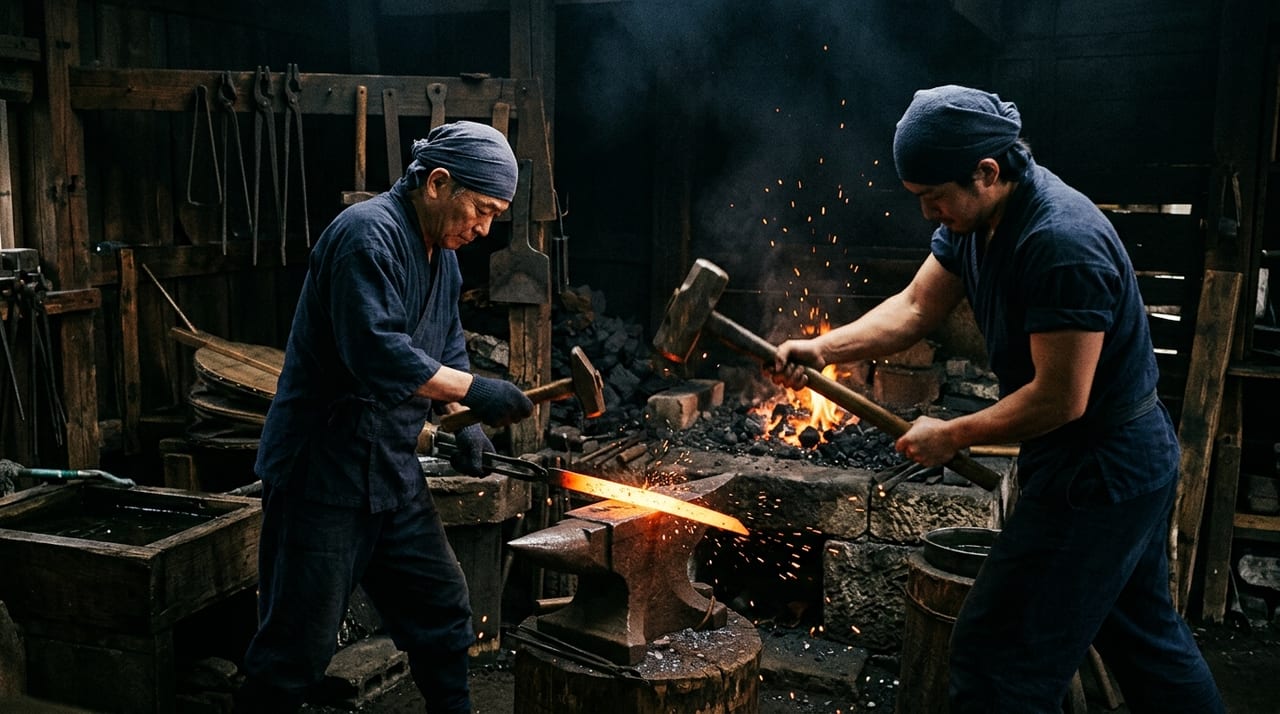
Selected tamahagane proceeds to the forging (tanzo) stage. The sword maker reheats the split tamahagane in a furnace and shapes it by striking with a hammer while in a soft state. During this process, impurities are removed as much as possible and the iron crystals are aligned.
- High-Carbon Tamahagane: Has high hardness, making it suitable for the blade edge.
- Low-Carbon Tamahagane: Has high flexibility, making it suitable for the spine (back of the blade).
By combining multiple different types of tamahagane, sword makers create blades balanced between hardness and flexibility. This technique of "composite forging" is the secret to producing the strength and beauty of Japanese swords.
Craftsmanship and Experience in Tamahagane Selection
Selection and splitting of tamahagane is an advanced technique that can only be mastered through decades of training. By examining, handling, and splitting thousands of tamahagane, sword makers come to intuitively understand their characteristics. It is not textbook knowledge but experience ingrained in the body that matters most.
The ability to distinguish good tamahagane greatly affects a sword maker's value. Even when tamahagane is produced in the same era and place, the quality of swords produced varies greatly depending on how it is selected and used. This is one reason why differences in quality emerge between sword makers despite using the same materials.
Passing Down Tamahagane Selection in Modern Times
Today, Japanese sword craftsmen continue to perform tamahagane selection and splitting. They source tamahagane from traditional smelting facilities and use their skills to select the optimal tamahagane for blade making. This process contains many elements that cannot be mechanized, making the craftsman's experience and intuition essential.
Tamahagane selection technique is the most fundamental part of Japanese sword making. Excellent swords cannot be created without the selection of high-quality materials. Modern sword makers create blades for a new era while preserving the selection techniques passed down from their predecessors. In TOUKENZA's online catalog, one can discover swords that are crystallizations of such craftsman technique. Meeting masterworks that lie beyond the long manufacturing process beginning with tamahagane selection will bring a deep understanding of Japanese sword culture.