Clay Preparation for Quenching: Soil Formula, Hardness Control, and Hamon Creation
 * Image is for illustrative purposes only.
Table of Contents
The "Clay" Supporting Quenching
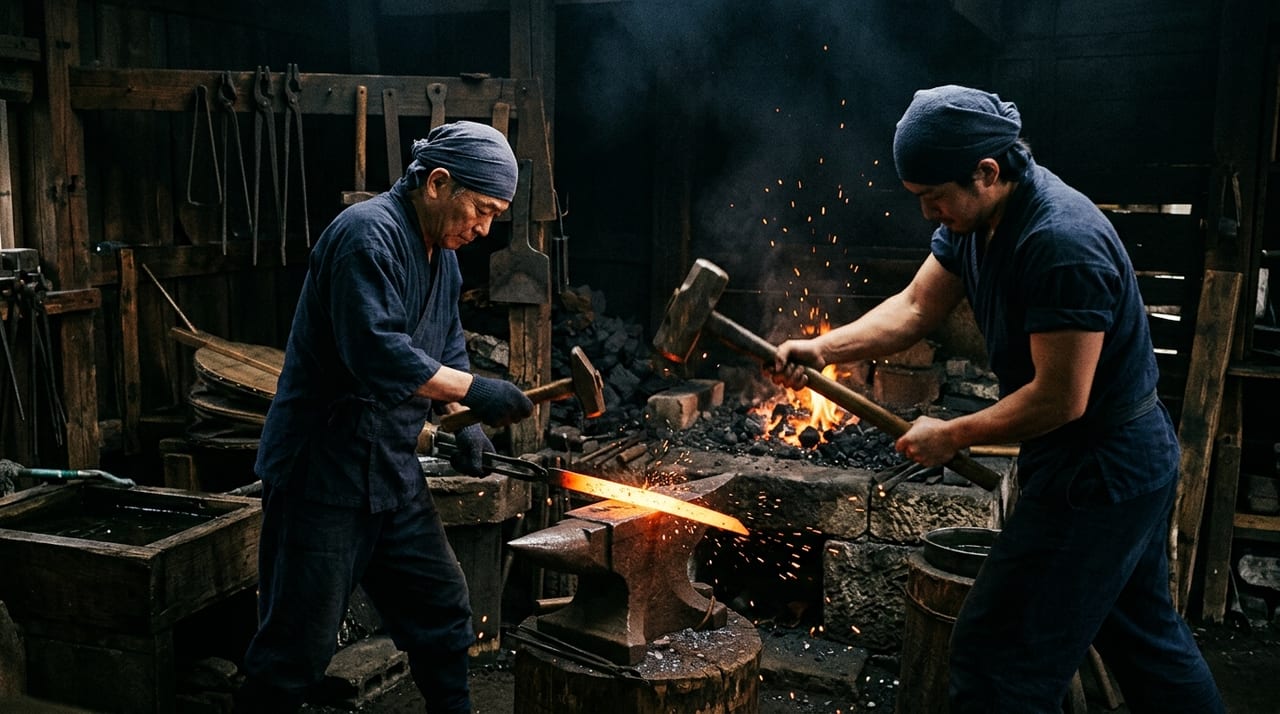
Among the manufacturing processes of Japanese swords, quenching (yakiire) is the shortest and most irreversible moment. For the few seconds that a blade heated red-hot is submerged in water, the bladesmith stands committed with everything at stake. It is far from rare for a sword that consumed days in forging to crack at this moment.
What controls this extreme process is the "quenching clay (yakitsuichi)" applied to the blade before quenching. This clay, mixed in a unique blend of sand, clay, and polishing powder (tokona), is not merely a protective material. By varying the cooling speed at different locations on the blade, creating hamon, and preventing cracks—it is a material that determines the completion of the sword.
Clay Composition and Mixing—Each Bladesmith's Secret Technique
The main materials used in quenching clay are primarily obtained from the natural world.
- Polishing powder (powder from natural whetstones used for grinding)
- Charcoal powder
- Clay
- Sand
These are mixed with water, and the bladesmith repeatedly makes fine adjustments while observing the viscosity, extensibility, and how it peels after drying.
The proportions of the mixture vary by school and bladesmith, and have been handed down as secret techniques not to be shared with outsiders. Even taking just the particle size of the polishing powder, the properties change depending on which mountain's stone is used and what season it is harvested. Clay types also vary by region, and it is difficult for different bladesmiths to recreate exactly the same clay even following the same procedures. Because of this, a practice has long continued whereby a master gives clay to an apprentice striking out independently, and among bladesmiths today there remains a consciousness that "clay is the bloodline of a school."
The prepared clay is stored at appropriate humidity until just before use. If it dries too much, it will not adhere well to the blade; if it contains too much moisture, it will evaporate during quenching and create uneven cooling. Preparing the clay's condition itself is an accumulation of highly refined technique.
Dividing the Cooling Speed of Edge and Spine—Clay Thickness Determines Hardness
In metallurgical terms, the principle of quenching is to rapidly cool steel heated to the austenite state, creating a martensite structure. This martensite is what gives the sharpness to a Japanese sword's edge. However, if the rapid cooling occurs uniformly, the entire steel becomes too hard and brittle, resulting in a sword that breaks easily.
To address this, the bladesmith intentionally creates differences in cooling speed by varying the thickness of clay at different points on the blade.
| Location | Clay Thickness | Cooling Speed | Resulting Structure |
|---|---|---|---|
| Edge side | Thin application | High contact with water, rapid | Hard martensite structure |
| Spine (mune) side | Thick buildup | Slow | Flexible structure without hardening |
This structure—achieving "a hard edge and tough spine" simultaneously within a single piece of steel—is the core that allows Japanese swords to be both resistant to breaking and sharp.
Control of clay thickness is where the bladesmith's skill is directly evident, and subtle differences are intentionally set at each location even though they appear uniform. The clay becomes thinner as it approaches the blade's point, and increases in thickness as it crosses the ridge (shinogi) toward the spine—the gradation and speed of this transition determine the character of the sword after quenching.
Preventing Crocodile-Mouth Cracks—The Battle Against Thermal Stress
One of the most feared failures in quenching is "crocodile-mouth cracking" (waniguchi-ware). Large radial cracks emanating from near the sword's point render the blade irreparable once they form.
The cause lies in the thermal stress created by the sudden temperature differential during quenching. The moment the blade enters water, the surface attempts to contract rapidly, but the interior is still hot and remains in an expanded state. When this difference between contraction and expansion exceeds the material's strength, cracks form. The kissaki is particularly vulnerable because it has a large surface area relative to volume, concentrating stress in a shape prone to cracking.
Clay composition plays a crucial role in preventing this.
- Increasing the amount of polishing powder—the transmission of heat becomes more gradual, moderating the concentration of stress from rapid cooling
- Selecting clay that separates easily after quenching—it prevents excessive restraint on the blade during cooling and reduces stress concentration
How the clay is applied in a particular shape toward the kissaki—this unique methodology becomes one of the key points in each bladesmith's and school's technique. Modifications such as changing the clay's contour only at the point or creating thickness in a specific shape are practical knowledge born from years of experience, passed down as embodied technique difficult to convey in writing.
Groove Construction and Stress Dispersion—Unifying Sculpture and Function
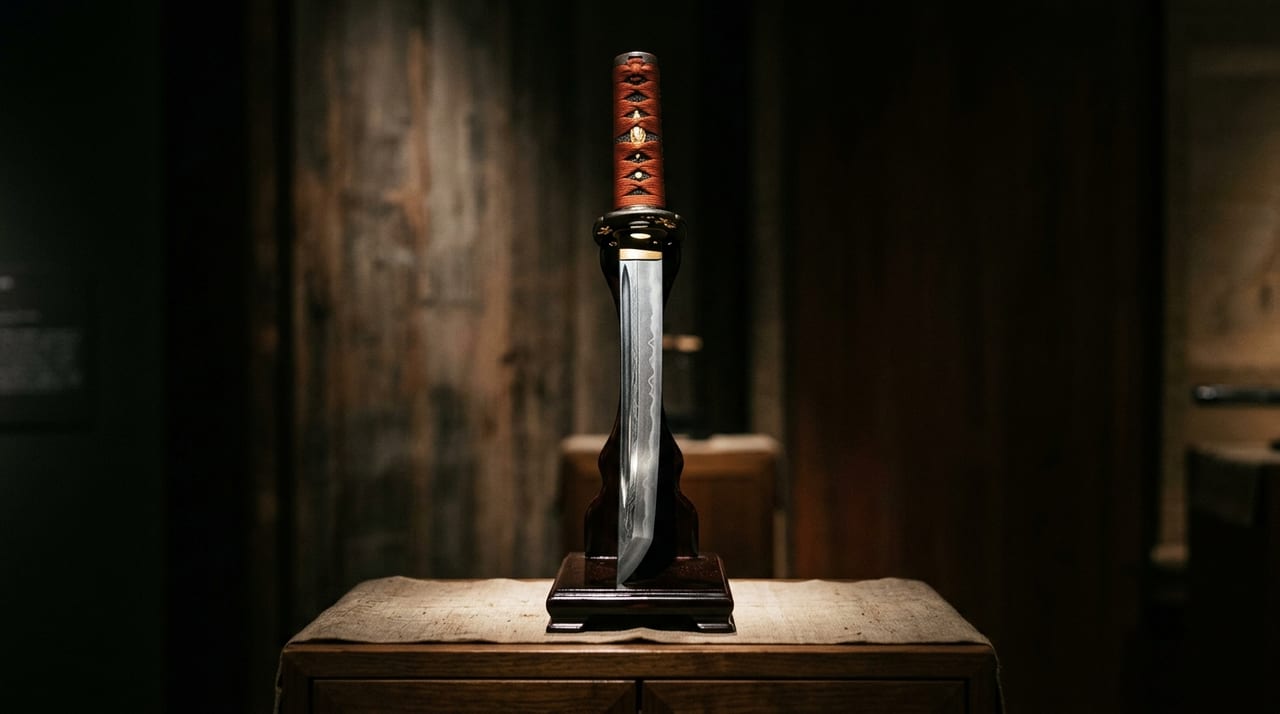
The vertical grooves carved into the blade, known as hi (groove), are often described as "ornamentation for weight reduction." However, from the bladesmith's perspective, the functional significance of stress dispersion during quenching cannot be overlooked.
When a hi is carved, the ratio of cross-sectional area to surface area of the blade changes, altering how heat escapes. An effect emerges that disperses the concentration of stress during quenching away from specific locations, reducing the risk of cracking. The "toshi-hi" (groove running the full length) running lengthwise along the blade is a typical example, said to function by distributing stress uniformly along the blade's length.
Furthermore, the shape of the hi—the curvature of the bottom, its depth, and width—also influences the blade's rigidity.
| Groove Shape | Effect |
|---|---|
| Shallow and wide groove | Disperses stress broadly |
| Deep and narrow groove | Increases bending rigidity in specific directions |
When these functional qualities align with aesthetic beauty, the hi becomes an element that elevates the sword's completeness to another level.
Groove construction is completed before quenching, so the decision of "where to carve and what kind of groove" is considered in conjunction with how the clay is applied. The bladesmith designs the entire process from the forging stage onward with the sword's finished form in mind, and the groove's position and clay contour have a complementary relationship.
The Hamon Drawn by Clay—The Contest is Decided Before Quenching
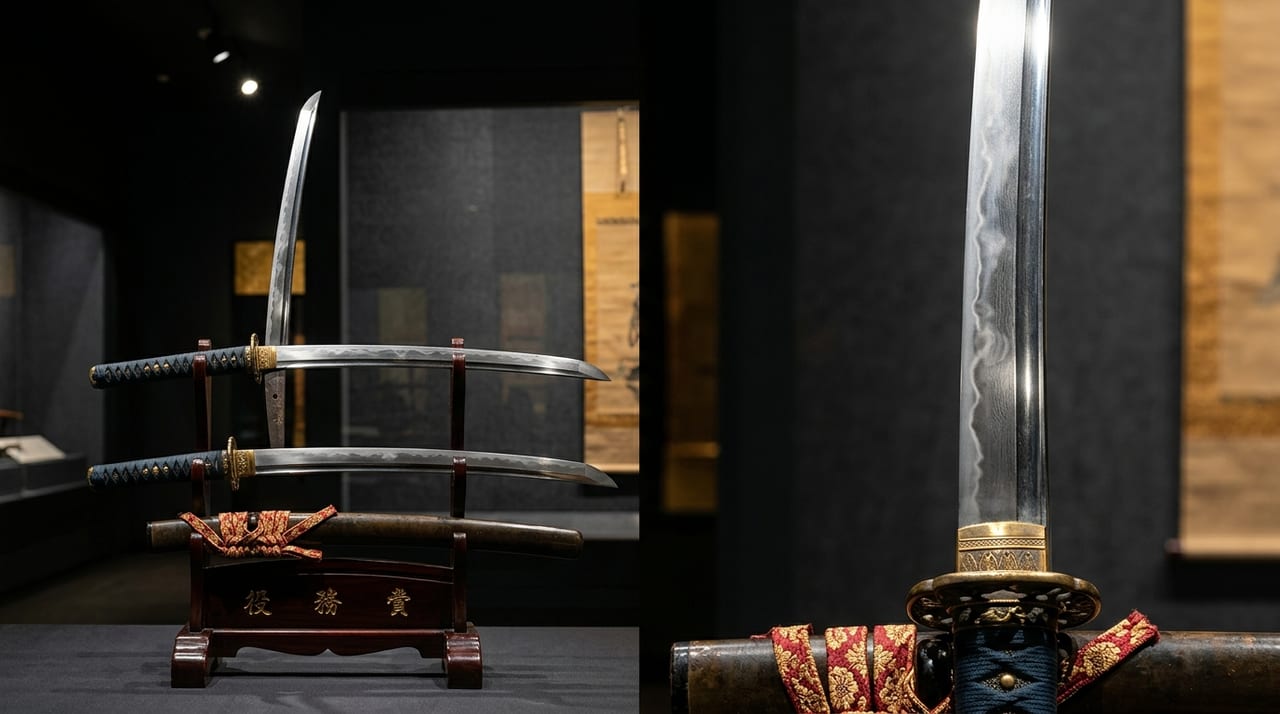
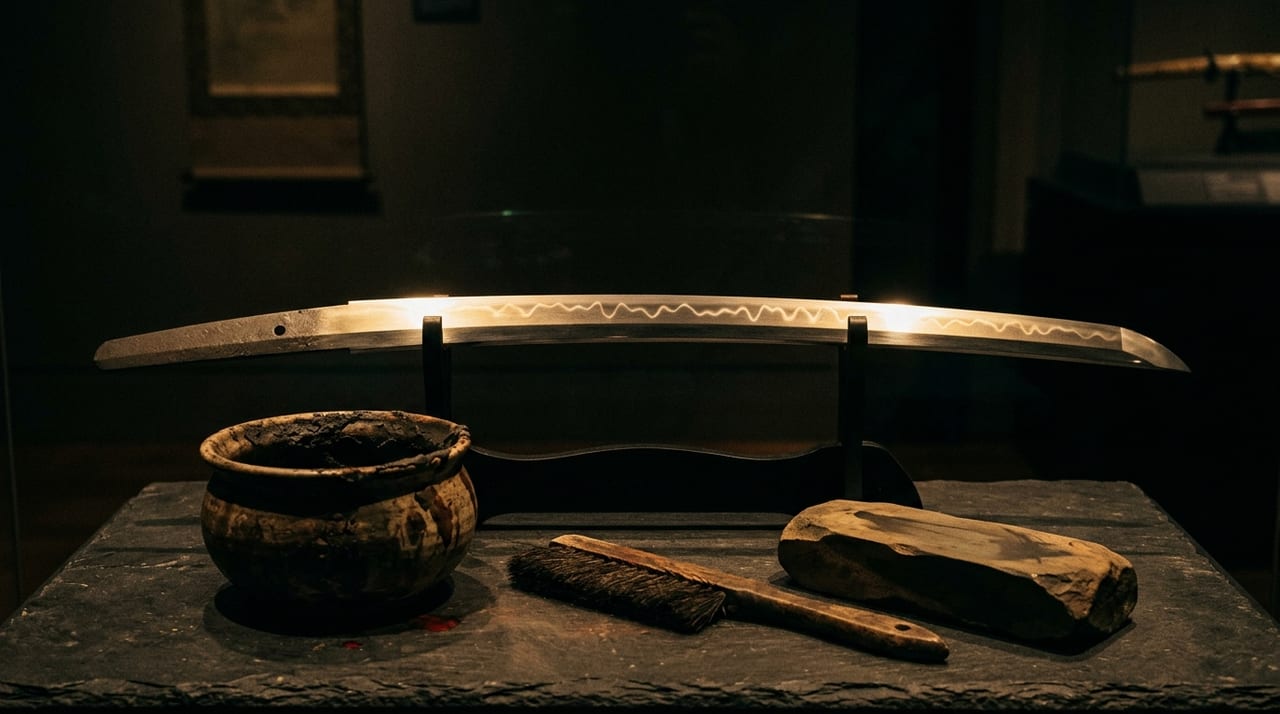
The hamon that first appears only after quenching is complete and the sword has been polished by the polisher's hand is the symbol of beauty in Japanese swords. The diverse forms of hamon are crystallizations of each school's aesthetic consciousness and technique.
- Suguha (straight edge)
- Notare (wave pattern)
- Choji (clove pattern)
- Gunome (wavy pattern)
However, the hamon is largely determined not at the moment of quenching but at the stage of applying clay. How the clay's contour line is drawn—the rises and falls and rhythm of that curve—through the variation in cooling speed, shapes the boundary line of the martensite structure. The "form" of the hamon is, in truth, a mirror image of the clay's own contour.
When applying clay, the bladesmith uses a spatula or fingers to draw the hamon's outline stroke by stroke. This work is entirely hand-drawn, and even when the same bladesmith creates it, no two hamon will be identical. The individuality of the hamon is the individuality of the sword, and a trained eye can read even the bladesmith's own individuality from the brushwork.
The saying "clay determines the sword's lifespan" has long been passed down among bladesmiths approaching quenching. Physical strength, resistance to cracking, and the beauty of the hamon—all of it is already inherent in the clay before quenching. Even if forging is completed perfectly, if the clay is poor, everything becomes futile. Conversely, if the clay is good, the sword's full potential can be realized. The blending of clay in swordmaking is one of the most densely concentrated pieces of work where technique, experience, and sensibility converge.