The Art of the Tsuba: A Small Universe in the Palm of the Hand
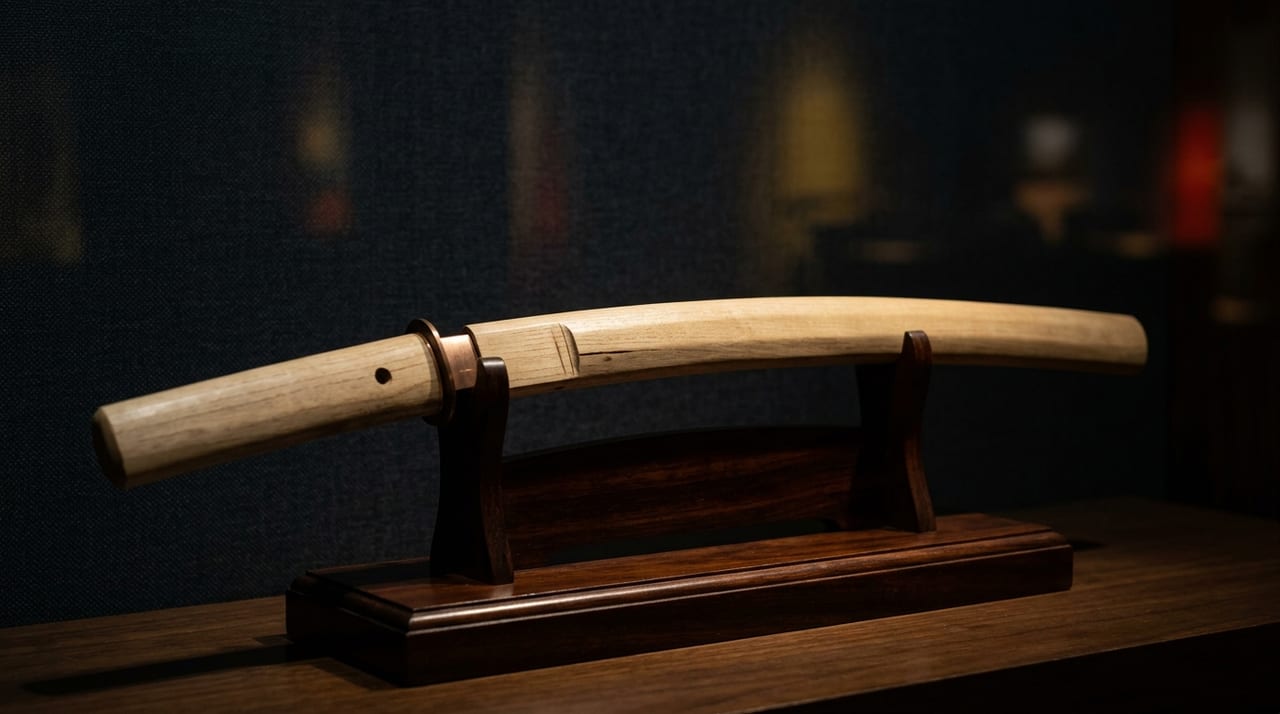 * Image is for illustrative purposes only.
Table of Contents
The Artistic Nature and Historical Significance of the Tsuba
The tsuba (hand guard) is a metal component attached at the tsuba-moto of a sword and has long served an important practical role as the sword's hand guard. However, its role does not stop at the practical. The tsuba is one of the highest pinnacles of Japanese metalwork art, and its history of development can be described as a microcosm of the whole of Japanese art history. On a metal disk of just a few inches, craftsmen expressed landscapes and stories with a degree of completeness rivaling painting. Today, the tsuba is treated as a work of art that receives equal or sometimes even higher appraisal than the blade itself.
The Age of Practicality (Kamakura to Muromachi Period)
Tsuba from the Kamakura through Muromachi periods embodied an aesthetic of practical beauty. The dominant design of this era was a simple style featuring openwork applied to an iron ground. Owari-sukashi tsuba and katchūshi tsuba are the representative styles of this period. These tsuba aimed to achieve both beauty of design and practicality while keeping ornamentation to a minimum. The size and placement of each opening in the openwork was not mere decoration but was based on mechanical calculation to reduce weight while maintaining strength.
The standard of evaluation for tsuba of this era was the harmonious role they played within the overall picture of the sword as a weapon. Refined simplicity was prized over extravagance. However, to execute that seemingly simple openwork to perfection required advanced metalworking technique.
The Age of Decoration (Edo Period)
When the Edo period arrived, the world of the samurai changed dramatically. With the arrival of a peaceful age without war, the sword transformed from its role as a purely martial weapon into a personal ornament expressing status and aesthetic sensibility. The tsuba, too, was elevated into a work of art alongside this shift. Edo-period tsuba came to function not merely as hand guards but as a comprehensive art form combining painting, sculpture, and metalworking technique.
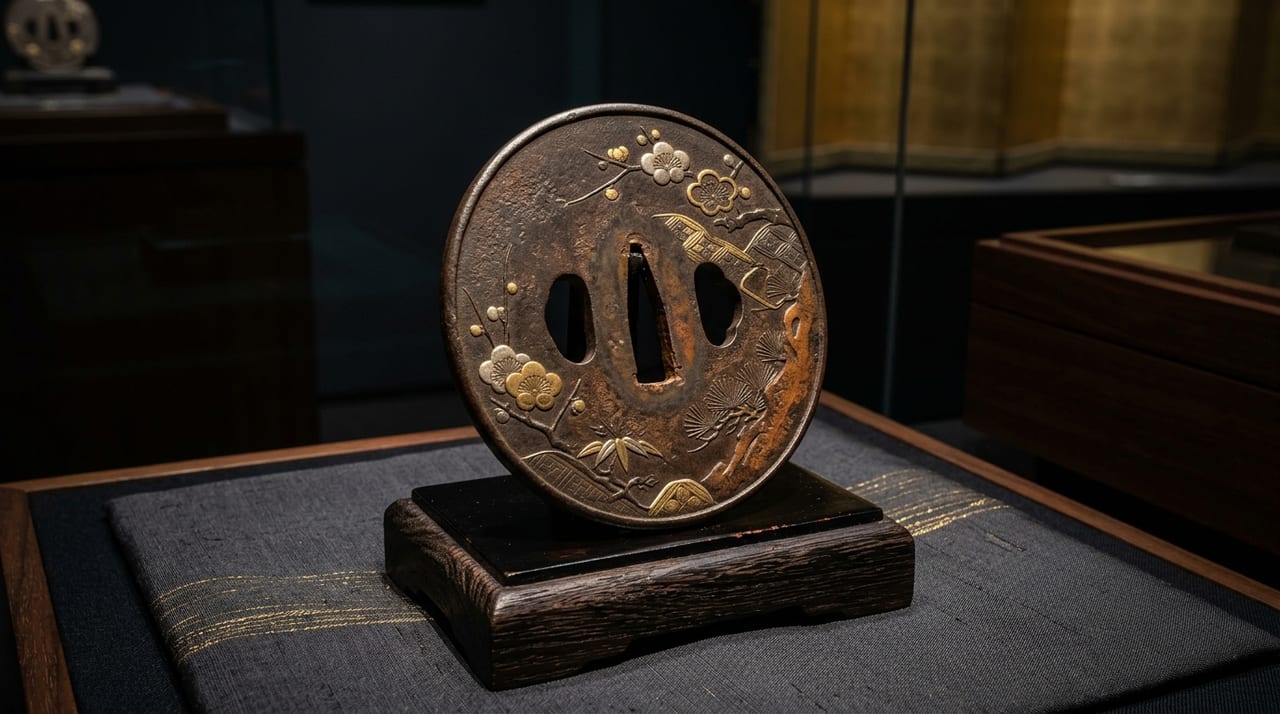
A technique was developed using an alloy of copper and gold called shakudō, to which a black oxidized patina was applied to produce an antique finish, and this became the mainstream of Edo-period tsuba. By applying kin zōgan (gold inlay) over a shakudō ground, it became possible to produce astonishingly complex and rich colors. This technique made it possible to express poetic landscapes and narratives on a piece of metal of the same size.
The Shōami School (shōami-ha) — The Pinnacle of Edo Metalworking
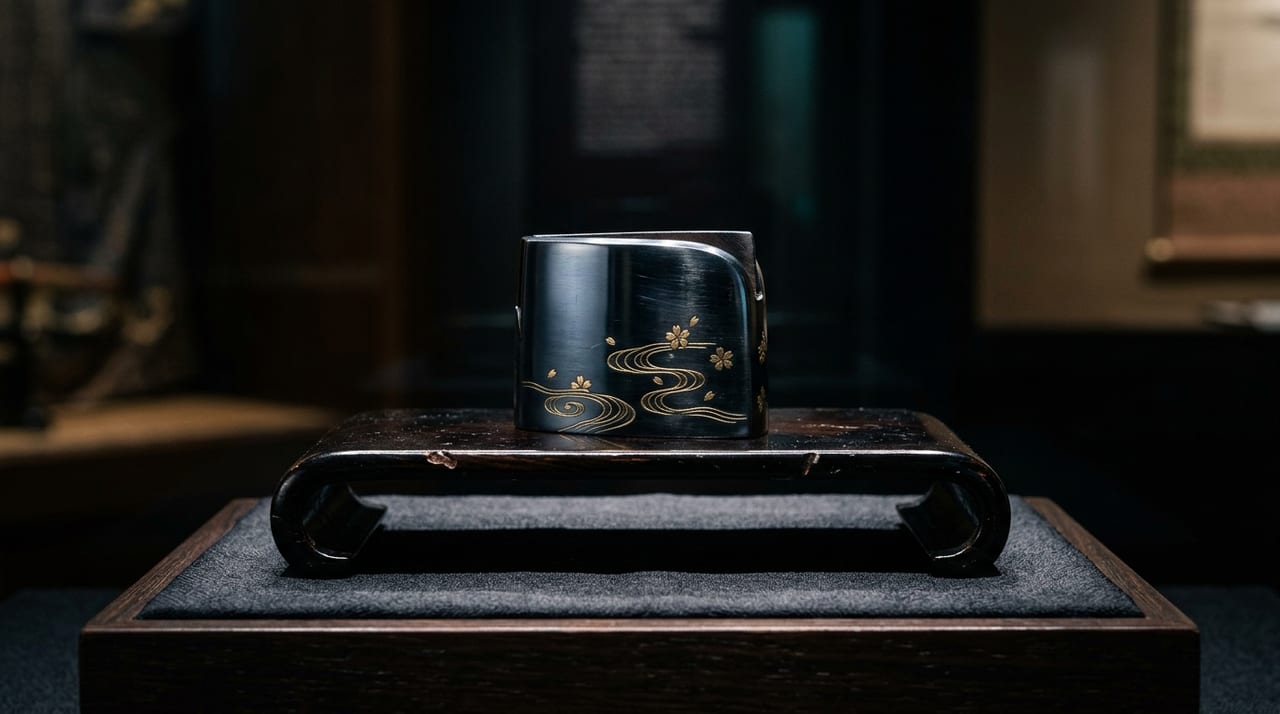
The Shōami school was a leading school of metalworking representative of the Edo period, a celebrated family that perfected the techniques of shakudō and gold inlay. Tsuba of the Shōami school use the deep black of shakudō as their foundation, while natural motifs such as pine, plum, clouds, and waves rendered in gold inlay are expressed with both delicacy and boldness. The work of the Shōami school is of the highest caliber not only in technical perfection but also in the landscapes and narrative quality expressed.
The family, continuing from the first generation down through successive generations, gained the trust of the shogunal house and produced tsuba for many commissioned swords. Within that experience and tradition, the combination of shakudō and gold inlay was fully refined, becoming the standard that later craftsmen aspired to achieve.
The Gotō Family (gotō-ke) — Official Metalworkers to the Shogunal House
The Gotō family served the shogunal house as official metalworkers for a long period from the Muromachi through Edo periods and was a celebrated family. The characteristic techniques of the Gotō family are a technique called shakudō nanako-ji, in which a fine granular pattern called nanako is applied across the entire shakudō ground, and the precise carving of taka-bori kin (high-relief gold carving) applied over it. This technique known as Gotō-bori is an advanced skill that cannot be acquired overnight.
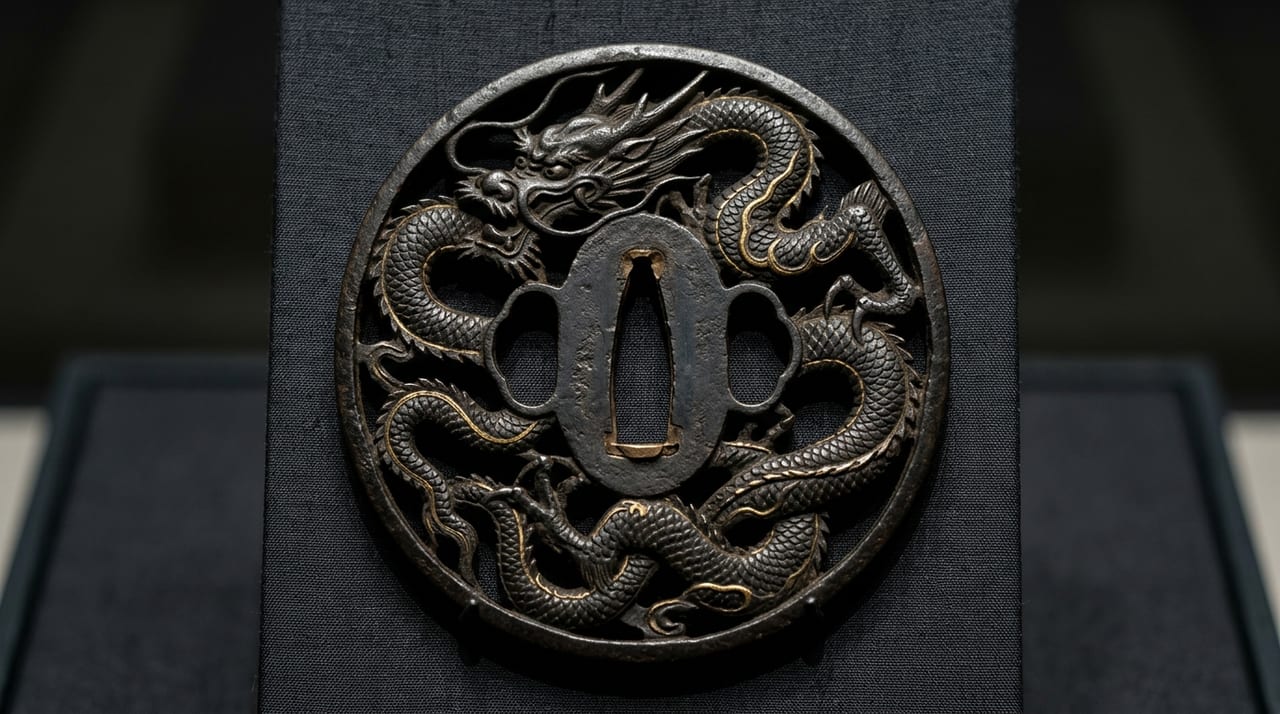
On Gotō family tsuba, plant motifs such as pine, plum, chrysanthemum, and tree peony, and animal motifs such as dragon and lion, are carved in three dimensions. Further fine openwork is sometimes applied over this three-dimensional carving, producing a complex interplay of shadow and light when light strikes it. The works of the Gotō family remain, as representative masterpieces of the Edo period, the mainstay exhibits of museums even today.
Yokoya Sōmin (yokoya sōmin) — The Revolutionary of Machi-bori
Yokoya Sōmin (born Kanbun 10 [1670] – died Kyōhō 18 [1733]) is known as the founder of machi-bori (town carving) and is the figure who brought revolution to the world of metalworking. Machi-bori refers to carving by town craftsmen who devoted themselves to the production of tōsōgu (sword fittings); it signifies the advent of an era in which distinctive and innovative works were produced one after another by town craftsmen, moving away from the previous world centered on official metalworkers serving the warrior class.
Sōmin's hallmark is a painting-like technique called katakiri-bori. In this technique, the ground of the tsuba is carved away to express the background, while the raised portions render birds, flowers, landscapes, and the natural world in three dimensions. A three-dimensional and deeply layered expression was achieved in which parts not fully visible from the front reveal further aspects when the viewing angle is changed. Sōmin's works elevated metalwork art beyond the realm of mere decorative objects and into the realm of independent works of fine art.
The Appeal of Tsuba Collecting and How to Begin
The tsuba is also ideal as an entry point into sword collecting.
- Compared to the sword itself, tsuba can be purchased at relatively accessible prices; with a quality Hozon-grade tsuba, it is possible to encounter excellent works in the range of several hundred thousand to several million yen
- Since tsuba can be collected in a small space, no large display area is required
- By collecting works on the same theme (for example, "tsuba featuring pine motifs"), one can learn how metalworkers of different eras interpreted the same motif
The appeal of the tsuba lies in finding a large world within its small size. On a metal disk of just a few inches, craftsmen condensed a lifetime's artistic expression. When you hold a fine tsuba in your hand, you can make direct contact with the skill and aesthetic sensibility of the craftsman who created it.