Tsukashi and Menukishi — The Craft of the Artisans Who Create a Small Universe in the Palm
 * Image is for illustrative purposes only.
Table of Contents
The Structure of the Tsuka and the Craftsmen Who Support It
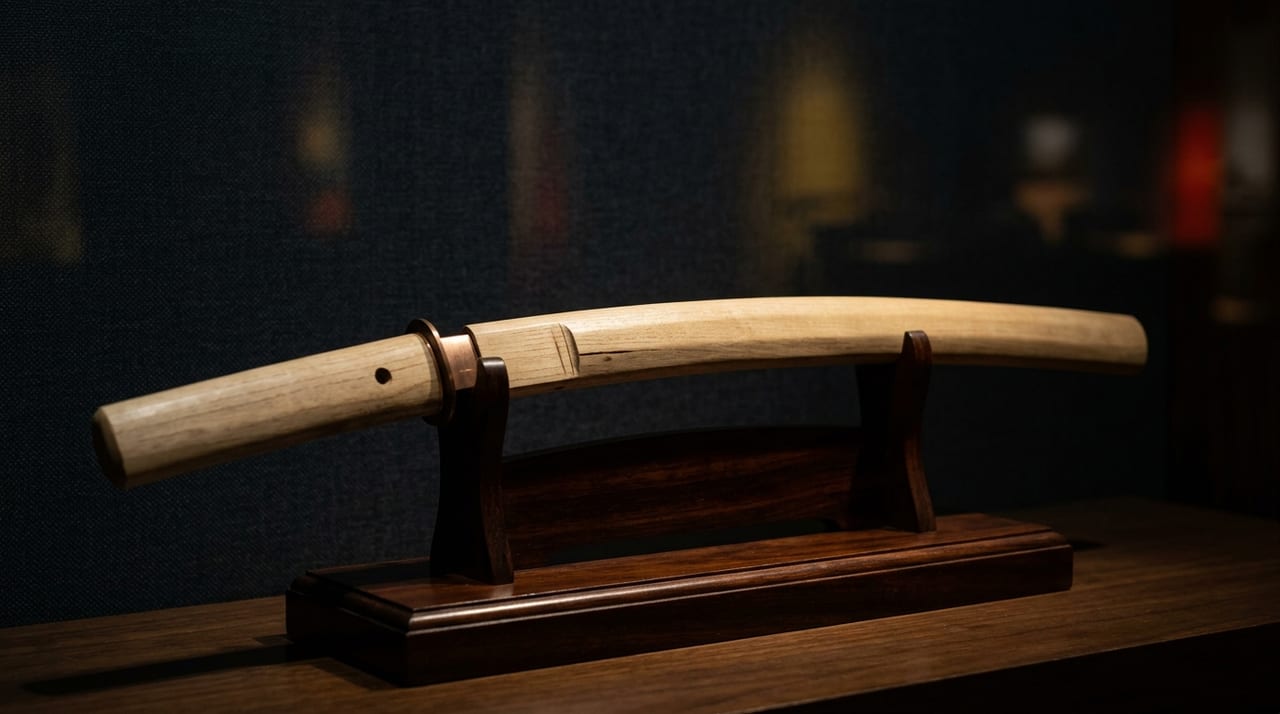
The tsuka (hilt) of a Japanese sword appears to be a simple grip at first glance, but in reality it is a precision craft object in which multiple materials and the skills of multiple craftsmen are intricately interwoven. Simply listing the component parts conveys the complexity involved.
- Tsukagi (hilt core): The wooden core into which the nakago (tang) of the sword is inserted
- Same-gawa (ray skin): A material made from dried ray skin that covers the tsukagi. Its distinctive granular surface serves as a non-slip grip
- Menuki: Decorative metal fittings attached to both sides of the tsuka. They conceal the mekugi hole while improving the ease of gripping
- Fuchi and kashira: A pair of metal fittings that ornament the tsuba-side end and the tip of the tsuka
- Tsuka-ito (hilt wrapping cord): Silk or cotton thread wound over the same-gawa while passing around the menuki
Specialist craftsmen exist for each of these components, and a single tsuka is completed as the sum of the work of multiple masters. This is why it is called "a small universe that fits in the palm of the hand."
Tsukashi — Specialists in the Wood Core and Same-gawa
The tsukashi is the craftsman who shapes the tsukagi and applies the same-gawa, laying the foundation of koshirae production.
In selecting and shaping the tsukagi, hō wood is most widely used. This is because it is lightweight, easy to work, and possesses appropriate hardness and toughness to protect the sword's nakago over a long period. The tsukashi first makes a mold of the sword's nakago, then carefully pares down the wood to create a cavity into which the nakago fits without play. This process is also known as "hiyose," and involves lightly charring the wood while drying and shrinking it, increasing the closeness of fit with the nakago. If the nakago is too loose, danger arises when drawing the sword; if it is too tight, the nakago is damaged. This delicate balance is the mark of a master.
In selecting and attaching the same-gawa, the quality of the material greatly determines the final result. Although written with characters meaning "shark skin," the material is actually dried and processed skin from the red stingray. Ray skin is densely packed with small bone fragments (protrusions of calcium silicate), producing its distinctive granular texture. High-quality same-gawa has uniform particle size and density, with a characteristic large grain called "oya-tsubu (parent grain)" located at its center. The tsukashi cuts the material so that this oya-tsubu falls at the center of the tsuka, then applies it with a lacquer-based adhesive under uniform pressure. If the bond after drying is not uniform, the work must be redone.
Menukishi — Engraving a Universe in the Area of a Fingertip
The work of the menukishi is a field that boasts particularly exceptional precision among Japanese metalwork techniques. The actual dimensions of menuki are generally only 3 to 5 cm, yet the density and three-dimensionality of the chasing applied to that area astonishes even experienced connoisseurs.
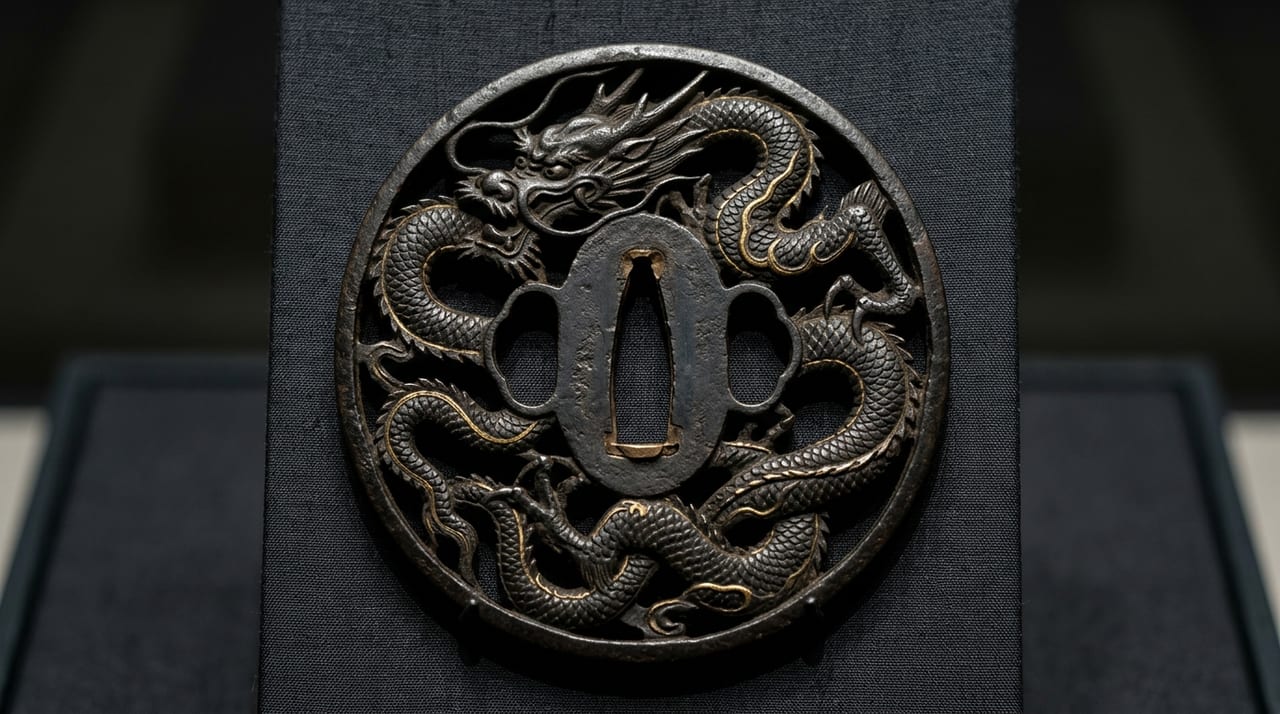
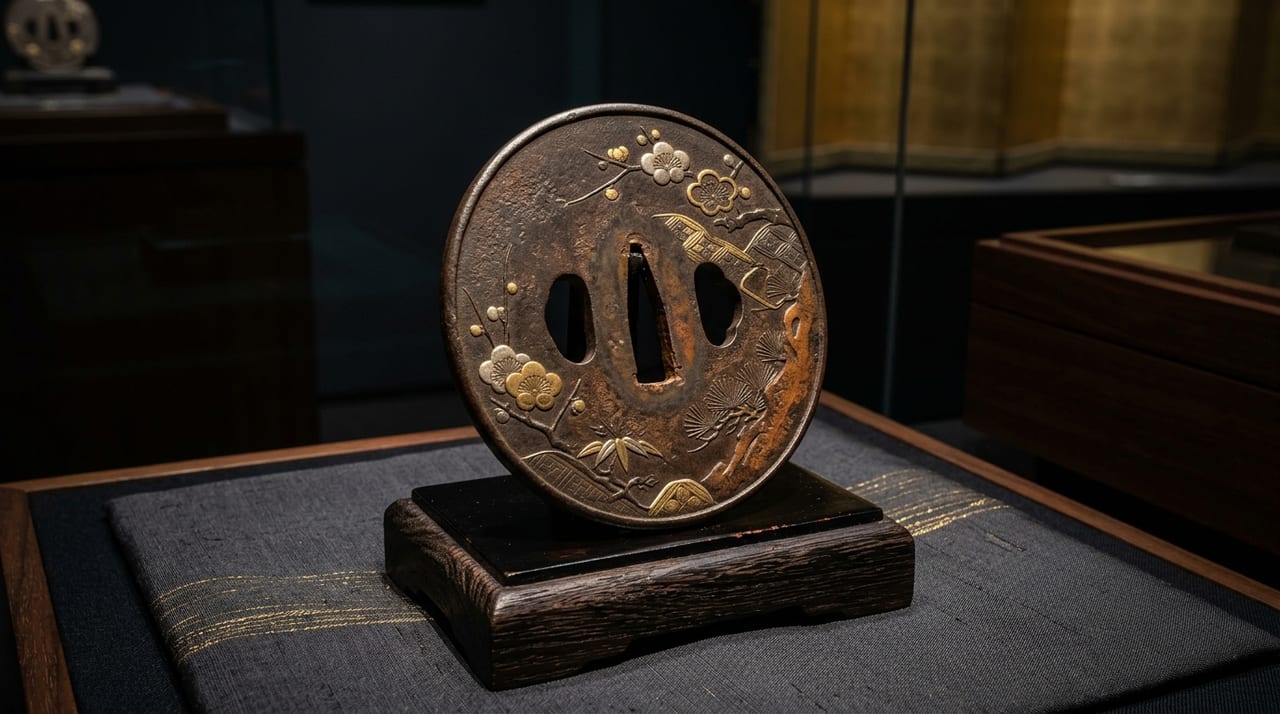
Menuki motifs are varied according to period and purpose. For practical swords of the warrior class, subjects conveying martial authority — dragons, tigers, hawks, and lions — were chosen, while for decorative tachi of the court nobility and daimyo, elegant motifs such as pine, bamboo, and plum; waves; clouds; flowers and plants; and nō masks were preferred. Pieces were also frequently commissioned with the owner's family crest or guardian deity and zodiac sign, and menuki were thus more than mere decoration — they were symbols representing the owner's identity.
The diversity of materials and techniques also gives depth to the menukishi's world. Materials used include gold, silver, shakudō, shibuichi, and brass, with shakudō being a distinctly Japanese alloy that acquires a deep blackish-purple color through sulfidation treatment. The basic production process involves creating a prototype by lost-wax casting, then finishing the details with chasing. Advanced works are given three-dimensional carved expression called "takabori," in which every scale of a dragon and every flow of a tiger's fur is reproduced in minute detail. By combining the inlay technique known as "zōgan (inlay)," embedding gold, silver, and shakudō as "iroe (color pictures)," multiple colors and textures coexist within an area no larger than a fingertip.
During the Edo period, menukishi held high social standing together with tsuba-shi and kozuka-shi as sword-mounting metalworkers. Notable schools include the Gotō school, the Hirata school, the Nara school, and the Yokoya school, each having handed down its own distinctive aesthetic and techniques. The Gotō family was known as purveyors to the Tokugawa shogunal house, and generation after generation was granted such Buddhist-derived court ranks as "hōgen" and "hōin," such was the distinction they commanded.
Tsukamakishi — The Geometric Beauty Born from the Tension and Relaxation of Thread
Tsukamaki is the process of winding the tsuka-ito over the same-gawa while positioning the menuki at the appropriate locations. It is an important final step that determines the overall impression of the koshirae, and while cases of saya-shi taking on this work in addition to their own have increased in modern times, dedicated tsukamakishi still exist in various parts of the country.
The finest grade of tsuka-ito material is shōken (pure silk). The luster and texture of natural silk, along with its appropriate elasticity, conforms to the hand of the user. Cotton and synthetic threads are also used, selected according to purpose and budget. Colors are diverse — black, navy, brown, white, vermilion, asagi (pale blue-green), and others — chosen to suit the overall color scheme of the koshirae and historical period accuracy.
Types of winding can be broadly classified as follows.
- Moroyori-maki: The most standard technique, in which two threads are twisted together to create a diamond pattern
- Jabara-maki: An advanced technique in which a folded, accordion-like pattern emerges
- Hira-maki: Flat ribbon-like thread is laid side by side without gaps. Maintaining uniformity is difficult and requires skill
- Tsumami-maki: A decorative technique in which the thread is pinched as it is wound. Seen frequently on koshirae of the court nobility tradition
The quality evaluation criteria for tsukamaki are summed up in three points: "uniformity of thread tension," "placement of the menuki," and "consistency of the diamond shapes." If the force applied is not consistent, the diamond shapes become distorted; if the thread pull is slack, there is also the risk of the wrapping unraveling during use. Even a skilled craftsman requires several hours to complete the wrapping of a single sword — it is painstaking work.
Fuchigashirashi — The Metalworker Who Creates Paired Beauty
Fuchi and kashira are a pair of metal fittings attached to both ends of the tsuka, and the craftsman who specializes in making them is the fuchigashirashi. Like the menukishi, they belong to the category of sword-mounting metalworkers, and during the Edo period it was common for the same workshop to produce menuki, fuchi-kashira, kozuka, and kōgai together.
The greatest challenge in fuchi-kashira production is "unified beauty as a pair." The two fittings are produced independently, yet the continuity of the motif, unity of material, density of carving, and quality of surface finish must be perfectly matched. Harmony in design with the menuki from the same commission is also required. In a dragon-themed combination, for instance, the work might be designed as "a single divided story," with the dragon's body on the fuchi, the dragon's head on the kashira, and the dragon's claws on the menuki. Such coherence of design cannot be realized without close cooperation between craftsmen.
Conclusion — The Tsuka as a Collaborative Art by Multiple Craftsmen
Until a single sword tsuka is completed, the skills of craftsmen with different specializations — tsukashi, menukishi, fuchigashirashi, and tsukamakishi — are layered together. Each possesses an independent world, yet only when they are ultimately integrated as a single koshirae is a "beautiful sword" born.
In the modern era, the absolute number of these craftsmen has decreased markedly compared to the Edo period, and the transmission of techniques has become a serious challenge. However, the demand from Japanese sword enthusiasts both at home and abroad, together with the intangible cultural asset designation systems of the Agency for Cultural Affairs and of individual prefectures, supports that transmission, and the transfer of techniques to younger generations is proceeding little by little.
"A small universe that fits in the palm of the hand" — knowing that so much wisdom, pride, and aesthetic sense from so many craftsmen is condensed within a single structure called the tsuka will surely change the very feeling of holding a sword. When admiring a sword in koshirae, please direct your eyes not only to the tsuba and the hamon, but also to these layers of craftsmanship applied to the tsuka.