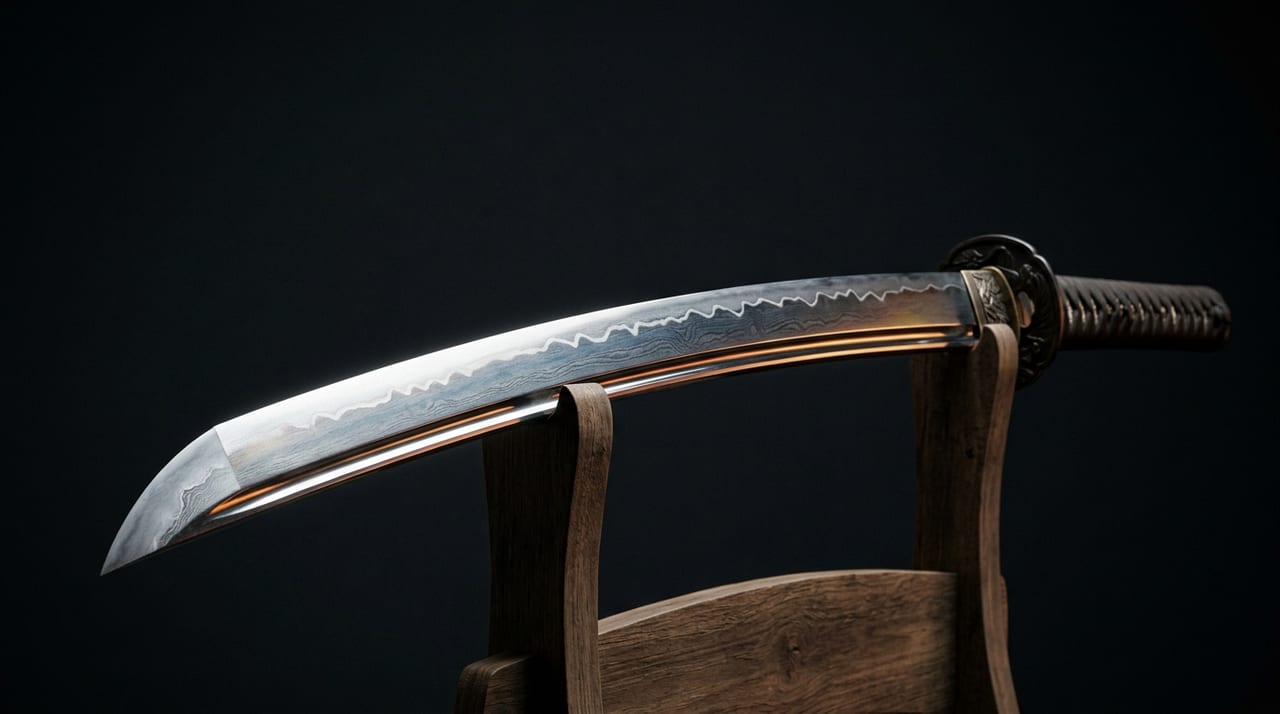
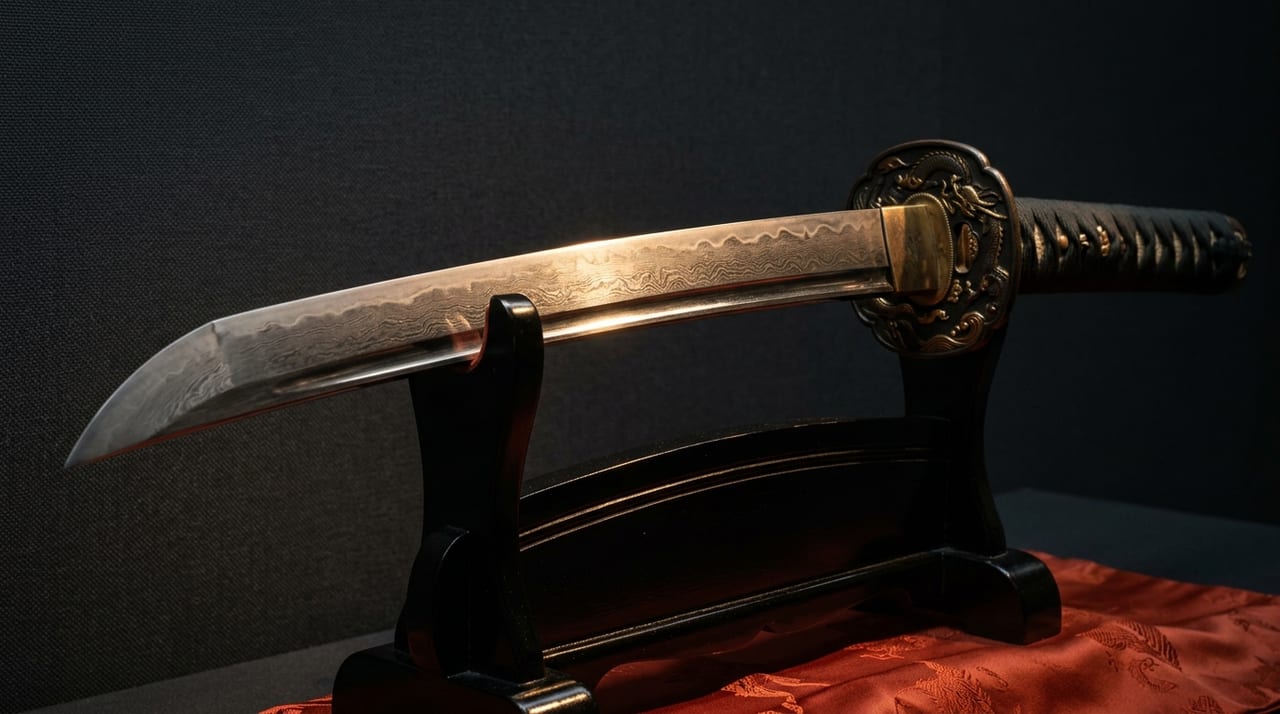
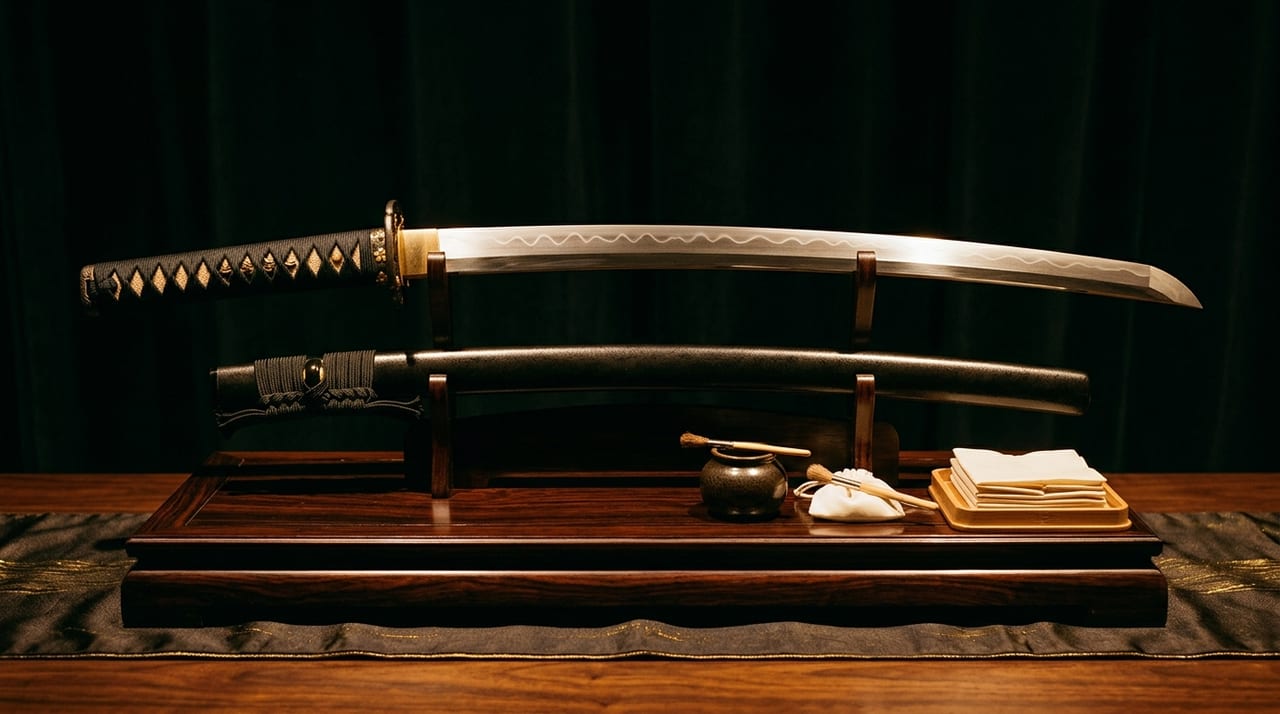
From tamahagane to nihontō: the complete process of orikaeshi tanren and its scientific significance
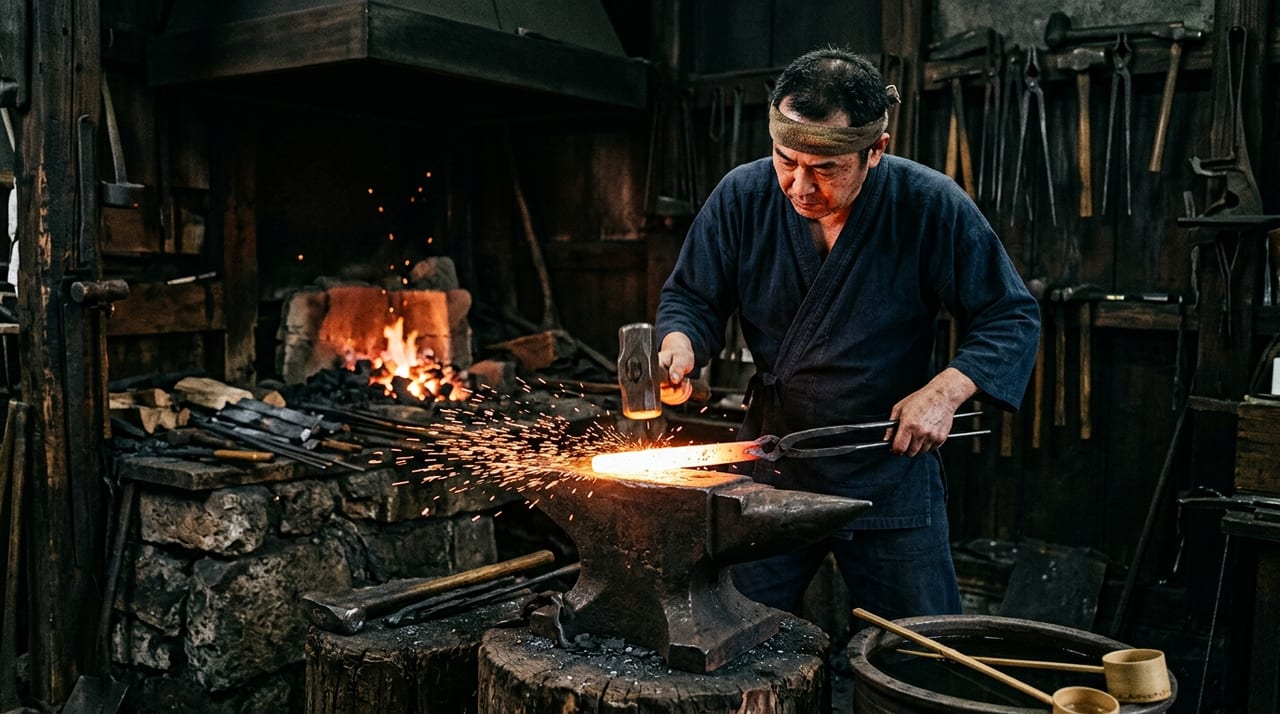 * Image is for illustrative purposes only.
Table of Contents
What is orikaeshi tanren? — where tradition and science intersect
Orikaeshi tanren is the core process in the forging technique of the nihontō. Steel is heated and hammered, then folded and hammered again — this repetition removes impurities and produces high-quality steel with a uniform crystalline structure.
At first glance it appears to be a simple repetitive task, yet analysis from the perspective of modern metallurgy confirms that it is an extremely rational technique. In an era without thermometers or analytical instruments, tōkō judged the condition of the steel solely from the color of the fire, sound, and feel, and achieved optimal forging. The accumulated experience and intuition represent the crystallization of a craft that modern science has only now caught up with and can explain.
Raw material — the selection and significance of tamahagane
The starting point for the nihontō is tamahagane. At the Nittoho tatara in the Okuizumo area of Shimane Prefecture, tamahagane continues to be produced to this day using the traditional tatara smelting method — reduction smelting using iron sand and charcoal. The smelting process itself is covered in detail in Tamahagane and tatara ironmaking.
Tamahagane obtained through tatara smelting is a non-uniform material whose carbon content varies widely by location, approximately 0.5 to 1.5%. The tōkō first breaks it apart in a process called kawawari, then assesses and sorts it by gauging the carbon content from the color, luster, and granular condition of the cross-section. This discerning eye for selection is said to be the first requirement of a fine sword.
Kawagane (jacket steel) is a hard, high-carbon steel used for the outer layer of the blade — the edge and surface. It is the part responsible for wear resistance and sharpness. Shingane (core steel), on the other hand, is a tough, low-carbon steel used for the core (interior) of the blade. By combining the hardness of the edge with the toughness of the core, the seemingly contradictory properties of "sharp yet unbreakable" are realized in a single blade.
From sunobe to orikaeshi tanren — impurity removal and grain refinement
The work of heating the selected lump of steel in a furnace to approximately 1,200–1,300°C and hammering it out is called sunobe. At this stage there are three main purposes.
First, slag removal. When the heated steel is struck forcefully, the oxides and non-metallic inclusions (slag) remaining inside melt and fly out. This is why orange sparks scatter with each blow. Second, homogenization of the steel structure — hammering mechanically fractures and rearranges the metallic crystal structure, breaking down coarse grain into finer form. Third, shaping — that is, forming the steel into a plate shape so that it can be easily folded in subsequent processes.
The steel plate after sunobe becomes the material for orikaeshi tanren. This plate is reheated, folded in half, pressed together, and hammered. By repeating this, the number of layers increases exponentially.
- 8 folds = 2⁸ = 256 layers
- 10 folds = 2¹⁰ = 1,024 layers
- 12 folds = 2¹² = 4,096 layers
- 15 folds = 2¹⁵ = 32,768 layers
In a typical nihontō, 10 to 15 folds are performed, which is the origin of expressions such as "over a thousand layers" or "tens of thousands of layers." However, more folds are not necessarily better. Excessive folding causes the carbon to oxidize and decarburize through repeated heating and forging, which in turn degrades the quality of the steel. Experienced tōkō judge the appropriate number of folds through their body — from the color of the fire, the sound of the steel, and the feel of the hammer. How differences in the number of folds affect jigane and hamon is discussed in Fold count in orikaeshi tanren and changes in the steel.
Metallurgical effects of orikaeshi tanren
Examined from the perspective of modern metallurgy, this process has three important effects.
Uniform dispersion of impurities: Repeated hammering finely crushes the phosphorus, sulfur, and non-metallic inclusions in the steel and disperses them uniformly. Local weak points are eliminated, producing homogeneous strength throughout the blade. These dispersed inclusions are also the origin of the hada — itame hada, mokume hada, masame hada, and others — that appear in the jigane.
Homogenization of carbon distribution: The non-uniform carbon distribution inherent in tamahagane is homogenized through repeated diffusion and mixing. Unevenness in hardness after yaki-ire is eliminated, and stable sharpness is realized across the entire cutting edge.
Formation of fine crystalline structure: Repeated working and heat treatment refine the iron crystal grains, markedly improving toughness. In a coarse crystalline structure, cracks propagate rapidly along grain boundaries, but in a fine structure that propagation is suppressed. The nihontō's characteristic of being resistant to breaking depends greatly on this fine structure.
Tsukurikomi — the design philosophy of the blade cross-section structure
The process of combining the kawagane and shingane that have undergone orikaeshi tanren to build up the cross-sectional structure of the blade is called tsukurikomi. Here the essential design philosophy of the nihontō is concentrated.
Kobuse is the most common structure, in which kawagane wraps around shingane. The balance of a hard exterior and a tough interior achieves the combination of sharpness and strength. Honsanmai is an advanced structure that combines three types of steel for the edge, sides, and mune, allowing optimal hardness to be placed at each part — a technique used by master tōkō. Shihozume is a structure in which kawagane wraps all four sides, used mainly for tantō, maximizing rigidity and sharpness.
Japanese tōkō were intuitively practicing, several hundred years ago, the concept known in modern composite materials engineering as "functionally graded materials (FGM)" — a design that combines materials with different properties in layers to draw out optimal performance.
Toward yaki-ire — the final process that fixes the form
After tsukurikomi, the blade is roughly shaped in a process called hizukuri, its outline refined in a filing process called yasuri-shiage, and then preparations begin for yaki-ire (quenching).
In tsuchioki, refractory clay is applied to the blade. By applying it thinly on the edge and thickly on the mune, a difference in cooling rate is created during rapid quenching. The thin edge area is rapidly quenched and transforms into a hard martensitic structure, while the thick mune area cools slowly and remains as tough pearlitic structure. This difference in cooling rate produces the beautiful line called the hamon, while at the same time embodying in a single blade the functional duality of a hard edge and a tough mune.
Yaki-ire (quenching) is the culmination of the tōkō's skill. The moment the temperature of the blade reaches approximately 750–800°C (which the tōkō judges by the color of the fire), it is plunged into a water tank for rapid quenching. A slight deviation in temperature affects the shape of the hamon, and overheating causes cracking while too low a temperature results in insufficient hardening. Years of experience are concentrated in that split-second judgment.
Conclusion — where the craftsman's intuition and science converge
The forging of the nihontō may appear "inefficient" by the standards of modern industrial technology. Yet blades made by traditional hand forging (tekaji) possess inherent characteristics that industrial products cannot easily replicate. Selecting non-uniform tamahagane as the raw material, homogenizing it through orikaeshi tanren, designing the function through tsukurikomi, and fixing the performance through yaki-ire — this series of processes had converged on an optimal solution as the empirical knowledge of tōkō long before modern metallurgy systematized it.
The fine structure of steel folded into countless layers, the temperature read from the color of the fire by a practiced eye, the judgment of the moment of plunging into water — only when all of these accumulate together is the nihontō — at once a work of art and a weapon — born. Even now that science can explain it, its depth does not fade. By comparing photographs of jigane and hamon published in the online catalog, one can confirm for oneself how the traces of this tanren appear.