Water Quenching vs. Oil Quenching: How the Quench Medium Shapes a Nihonto's Hamon
 * Image is for illustrative purposes only.
Table of Contents
Quenching: The Moment the Soul of the Japanese Sword Is Born
"Quenching" (yaki-ire) is the most important and technically demanding step in the entire process of Japanese sword manufacturing. After applying clay (tsuchi-oki), heating in a furnace, and watching for the moment when the optimal temperature is reached, the sword is rapidly cooled in water or oil—that split-second judgment determines everything about the finished blade.
If the quench fails, the sword may crack (yaki-wari), warp (insufficient or excessive curvature), or the hamon may not emerge—any of which means months of forging work come to nothing. In the moment when the sword's light dissolves into the darkness of the furnace, years of training and experience are put to the ultimate test.
Through quenching, the blade acquires two different metallic structures. The edge becomes hard "yaki-ba" (hardened edge) martensitic through rapid cooling, while the spine side becomes "yaki-mune" (hardened spine) that cools more slowly and retains toughness. This exquisite combination of hardness and softness achieves both sharpness and resistance to breaking.
Water Quenching (mizu-yaki)—The Pinnacle Hamon Born from Traditional Rigor
Traditional quenching of Japanese swords is based fundamentally on "water quenching." Most celebrated swords of the ko-to (pre-1596) period were created using water quenching.
Process: The clay-coated blade is heated in a furnace. Temperature is judged by the color of the hamon (its luster and tone), and when optimal temperature (approximately 730–800°C) is reached, the sword is quickly plunged into water. The angle, speed, and depth at which the sword enters the water also influence how the hamon emerges.
Water Temperature's Importance: Water temperature varies by season and time of day, so the swordsmith exercises great care. Summer water is warmer and cools more slowly; winter water is colder and cools faster. Generally, around 20–30°C is considered "ideal," though swordsmiths' opinions differ. If cooling is too fast, yaki-wari (quench cracks) occur; if too slow, sufficient hardness is not achieved. This delicate balance is water quenching's greatest challenge.
The Tradition of "Quenching at Night": Swordsmiths perform quenching at night (in darkness) because they judge temperature from the sword's color. In bright environments, subtle changes in tone are difficult to see. That split second when the color shifts from cherry-blossom pink to pale white—miss it and everything is ruined.
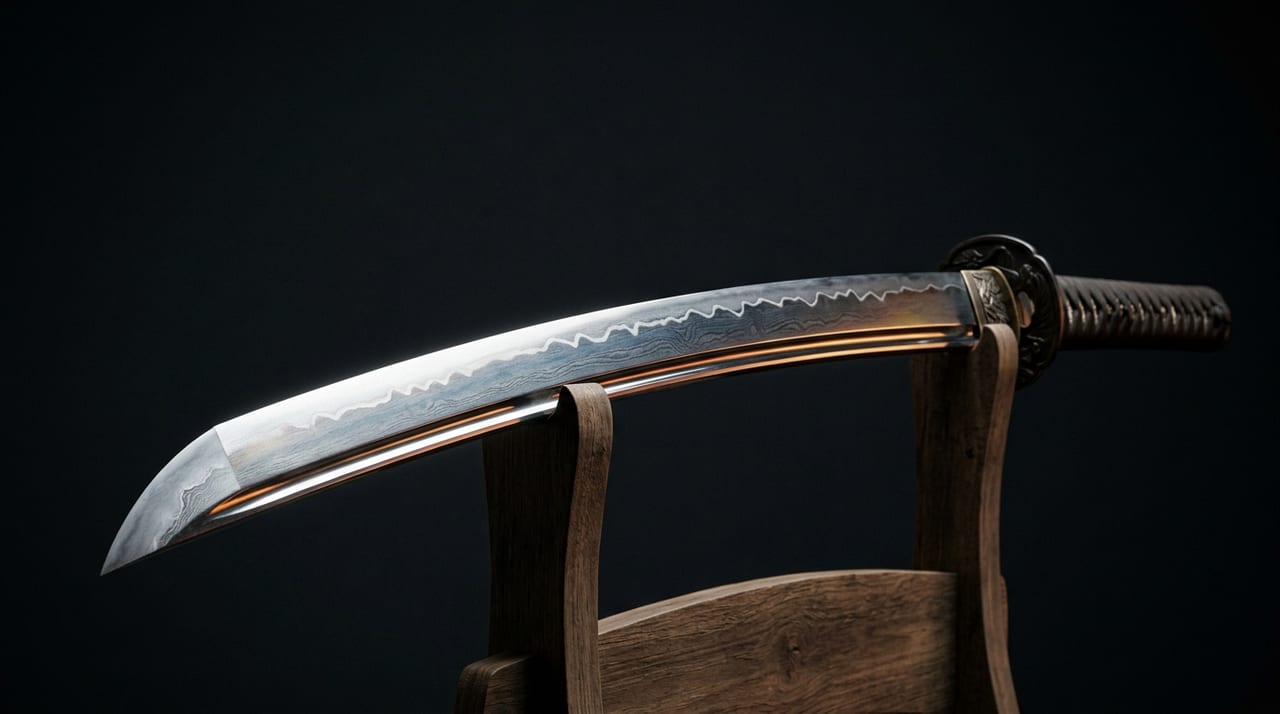
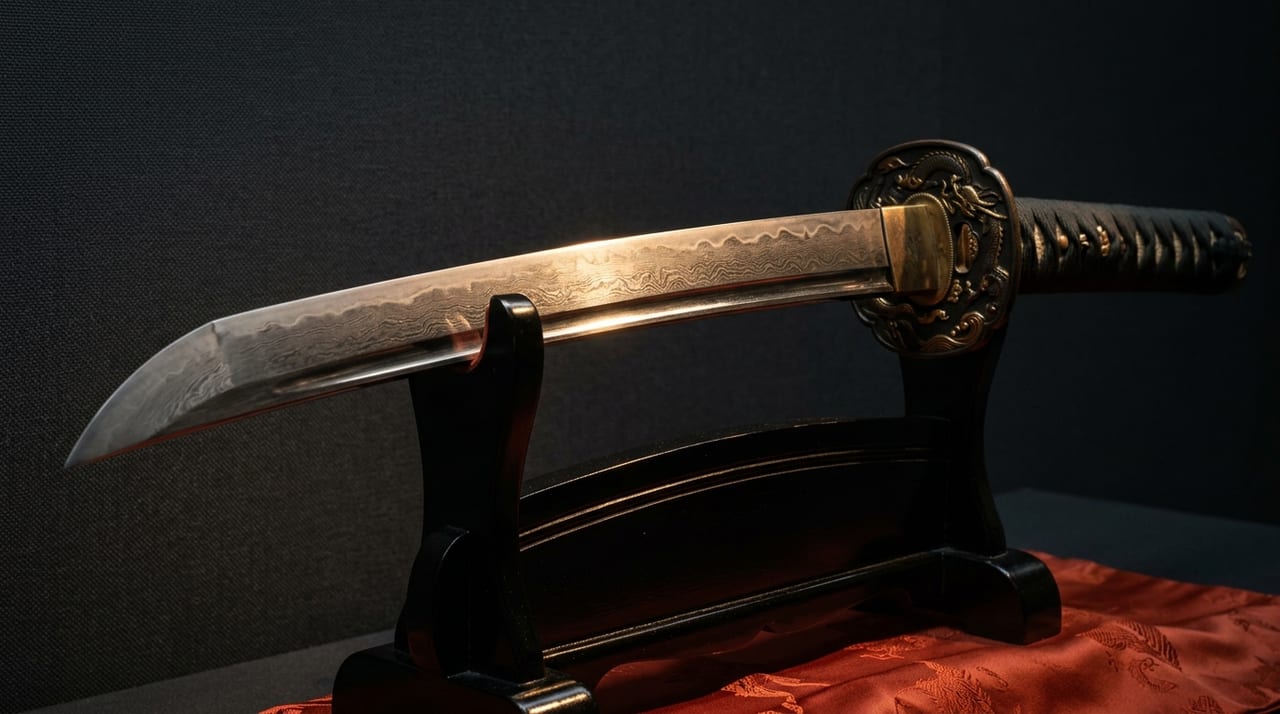
The "Nie" (Particles) Produced by Water Quenching: Water quenching's characteristic is the tendency for large, vigorous nie to appear in the hamon. Nie are white, lustrous granular structures that form near the boundary with the quenching clay; they are thought to result from coarse martensitic grain growth. The "nie-deki" (particle appearance) of the Soshu tradition is precisely a product of water quenching, and the masterworks of Masamune, Sadamune, and Soshu Hiromitsu are all founded on this technique.
Oil Quenching (abura-yaki)—The Technique of Beauty Born from Stability
"Oil quenching" is a quenching method that became widespread from the Edo period (shin-to period, 1596 onward). The blade is rapidly cooled using plant oils (rapeseed oil, camellia oil, etc.) or animal fats instead of water.
Oil Quenching's Physical Properties: Oil has lower specific heat than water and does not evaporate, so cooling is gradual and uniform. Yaki-wari is unlikely to occur, and the hamon appears more stably. Conversely, because the shock of rapid cooling is diminished, large or abundant nie do not form as readily as in water quenching. Instead, "nioi" (scent)—a soft hamon pattern with fine particles gathered in mist-like formation—tends to emerge.
Why Oil Quenching Spread in the Edo Period: During the Edo period, aesthetics were prioritized over battlefield effectiveness in sword manufacturing. Creating beautiful hamon consistently became paramount, and oil quenching—with its lower failure risk—became widespread. Master craftsmen of the shin-to such as Nagasone Kotetsu and those of the shin-shin-to period like Koyama Munetsugu actively adopted oil quenching.
Oil Type and Management: Cooling characteristics vary depending on the oil's type, viscosity, and temperature. Camellia oil, with relatively low viscosity and high fluidity, remains popular even today. The "oil recipe" can be a closely guarded secret of individual swordsmiths, so "oil quenching" varies in character from one craftsman to another.
Comparison of Water Quenching and Oil Quenching
| Item | Water Quenching | Oil Quenching |
|---|---|---|
| Cooling Speed | Fast | Slow |
| Yaki-wari Risk | High | Low |
| Nie Appearance | Large, abundant nie tend to appear | Relatively fine nie (nioi-dominant) |
| Stability | High variation depending on skill | Stable, hamon emerges consistently |
| Hamon Atmosphere | Intensity, vigor | Softness, delicacy |
| Typical Origin/Period | Ko-to (~1596), Soshu, Bizen, etc. | Shin-to, shin-shin-to (Edo period onward) |
There is no answer to which is superior. The vigorous nie produced by water quenching and the delicate nioi produced by oil quenching each possess their own distinctive beauty, drawing the appreciation of connoisseurs.
The Influence of Clay Application (tsuchi-oki)—A Key Factor in Hamon Determination Equal to Quenching Medium
The outcome of quenching is determined not only by the quenching medium but also significantly by the composition of the clay application. Indeed, the clay application itself could be said to be the primary factor determining the "outline" of the hamon.
Clay Composition: The secret formulation of clay (the mixing ratio of clay, stone powder, charcoal powder, and other additives) varies by swordsmith and directly influences the hamon's shape. This "clay composition recipe" is one of the greatest secrets of each smith and school. Even with the same water quenching, the Bizen tradition's choji-midare and the Soshu tradition's ō-gunome appear different largely due to differences in clay application.
Clay Application Technique: By applying the clay thinly on the edge side (allowing deeper penetration of the quench) and thickly on the spine side (shallower penetration), the general direction of the hamon's form is determined. However, the fine details of the shape form naturally through heat flow and convection during quenching and cannot be fully controlled. The hamon's true essence lies in this collaboration between what the swordsmith "draws" and what nature "creates."
Variations in Thickness and Scenery: By intentionally varying the clay's thickness, complex scenery such as ashi (feet), yo (leaves), and sunanagashi (sand wash) emerge. Master craftsmen, fully understanding this, wait for the hamon to manifest in a way that is "intentional yet unintentional"—truly a dialogue with nature.
Modern Technical Support and the Transmission of Tradition
Some contemporary swordsmiths, in addition to the traditional method of "judging by furnace color," use thermocouples (temperature sensors) as supplementary measurement aids. Attempts are also being made to precisely control the type and temperature of oil used in oil quenching.
However, such aids are merely "reference"; final judgment rests on the swordsmith's experience and intuition. At the quenching site, where countless variables—carbon content in tamahagane, number of forging cycles, weather, furnace condition—interact, embodied knowledge speaks louder than data.
The transmission of quenching technique is also a challenge. The accumulation of experience that begins with years of "watching" before the master's furnace is difficult to codify in manuals or video. While some swordsmiths continue to challenge water quenching to recreate ko-to techniques, others increasingly shift to oil quenching to avoid yaki-wari risk. This tension enriches contemporary Japanese sword smithing.
Conclusion—Quenching is "Controlled Chance"
Both water quenching and oil quenching contain elements that can be explained by theory and elements born of chance. The finest hamon is a product of chance woven together by the swordsmith's skill, tamahagane, heat, and water (or oil).
Before the furnace, the swordsmith stakes all of his experience on a split-second decision. In the instant the blade plunges into water, white steam rises from the blade and a hissing sound emerges—what is born in that moment is called "hamon." This "controlled chance" is what makes Japanese sword hamon unique in the world; even if the same smith uses the same technique, the hamon will never be identical twice. The beauty of this once-in-a-lifetime encounter is the basis for elevating the Japanese sword beyond mere weaponry into the realm of art.