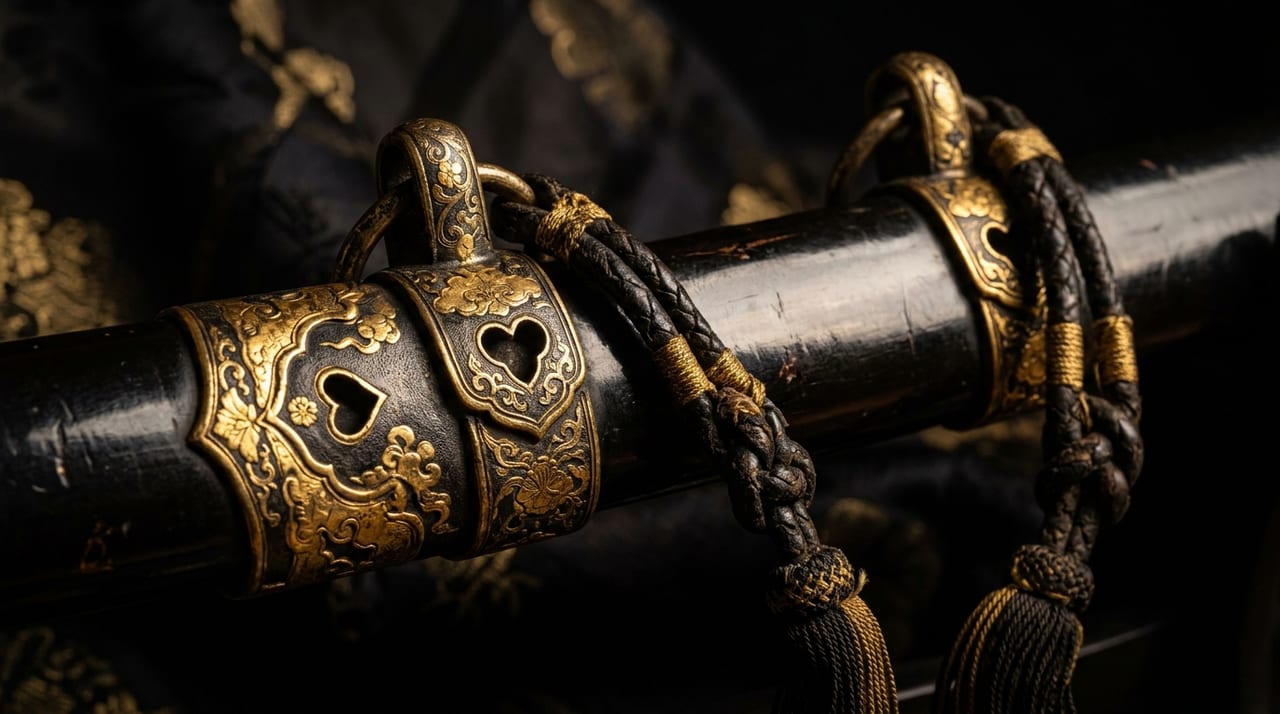
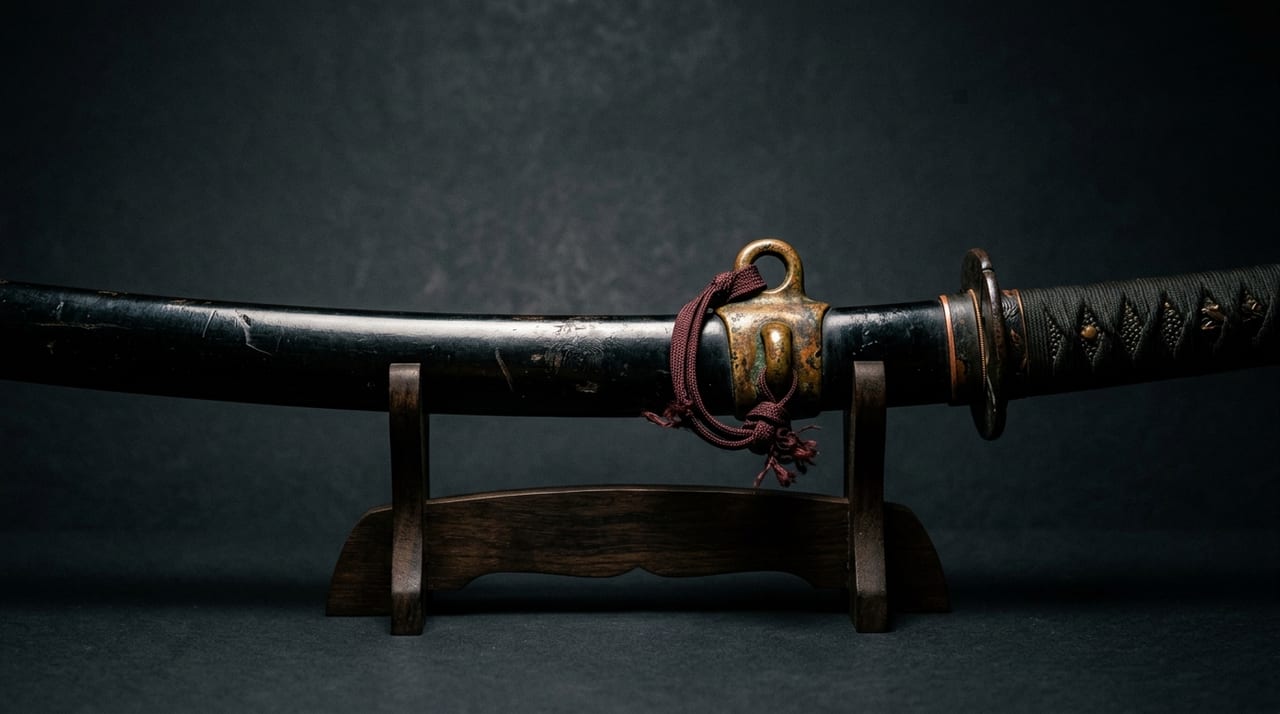
Kaeritsuno — the protrusion on the saya that hooks onto the obi to prevent the saya from slipping out
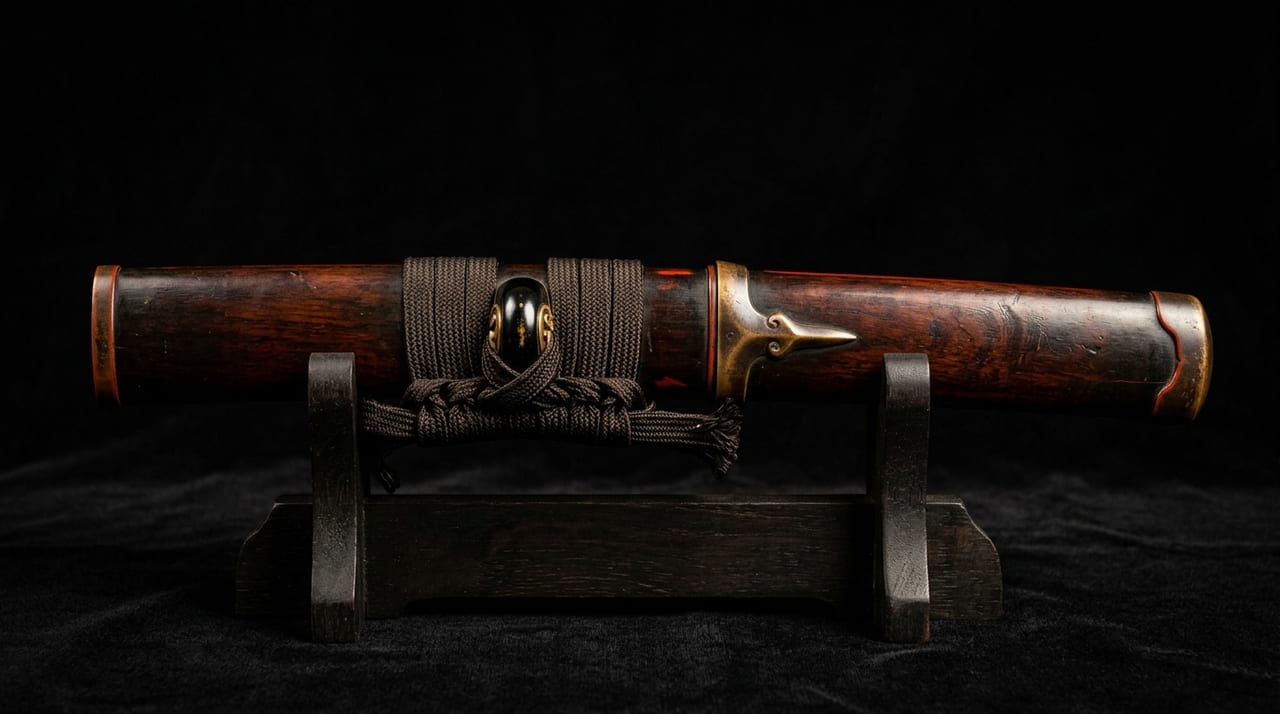 * Image is for illustrative purposes only.
Table of Contents
Looking at an uchigatana's saya from the side, there is sometimes a small protrusion partway along it. This is the kaeritsuno. Unlike the kurigata, it has no hole through which to pass a sageo, and unlike the tsuba, it offers no surface for decorative display. Yet when one considers the act of drawing a sword worn at the obi, the purpose of this small protrusion becomes clear. This article explains the role, shape, materials, and historical changes of the kaeritsuno.
What is the kaeritsuno — a protrusion partway along the saya
The kaeritsuno (also written kaeri-tsuno) is a protrusion located partway along the saya. Its alternative name is sakatsuno. When drawing the sword, it hooks onto the obi to prevent the saya from being pulled forward along with the blade. This explanation follows the Weblio entry for kaeri-tsuno.
The key points are as follows.
- Location: partway along the saya
- Function: to prevent the saya from being drawn forward away from the obi during the draw
- Alternative name: sakatsuno
- Material: in most cases, horn
The uchigatana is worn by thrusting it directly through the obi. To draw the sword, one hand holds the saya while the other pulls the tsuka. If the saya moves along with this action, the blade cannot be drawn cleanly. The kaeritsuno is the fitting that checks this movement of the saya by catching on the obi.
The relationship between the obi and the kaeritsuno
According to the explanation at Asahi Token (the Asahi Token page on kaeritsuno), the obi passes between the tip of the kaeritsuno and the surface of the saya, preventing the saya from sliding forward. The fitting is positioned slightly toward the mune side from the center of the saya's width.
The structure — in which the obi fits between the protrusion and the saya — is easy to picture. The obi wraps around the body over the saya, and the tip of the kaeritsuno tucks under the lower side of that obi. When a drawing force is applied to the saya, the protrusion catches on the obi and stops it.
The same explanation notes that the kurigata is located to the left of the kaeritsuno's attachment point, approximately 9 centimeters away. The kurigata is treated as a protrusion with a hole for passing the sageo in a separate article (Kurigata and Semegane). Both the kurigata and the kaeritsuno are protrusions on the saya, but they serve different functions.
- The kurigata is a fitting for passing the sageo through
- The kaeritsuno is a fitting that hooks onto the obi to prevent the saya from slipping out
Sageo types and usage are covered in Sageo Types and History. Reading that alongside this article gives a clear picture of how the small fittings around the saya divide their roles.
Not present on every koshirae
The Asahi Token article notes that some uchigatana koshirae do not have a kaeritsuno. Even among uchigatana, the presence or absence of a kaeritsuno varies by koshirae.
Materials from the Kyoto National Museum show that the tachi is suspended from the obi by its saya fittings and cords, while the uchigatana is thrust directly through the obi. It is natural to understand the kaeritsuno — which works by hooking onto the obi — as a fitting tied to the way the uchigatana is carried by being thrust directly through the obi. For the structure and history of tachi koshirae, the article on hantachi koshirae is also informative.
Horn and metal — a note on materials
The Weblio glossary of sword terminology describes kaeritsuno as most often made of horn. There is also an explanation that distinguishes metal examples by calling them origane, as opposed to horn kaeritsuno. When seeking to identify the material of a koshirae fitting, one must judge from the accompanying description or photographs.
From functional fitting to decoration
Weblio also states that in the late Edo period, as opportunities to draw the sword decreased, there are many examples of kaeritsuno in which the decorative aspect became predominant. Some Satsuma koshirae feature a distinctive convex form.
During the Edo period, while samurai wore swords as a matter of daily life, actual occasions to draw them grew infrequent. Against this backdrop, one can read the kaeritsuno — originally a functional fitting — as having come to be made with greater emphasis on visual design. Sword-drawing etiquette is also touched upon in the article Edo Samurai Sword Etiquette.
A tip for viewing koshirae
When viewing a sword with its koshirae, one's eye tends to be drawn to the tsuba, fuchi-kashira, and menuki. Turning one's attention to the side of the saya as well makes it possible to understand the positional relationship between the kurigata and the kaeritsuno.
- Check the position of the kurigata and whether there is a protrusion nearby
- Observe which direction the tip of the protrusion faces
- Confirm from photographs or descriptions whether the material is horn or metal
For swords with koshirae listed in the TOUKENZA online catalogue, the condition of the saya can be confirmed from photographs and descriptions. If there is anything of interest, please feel free to get in touch via the contact form.
It is a small fitting, but the trace of ingenuity born from the relationship between the obi and the saya remains there.