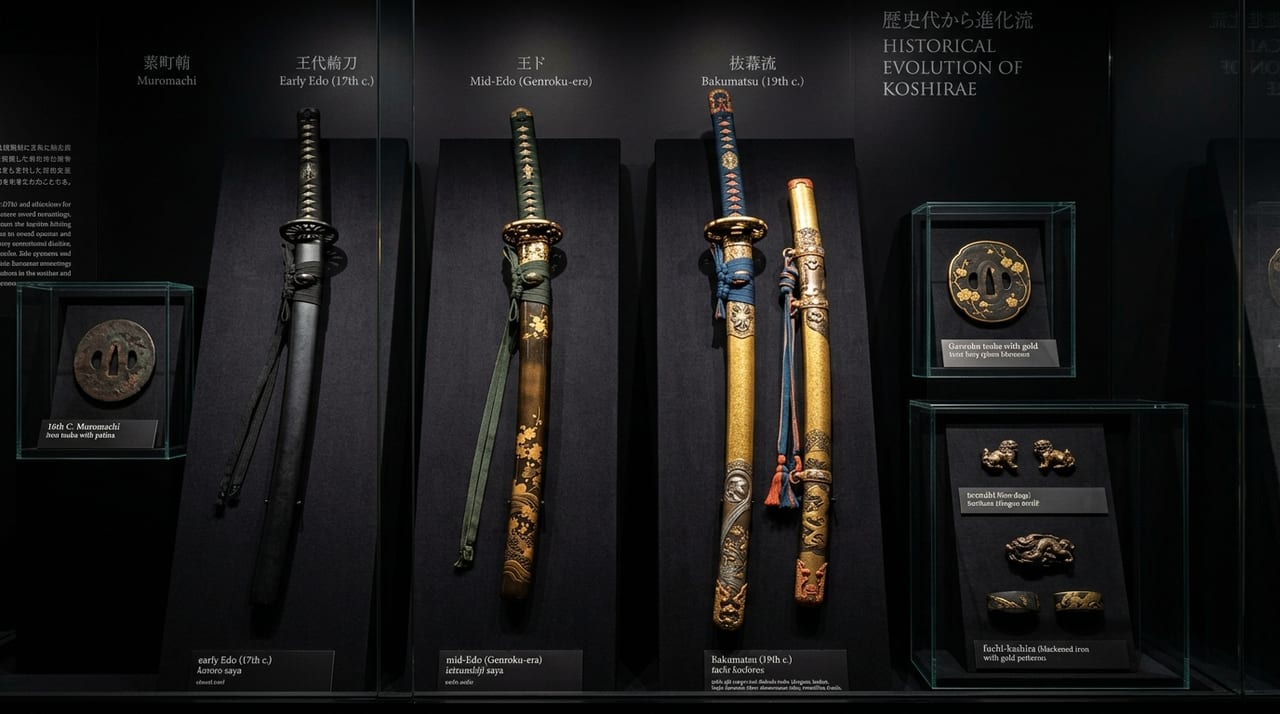
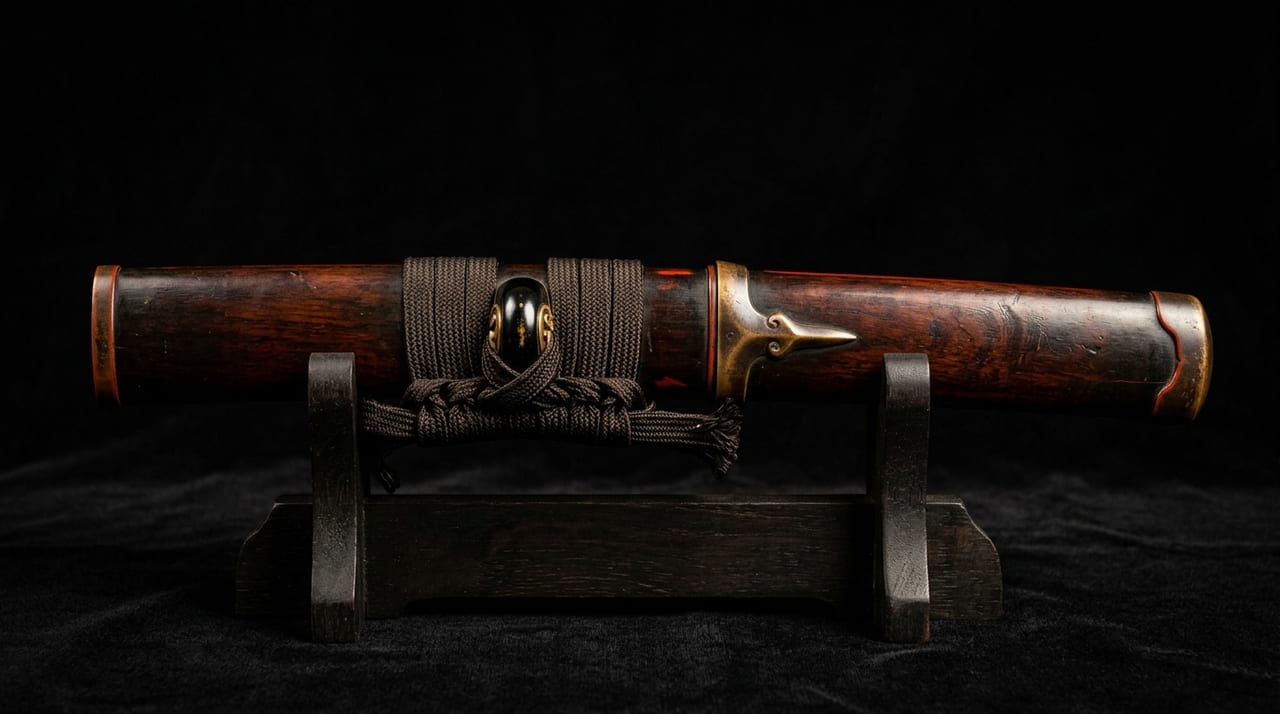
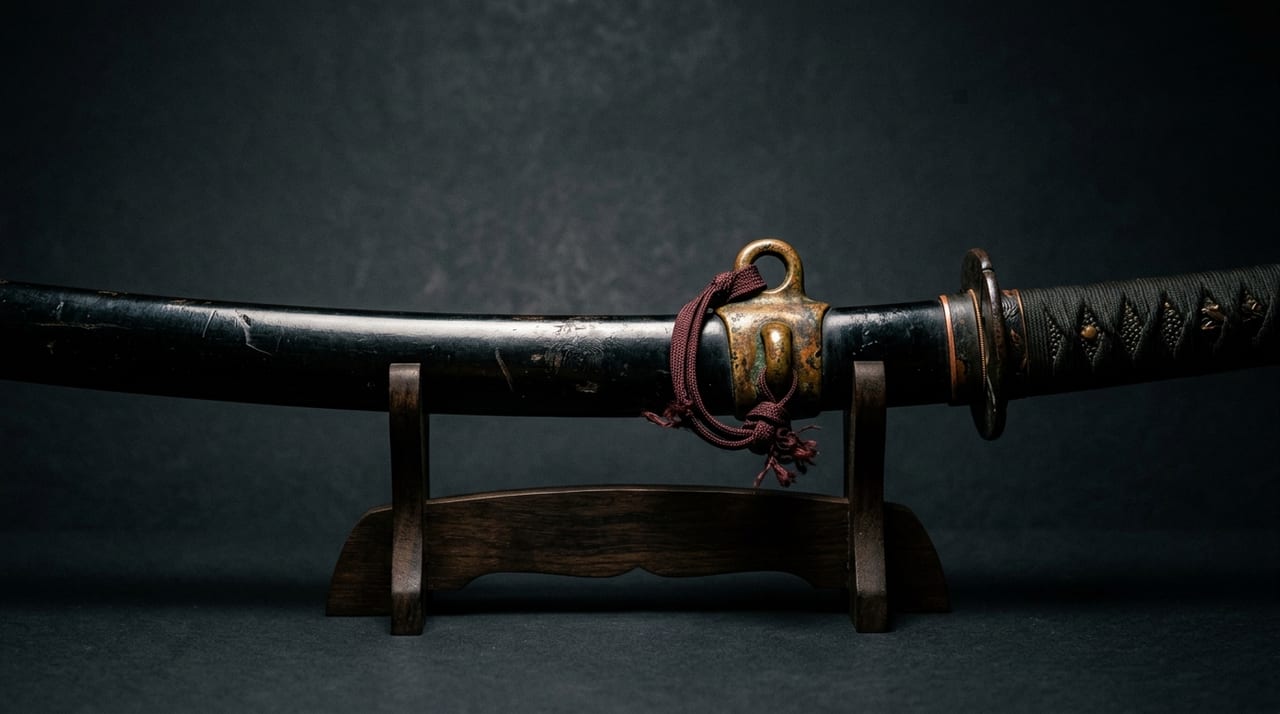
Ashi-kanamono and obitori — the fittings and leather cord system for suspending a tachi koshirae, and the differences between ichi-no-ashi, ni-no-ashi, and uchigatana koshirae
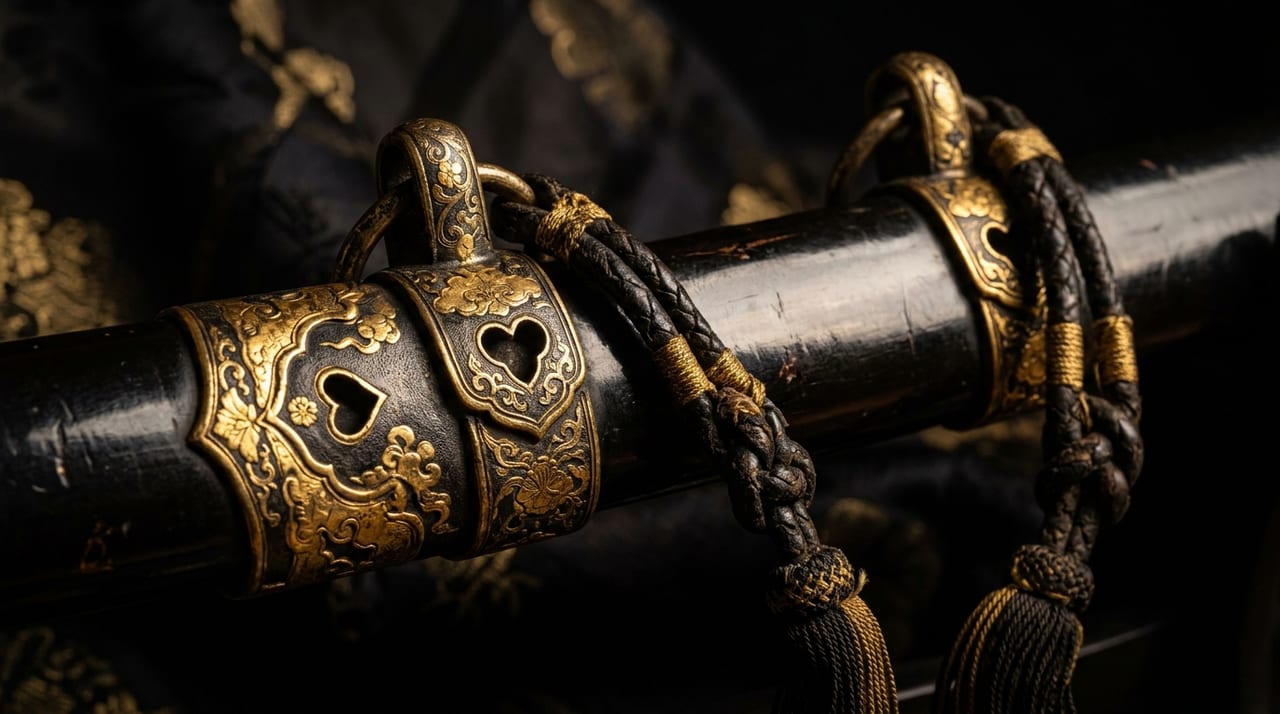 * Image is for illustrative purposes only.
Table of Contents
When you examine a tachi koshirae closely, you can see two small fittings attached at intervals on the belly side (the side facing the blade) of the saya. These are the ashi-kanamono, fittings that clearly demonstrate that a tachi is not a sword that is "inserted" but one that is "suspended." Because a tachi is worn by hanging it from the waist with the blade pointing downward — a distinctive manner of wearing — a dedicated mechanism was needed to hold the saya in a stable suspended position. At the heart of this mechanism are the ashi-kanamono and the leather cord known as the obitori, which is threaded through them.
Whereas a uchigatana is inserted into the belt saya and all, the suspension mechanism of a tachi takes on a considerably more complex configuration. However, by tracing the role of each component in turn, one can see why warriors of the Heian through Kamakura periods chose this form.
The three elements of suspension——ashi-kanamono, obitori, and tachi-o
Wearing a tachi depends on three interrelated components.
- Ashi-kanamono: ring- or band-shaped metal fittings fixed to the outer surface (belly side) of the saya, fitted with a hole or ring through which the leather cord is threaded.
- Obitori (obitoru, ashi-o): a leather cord threaded through the holes of the ashi-kanamono, passing through each of the two fittings to form a loop that receives the tachi-o.
- Tachi-o (haki-o): a long cord threaded through the loop of the obitori and tied at the waist, connecting to the waist belt or armor fittings to bear the entire weight of the tachi.
With these three components linked together, the tachi hangs from the waist belt at a stable angle. The near-horizontal posture with the blade pointing downward is well suited to being carried on horseback, reflecting a design philosophy premised on mounted combat. Note that obitori, obitoru, and ashi-o are all alternative names referring to the same leather cord, and the term used varies depending on the source.
Ichi-no-ashi and ni-no-ashi——why two fittings are needed
Because a single ashi-kanamono would cause the saya to sway without stability, two fittings are always provided. The fitting closer to the sayaguchi (the opening into which the sword is inserted) is called the "ichi-no-ashi," and the one farther from the sayaguchi — positioned toward the kojiri from the middle of the saya — is called the "ni-no-ashi." By receiving the cord at these two points, the saya is securely held at a distance from the belt, and the orientation of the blade remains stable.
The interval between the ichi-no-ashi and ni-no-ashi is called the "ashima." The length of the ashima varies according to the formality of the koshirae and the period, and it also affects the overall proportions of the tachi. A short ashima makes the saya more prone to swinging sideways, while a long ashima achieves a more stable hang.
The shape of the ashi-kanamono varies depending on the type of koshirae, but the haraobinari, which fits snugly along the surface of the saya, is one typical form. In the case of the haraobinari, surviving examples exist in which a heart-shaped open-work design called the inome is applied to the center of the fitting. The inome has traditionally been regarded as a pattern with an apotropaic meaning and has been widely used in the decoration of arms and armor. The Agency for Cultural Affairs' cultural heritage database includes examples of pine-and-wisteria-pattern hyogo-gusari tachi koshirae with haraobinari ashi-kanamono featuring inome open-work and obitori made of hyogo-gusari chain, which can be consulted as concrete examples of this design.
Materials for the obitori and hyogo-gusari
The obitori threaded through the ashi-kanamono is fundamentally made of leather. The material that has been used for a long time is fusubegawa. Fusubegawa is a processed leather in which the hide is smoked to enhance its water resistance and durability, and it was widely used throughout arms and armor. Fusubegawa cord made round by tube-stitching threaded smoothly through the holes of the ashi-kanamono and also had excellent durability. It is said that using fusubegawa for the ashi-o was standard practice until around the middle of the Muromachi period.
From the Muromachi period onward, a form emerged in which a metal chain was used in place of the leather obitori. A tachi koshirae in which the obitori is composed of the decorative chain known as hyogo-gusari — fashioned by linking rivet-shaped links — is called a "hyogo-gusari tachi." The appearance of iron or gold-and-silver-adorned chain hanging from the ashi-kanamono creates an ornate impression different from leather cord, and this form developed as a koshirae for formal ceremonial wear among warrior families. The hyogo-gusari tachi is explained in detail in Hyogo-gusari tachi (hyogo-gusari no tachi).
Structural differences from uchigatana koshirae
The tachi and uchigatana differ fundamentally in their basic koshirae structure. While tachi koshirae is of the "suspension type," uchigatana koshirae is of the "insertion type."
Uchigatana koshirae has no ashi-kanamono. Instead, the sashiomote (the face of the saya that faces outward) has a projection called the kurigata, through which the sageo is threaded. The sageo serves to secure the saya by wrapping around the belt to prevent it from falling out, a function different from that of the tachi-o, which is a suspension cord that bears the weight.
Furthermore, the tachi is suspended at a near-vertical angle with the blade pointing downward, whereas the uchigatana is inserted into the belt at a near-horizontal angle with the blade pointing upward. This difference in wearing style corresponds to the shift in combat from mounted warfare to infantry-centered kachi warfare, and it shows how the tachi form, which had developed for rapid sword drawing on horseback, transitioned to the uchigatana form better suited to infantry combat.
| Tachi koshirae | Uchigatana koshirae | |
|---|---|---|
| Saya fastening method | Suspension (ashi-kanamono + obitori) | Inserted into the belt |
| Blade orientation | Pointing downward | Pointing upward |
| Suspension/securing cord | Tachi-o (haki-o) | Sageo |
| Saya accessory fittings | Ashi-kanamono (ichi-no-ashi, ni-no-ashi) | Kurigata (+ semegane, etc.) |
The mechanisms of the kurigata and semegane are covered in detail in Kurigata and semegane, and the types and functions of the sageo in Types and functions of the sageo.
Points to look for when appreciating koshirae
When observing tachi koshirae in museum exhibitions or as actual pieces, paying attention to the following points will deepen your understanding of the ashi-kanamono and obitori.
- The position of the ashi-kanamono and the length of the ashima (how the spacing between ichi-no-ashi and ni-no-ashi affects the overall proportions)
- The shape of the ashi-kanamono (whether haraobinari, ring-form, or other) and ornamentation (presence or absence of inome open-work and engraving)
- The material of the obitori (fusubegawa or hyogo-gusari) and the coherence of its design with the other fittings
- The overall coherence of design among the ashi-kanamono, kojiri-kanamono, fuchi-kashira, and other fittings
- Whether the overall balance of the center of gravity is well-suited to the suspended posture with the blade pointing downward
For the overall structure and types of tachi koshirae, see Complete Guide to Tachi Types; for the characteristics of hantachi-koshirae, see Structure and History of Hantachi-koshirae; and for a summary of structural differences between the tachi and uchigatana, see Structural Differences Between Tachi and Uchigatana.
The TOUKENZA online catalog allows you to browse swords currently listed for sale with photographs and detailed descriptions.