Complete Guide to Tachi Types: The Forms and Ceremonial Significance of Itomaki-no-tachi, Kuro-Urushi Tachi, Kazari Tachi, and Hyōgo-gusari Tachi
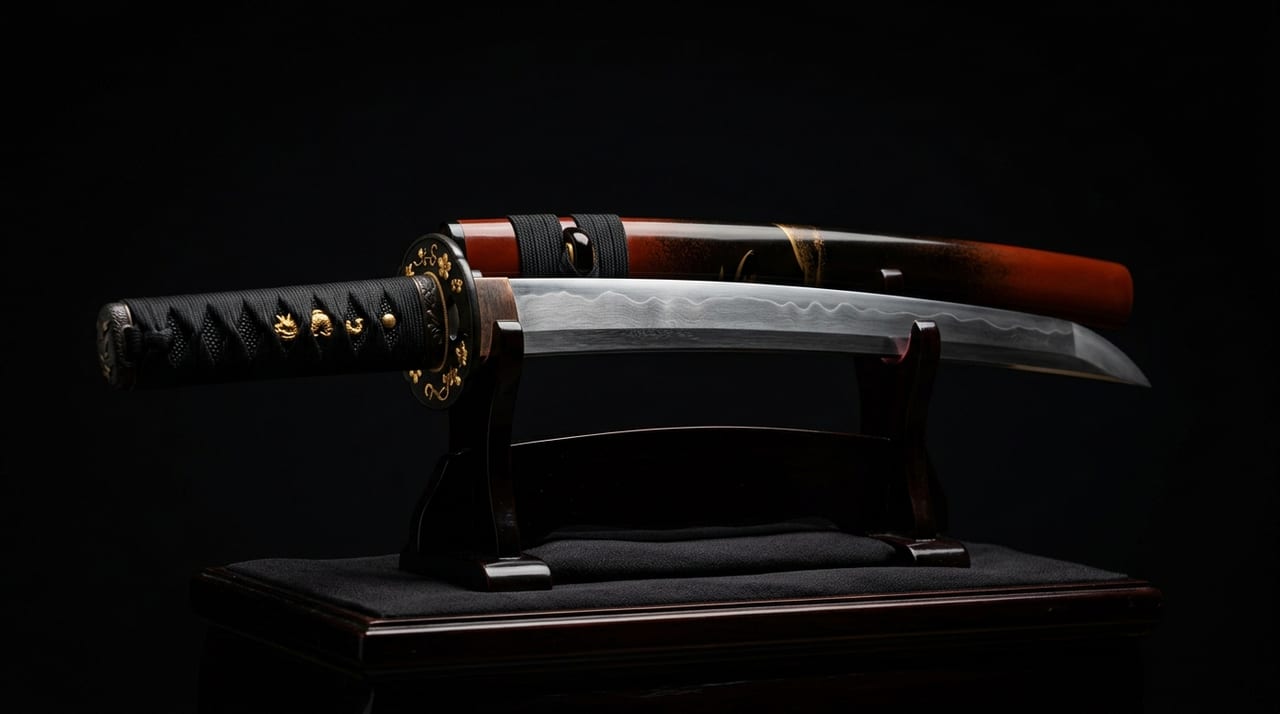
 * Image is for illustrative purposes only.
Table of Contents
What Is a Tachi? — Definition and Basic Classification
The tachi is the most fundamental and prestigious form in the history of the Japanese sword. Its basic definition is a sword with a nagasa (blade length) of approximately 60 cm or more, carried suspended from the hip with the edge facing downward. By contrast, the uchigatana — worn thrust through the belt with the edge facing upward — is distinguished from the tachi.
Within the concept of the tachi there is, in fact, a wide variety of types and forms. The rich diversity cannot be captured by the simple label "a sword with pronounced sori (curvature) suspended from the hip." This article explains the principal tachi types in detail from the perspectives of form, use, and historical background.
Itomaki-no-tachi — The Formal-Dress Koshirae of the Warrior Class
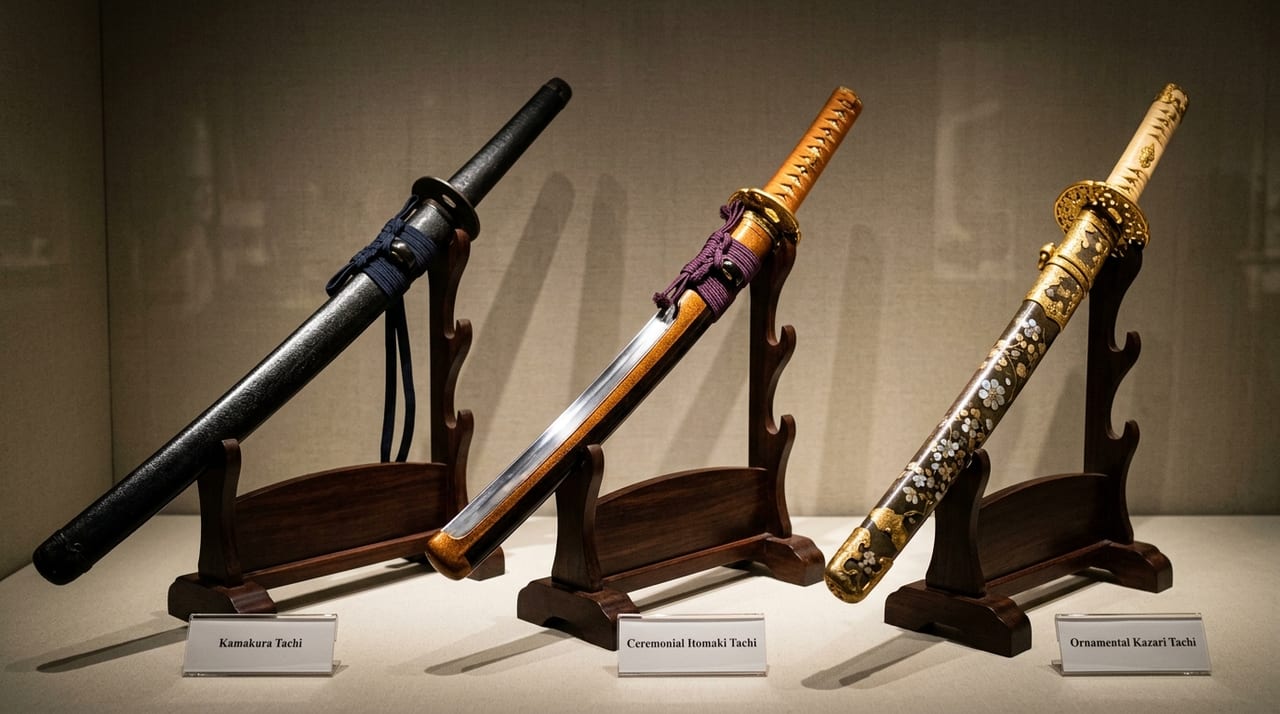
The itomaki-no-tachi is a type of tachi koshirae (mounting) in which thread is wrapped around the tsuka (hilt) and the upper portion of the saya (scabbard) — that is, the part above the hip. The thread material was silk, hemp, or similar fibers, and the color — gold thread, silver thread, purple, vermilion, and so on — was chosen according to rank.
This form was established from the late Kamakura period through the Muromachi period and was used with the formal ceremonial dress of the warrior class. It was worn especially on grand ceremonial occasions alongside the official court attire — sokutai or hitatare — of the shogun and daimyo class. What distinguishes the itomaki-no-tachi is that, while its appearance is magnificent, it retains its function as a practical sword, embodying the warrior-class aesthetic ideal of "mastery of both civil and military arts."
Among the noted surviving examples of itomaki-no-tachi is the "Kondōzukuri Itomaki-no-tachi Koshirae (jūyō bunkazai [Important Cultural Property])" in the collection of the Tokyo National Museum. These magnificent works, believed to date from the Azuchi-Momoyama through the early Edo period, convey to us today the grandeur of the daimyo houses.
Kuro-Urushi Tachi — From Battlefield Mainstay to Warrior Formal Dress
The kuro-urushi tachi is a tachi whose saya is lacquered in black. It was the most widely used form of combat sword from the late Heian period through the Kamakura period. Black lacquer is highly durable and does not readily reflect light, making it well suited to battlefield use.
The warrior image — "armor laced with black threads and a black-lacquered tachi" — that appears in the Heike Monogatari and records of the Genpei War represents the typical armament style of this era. The koshirae of the kuro-urushi tachi combines black thread for the tsuka wrapping, black lacquer for the saya, and black-ground metalwork for the fittings, achieving a unified, austere beauty.
From the late Kamakura period through the Nanbokuchō period, the forms of combat tachi diversified, but the kuro-urushi tachi came to be repurposed for ceremonial dress as well. The "kuro-urushi tachi koshirae" in particular occupied an important place as a votive sword for shrine offerings and as a ceremonial sword of the warrior class, and numerous examples survive today in shrines and museums across Japan.
The kuro-urushi tachi koshirae of the "Tachi, mumei (unsigned) (Honebami Tōshirō)" in the collection of the Tokyo National Museum is known as a representative surviving piece from the Nanbokuchō period.
Kazari Tachi — The "Sword for Display" Made Exclusively for Ceremony
The kazari tachi is a tachi made exclusively for ceremonial and decorative purposes, with no expectation of battlefield use. It was used for court ceremony, as a votive offering to shrines, and as a gift exchanged between daimyo.
The defining characteristic of the kazari tachi is its magnificent decoration. Gold, silver, precious stones, raden (mother-of-pearl inlay), makie (lacquerwork with sprinkled metal powder), and other techniques are lavished on the tsuka, saya, and fittings, giving it an exceptionally high degree of perfection as a work of craft. Indeed, the blade of a kazari tachi is sometimes only roughly forged with the minimum of polishing, or a "wooden blade" is inserted in its place. The value as "a work of art and a symbol of authority" takes precedence over function as a sword.
A representative form of kazari tachi is the "chokushi tachi (imperial-envoy tachi) of the Heian period." This is a tachi given by the emperor to a subject through an imperial envoy, and similar surviving pieces exist among the Shōsōin treasures. In addition, great shrines such as Ise Jingū, Kasuga Taisha, and Sumiyoshi Taisha preserve kazari tachi donated by master craftsmen of each era in their treasure halls, demonstrating the pinnacle of the history of Japanese sword craftsmanship.
Hyōgo-gusari Tachi — An Elegant Form Beloved by Both Court Nobles and Warriors
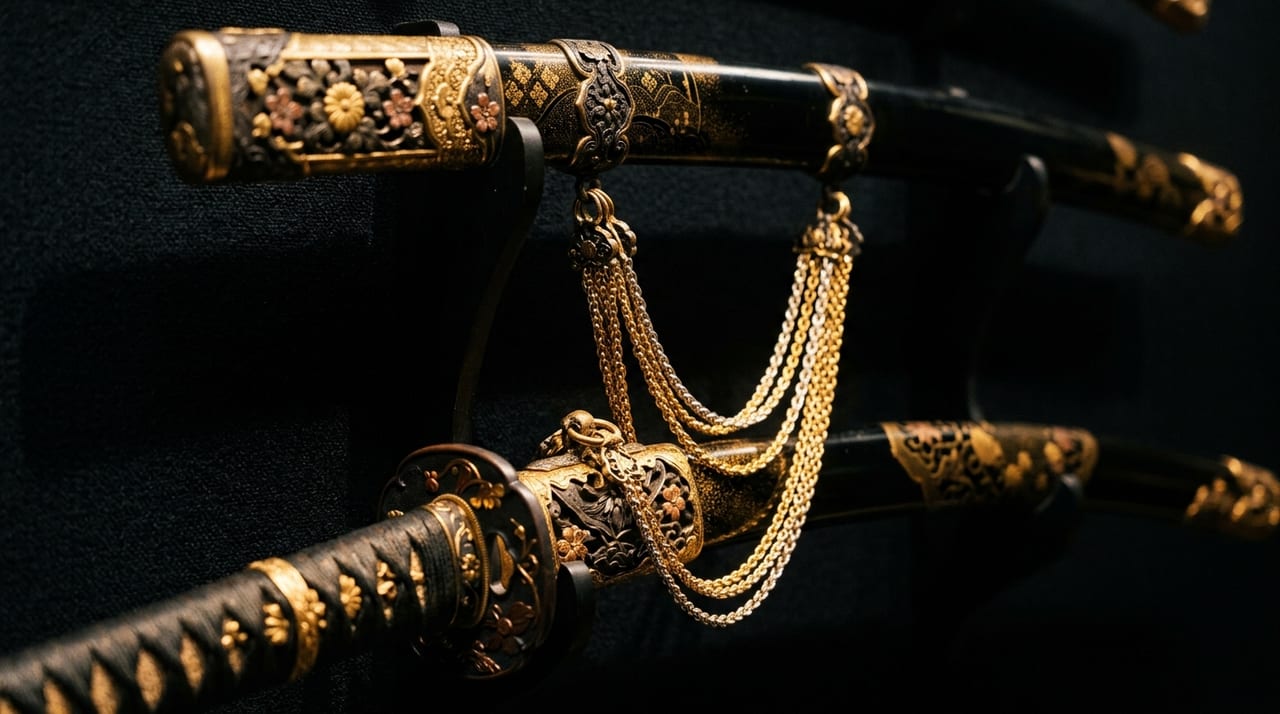
The hyōgo-gusari tachi is a form of tachi koshirae in which a metal chain (hyōgo-gusari) is used for the sageo — the cord by which the tachi is suspended from the hip. Whereas an ordinary tachi is suspended by braided cord of leather or silk, the use of a metal chain creates a distinctive brilliance and sense of weight.
There is a theory that the "hyōgo" in the name derives from hyōgono-kura (the armory), though this is unconfirmed. From the late Heian period through the Kamakura period it was widely favored by both court nobles and warriors, and the noted surviving examples — the Uesugi Tachi and the Hōjō Tachi — are both masterpieces associated with warrior houses. The substantial brilliance and elegance produced by the metal chain were widely appreciated regardless of rank.
Noted surviving examples of hyōgo-gusari tachi are few, but pieces from the Kamakura through the Muromachi period are preserved at the Kyoto National Museum and the treasure hall of Kasuga Taisha. Examples in which the chain is in good condition are rare, and it is a form that attracts keen attention among sword enthusiasts.
Kozukuri Tachi and the Transition to the Uchigatana
The form of the tachi changed over time. Tachi of the late Heian through the early Kamakura period are characterized by a pronounced koshi-zori and a relatively short nagasa — a "kozukuri" (compact) appearance. From the late Kamakura through the Nanbokuchō period, the nagasa grows longer and the mihaba (blade width) becomes broader, resulting in a grander, more imposing form.
From the mid-Muromachi period (the latter half of the 15th century) onward, the tachi was gradually replaced by the uchigatana. The uchigatana — worn thrust through the belt with the edge upward — excelled in rapid drawing and close combat, and was well suited to the battle style of the Sengoku period. The tachi survived as the sword for "ceremonial use," "shrine offerings," and "daimyo formal dress," but its function as the everyday carry sword passed to the uchigatana. The stylistic differences between the tachi and the uchigatana are compared in detail at Tachi and Uchigatana: A Thorough Comparison of the Two Great Styles and Key Points for Appraisal.
Key Points for Distinguishing Tachi Types
The principal points for identifying the type of a tachi are:
- Judging from the koshirae form: the material of the sageo (leather, braided silk, metal chain), the material and wrapping method of the tsuka binding, the lacquering of the saya (black lacquer, red lacquer, raden, makie), and the material and decorative technique of the fittings.
- Judging from the blade characteristics: the position of the sori (koshi-zori or center curve), the balance between nagasa and mihaba, the shape of the kissaki (point) (small, medium, or large kissaki), and the type of hamon (temper line).
- Judging from historical background: the period of manufacture inferred from the mei (signature) or kanteisho (appraisal certificate).
The evolution of the tachi's appearance by period is summarized below.
| Period | Form of the Tachi |
|---|---|
| Asuka / Nara | Straight sword |
| Heian | Koshi-zori tachi |
| Kamakura | Grand, imposing tachi |
| Nanbokuchō | Transitional ōdachi / nodachi |
| Muromachi onward | Transition to uchigatana |
Through its diverse forms, the tachi embodies the fusion of Japanese warrior culture, court culture, and Shinto culture. Going beyond the simple understanding of it as "a long sword suspended from the hip," knowing the historical context behind each form deepens the experience of appreciation immeasurably.