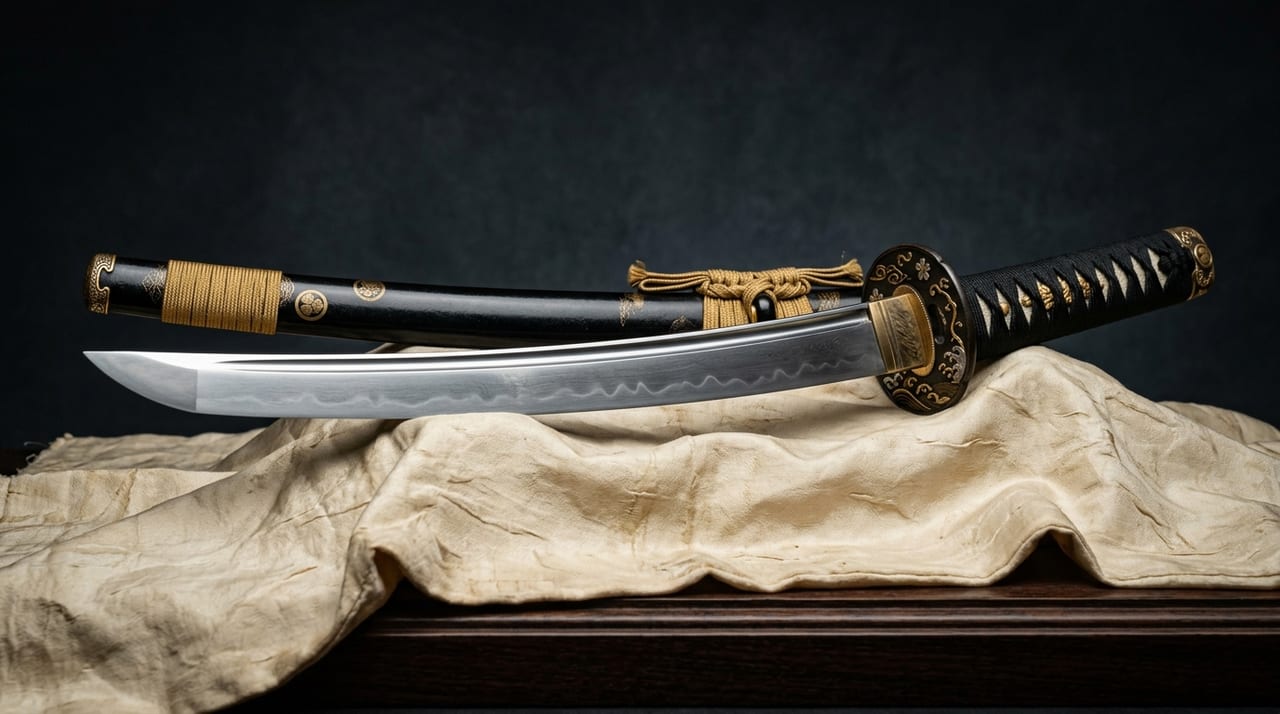
 * Image is for illustrative purposes only.
Honebami Tōshirō
骨喰藤四郎
Also known as: Bone Eater
Description
Overview of the Sword
A work by Awataguchi Yoshimitsu, one of the three greatest swordsmith masters, this renowned wakizashi has followed a remarkable fate of destruction and rebirth. Originally forged as a naginata, it was later reshaped and shortened into a wakizashi, retaining the form of a "naginata-reforged" blade. The blade is approximately 58 cm long with a shallow curve, and its distinctive shape, derived from the naginata, displays a powerful profile clearly distinct from ordinary wakizashi. As a naginata-reforged blade, it possesses considerable width and thickness, retaining much of the original naginata's imposing presence. The name "Honebami" (Bone Eater) derives from a formidable legend: merely making a playful cutting motion with this blade shattered an opponent's bones. The supernatural power to harm without the blade touching reveals that Honebami transcends a mere weapon and possesses a spiritual nature.
Provenance of the Sword
Its history traces back to the Ōtomo clan of Bungo Province (present-day Ōita Prefecture). The Ōtomo clan was a prominent Kyushu family since the Kamakura period, and Honebami is said to have been presented by the Ōtomo to Ashikaga Takauji in Kenmu 3 (1336) and handed down in the Ashikaga shogunal house; it passed into the hands of Matsunaga Hisahide in the Eiroku Incident of Eiroku 8 (1565) and was later bought back by Ōtomo Sōrin. In Tenshō 13 (1585), ahead of the Kyushu Campaign, it was presented to Hideyoshi by the Ōtomo clan. Hideyoshi placed this renowned blade in the Osaka Castle treasury, but when the castle fell during the Osaka Summer Campaign of Keichō 20 (1615), it was miraculously found intact in the ruins. Later, it was damaged and charred in the Great Meireki Fire of Meireki 3 (1657), but was restored through re-tempering by the renowned Echizen master Echizen Yasutsugu. The tale of this wakizashi, which rose like a phoenix from ashes to be reborn, continues to captivate people as "the sword that was re-tempered and rose again."
Current Location
It is currently housed at Toyokuni Shrine in Kyoto as an Important Cultural Property.
Legends & Stories
Legend and Anecdotes
The legend of Bone Eater Tōshirō consists of three elements. First, a supernatural power to shatter bones with a mere mock cut. Second, a transmission that passed back and forth between the Ōtomo clan and the Ashikaga shogunal house. Third, dramatic resurrection from the flames of Osaka Castle. Regarding the origin of the name "Bone Eater," the most widely known tradition holds that bones were shattered merely by making a playful cutting motion with the blade, but precisely when and against whom this occurred remains unclear in the historical record. However, the core of this legend lies not in specific factual circumstances, but in the terrifying image itself of "a blade that harms without contact."
In the Hands of Warriors
The Ōtomo clan, appointed guardians of Bungo Province during the Kamakura period, ruled the northeastern Kyūshū for approximately four hundred years. At their zenith under Ōtomo Sōrin (Yoshishige), they became a great daimyo controlling six provinces of Kyūshū. Bone Eater Tōshirō is said to have been an heirloom sword of the Ōtomo clan; it was presented to Ashikaga Takauji in Kenmu 3 (1336) and then handed down in the Ashikaga shogunal house, but in the Eiroku Incident (1565) it passed into the hands of Matsunaga Hisahide, and Ōtomo Sōrin bought it back.
Presented to Hideyoshi
In Tenshō 13 (1585), the Ōtomo clan presented Bone Eater Tōshirō to Toyotomi Hideyoshi through the intermediation of Matsui Tomoyoshi and Sen no Rikyū (a letter of thanks from Hideyoshi dated the twenty-seventh day of the ninth month of that year survives). This occurred prior to the Kyūshū Campaign of Tenshō 15 (1587). Hideyoshi possessed a passion for collecting celebrated swords of the realm, and Bone Eater Tōshirō was added to his collection and housed in Osaka Castle. In the fifth month of Keichō 20 (1615), when Osaka Castle burned during the Summer Siege of Osaka and the Toyotomi clan fell, Bone Eater Tōshirō was presumed destroyed, but is said to have been found unharmed in the moat and presented to Tokugawa Hidetada through Hon'ami Kōshitsu. Afterwards, during the Great Fire of Meireki in Meireki 3 (1657), the blade burned together with Edo Castle and became scorched. This was restored through re-tempering by Echizen Yasutsugu, the third generation, and Bone Eater Tōshirō was reborn with a new blade pattern. Re-tempering means re-forging; the original blade pattern by Yoshimitsu was forever lost, but traces of Yoshimitsu's forging remain in the steel body of the blade, and it is still recognized today as a work of Yoshimitsu. "A blade reborn from fire"—this narrative overlaid "immortality" upon Bone Eater Tōshirō and perfected its legend as "an eternal masterpiece that devours bone and overcomes fire." In the game Touken Ranbu, it is depicted as a wakizashi who has lost his memories. This skillfully incorporates the historical fact that the blade pattern (= memories) was lost through burning into the character design, and the character embodies both "the sorrow of what was lost" and "the strength to endure," capturing the hearts of many fans.