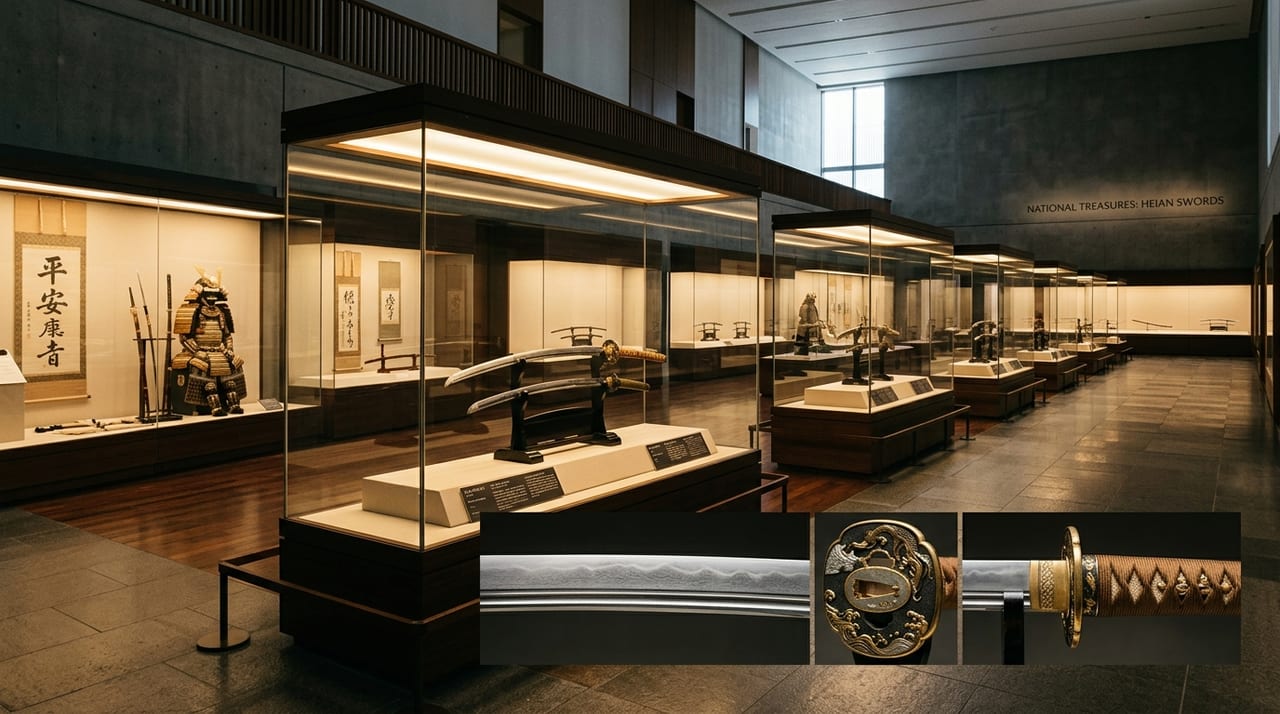
 * Image is for illustrative purposes only.
Tokyo National Museum
東京国立博物館
Overview
Museum Overview
The oldest and largest museum in Japan, tracing its origins to an exhibition held at Yushima Seidō in 1872 (Meiji 5). Its collection totals about 120,000 objects, including 89 National Treasures and 653 Important Cultural Properties (as of April 2025), bringing together the greatest treasures of Japanese art history. In the field of swords, it holds the largest number of sword designated as National Treasures in Japan, and is regarded as the foremost institution for appreciating Japanese swords.
Sword Gallery
In Room 13 on the first floor of the Honkan (Japanese Gallery), swords are displayed permanently alongside metalwork and ceramics, and the displays are rotated several times a year. Holding two of the Tenka Goken (Five Great Swords Under Heaven), Mikazuki Munechika and Dōjigiri Yasutsuna, is unmatched anywhere in the world. Mikazuki Munechika is a work by the Heian-period smith Sanjō Munechika of Yamashiro Province; its name derives from the crescent-shaped uchinoke (clusters of nie along the hamon) visible on the blade. Its graceful form has been praised for a thousand years as the ideal of the Japanese sword. Dōjigiri Yasutsuna is a work by the master smith Yasutsuna of Hōki Province, and is a majestic, dignified blade associated with the legend that Minamoto no Yorimitsu slew the oni Shuten-dōji of Mt. Ōe.
Other National Treasure Swords
In addition, Ōkanehira is a tachi by Kanehira of Bizen Province, and is widely acclaimed as the greatest masterpiece in the history of Japanese swords. Its majestic form and finely wrought hada overwhelm all who see it. Atsu Tōshirō is a tanto by Awataguchi Yoshimitsu; true to its name, its kasane (thickness) is exceptionally heavy, which speaks to Yoshimitsu's outstanding forging skill. Beyond these, the museum also holds a distinguished array of National Treasure and Important Cultural Property swords, including Kikkō Sadamune and the tachi signed Nagamitsu (Daihannya Nagamitsu).
A Multi-Building Museum Complex
Beyond the sword gallery, the Honkan's Arms and Armor of the Samurai display is also rich in sword fittings, armor, and horse gear, allowing visitors to experience Japan's martial culture in its full range. The expansive grounds contain five exhibition buildings: the Honkan, Tōyōkan, Heiseikan, Gallery of Hōryū-ji Treasures, and Hyōkeikan. The collection is so extensive that it cannot be seen in a single day. Visits in spring, combined with the cherry blossoms of Ueno Park, are especially popular, and during the garden's open period, visitors can also stroll through the Japanese garden behind the Honkan.
Highlights
- Mikazuki Munechika (National Treasure, Tenka Goken): a work by Sanjō Munechika from the Heian period. Its name derives from the crescent-shaped uchinoke on the blade. Regarded as the pinnacle of Japanese sword beauty, it is a supreme masterblade cherished for more than a thousand years.
- Dōjigiri Yasutsuna (National Treasure, Tenka Goken): a work by Yasutsuna of Hōki Province. It is associated with the legend that Minamoto no Yorimitsu slew Shuten-dōji. Its powerful itame-hada and beautiful utsuri embody the ideal of kotō (old swords).
- Ōkanehira (National Treasure): a work by Kanehira of Bizen Province, known as the 'yokozuna' of Japanese swords. With a blade length of 89.2 cm, its majestic tachi form, broad in width and high in curvature, has an overwhelming presence that stirs the spirit of the warrior.
- Atsu Tōshirō (National Treasure, work by Awataguchi Yoshimitsu): the most heavily built, thickest-kasane tanto among Yoshimitsu's works. Its fine nashiji-hada and crisp suguha make it the pinnacle of tanto in the Yamashiro tradition.
- In addition, the museum holds numerous National Treasure and Important Cultural Property swords, including Kikkō Sadamune and the tachi signed Nagamitsu (Daihannya Nagamitsu). Its collection is shown through displays rotated several times a year.
* Opening hours and exhibitions are subject to change. Please check the official website before visiting.