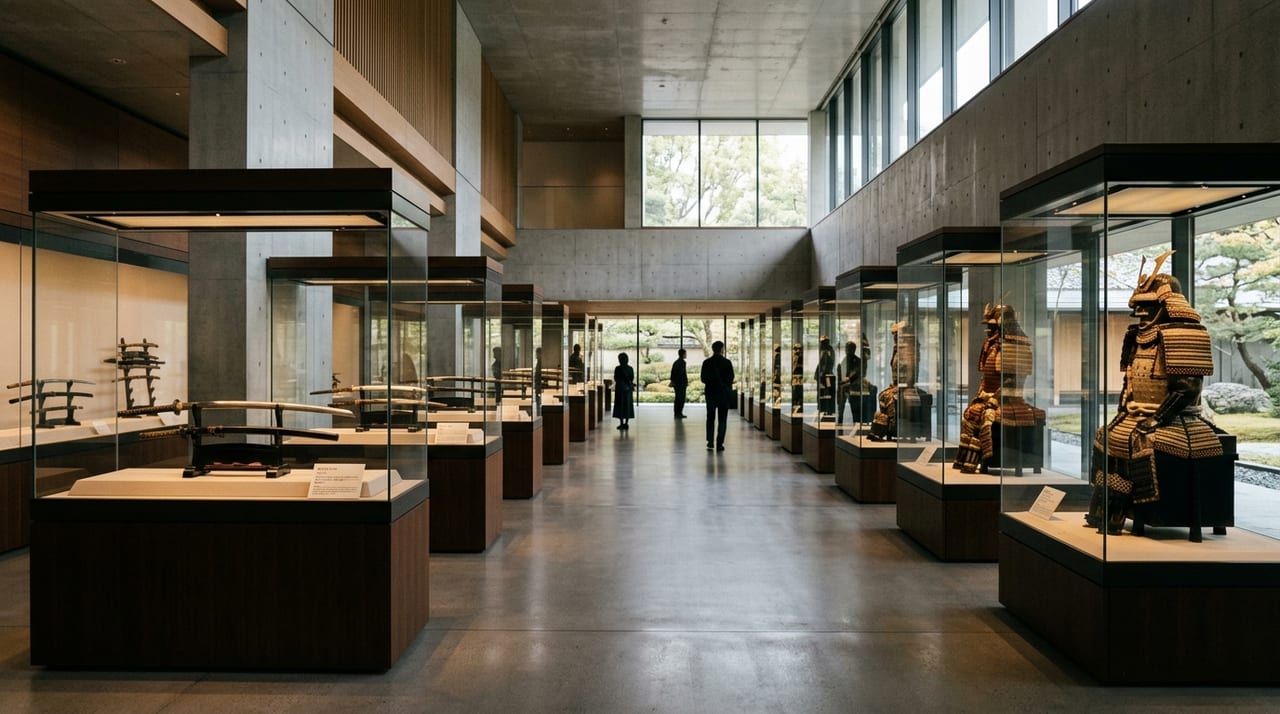
 * Image is for illustrative purposes only.
National Museum of Japanese History (Rekihaku)
国立歴史民俗博物館
Overview
The National Museum of Japanese History (Rekihaku) is a national museum specializing in history and folklore. It is located within Sakura Castle Ruins Park in Sakura, Chiba Prefecture, and is operated by the Inter-University Research Institute Corporation National Institutes for the Humanities. Since opening in Shōwa 58 (1983), it has systematically exhibited and researched the history and culture of Japan from ancient times to the present, and it is one of the central institutions of academic Japanese history research. Its comprehensive exhibitions, divided into Exhibition Rooms 1 to 6, allow visitors to survey Japan from prehistoric times to the modern era.
In its exhibitions related to Japanese swords, the National Museum of Japanese History (Rekihaku) is distinguished by presenting samurai and their arms and armor within the context of history and culture, rather than the swords themselves. In Exhibition Room 2 (Medieval) and Exhibition Room 3 (Early Modern), arms and armor held by the museum, such as suits of armor, may also be displayed as limited-term exhibition materials.
The National Museum of Japanese History (Rekihaku) is especially valuable to sword enthusiasts for understanding the “historical and cultural context of the Japanese sword.” Through historical documents, actual objects, and video, visitors can systematically understand the diverse roles the Japanese sword has played: as a weapon in the Sengoku period, as a spiritual symbol of the samurai, as a fine art object of the Edo period, and as a cultural identity of modern Japan. This contextual understanding gives sword enthusiasts deep insights that cannot be gained from appreciating individual famous swords alone.
Highlights
- Medieval and Early Modern Armor — Armor and other arms held by the museum, displayed for limited periods in Exhibition Room 2 (Medieval) and Exhibition Room 3 (Early Modern)
- Scholarly Understanding of the Historical and Cultural Context of Swords — A multifaceted display of the Japanese sword as a weapon, a symbol, and an art object
- Comprehensive Exhibitions in Rooms 1 to 6 — A national museum where the history and folk culture of Japan, from prehistoric and ancient times to the present, can be surveyed
- Academic Hub of an Inter-University Research Institute — Materials, papers, and databases released in collaboration with top-tier Japanese history research in Japan
- Location within Sakura Castle Ruins Park — An experience of engaging with the deeper context of sword culture amid the natural setting and historical space of the castle ruins
* Opening hours and exhibitions are subject to change. Please check the official website before visiting.