 * Image is for illustrative purposes only.
Edo Tokyo Museum
江戸東京博物館
Overview
The Edo Tokyo Museum is a large-scale history and culture museum located in Yokoami, Sumida Ward, Tokyo. Since it opened in Heisei 5 (1993), it has been widely known to visitors from Japan and abroad as a facility that comprehensively exhibits urban culture, commoner life, and samurai culture from the Edo period through modern Tokyo. Its distinctive raised-floor architecture, with 7 floors above ground and 2 below, a total floor area of approximately 51,000 square meters, and a height of 62.2 meters, was designed by Kikutake Kiyonori. Together with the Kokugikan and Ekōin temple in Ryōgoku, it forms a cultural landmark of Sumida Ward.
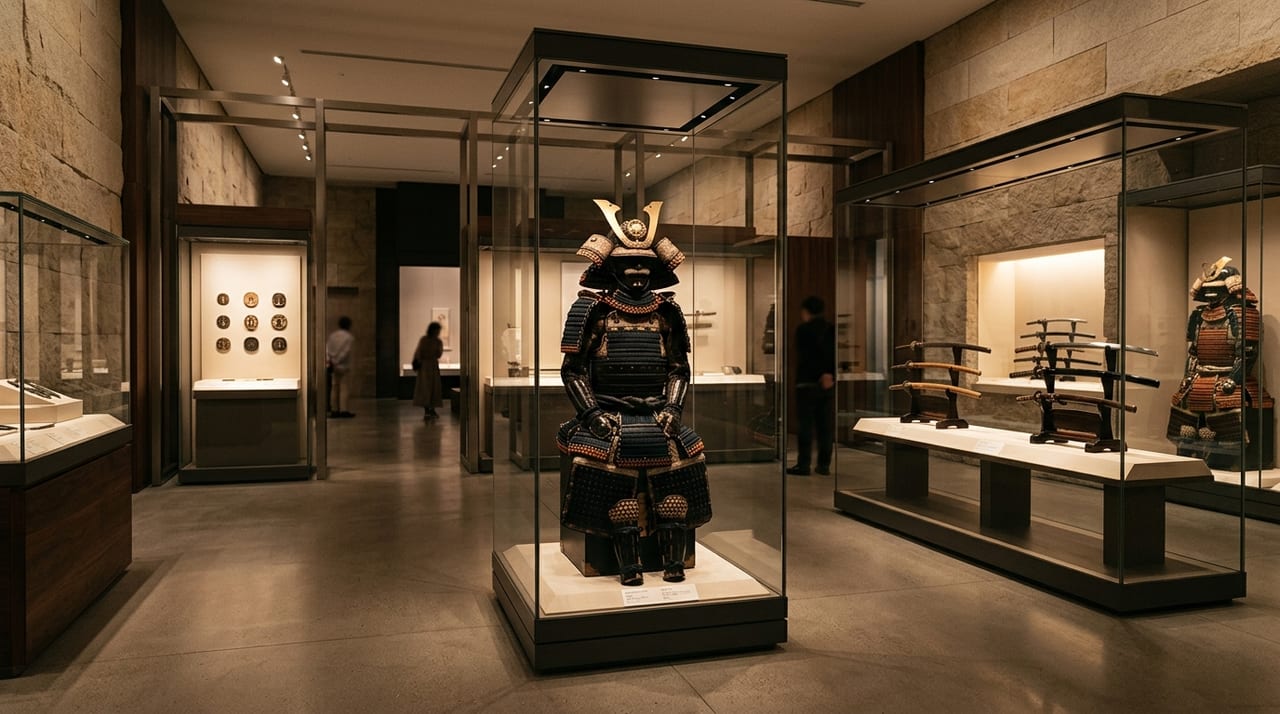
From the perspective of swords and samurai culture, the most important part of the Edo Tokyo Museum is its permanent exhibition 'Edo Zone'. In the 'Edo Castle and Town Layout' corner, which begins with a life-size reconstruction of Nihonbashi, there is a display on samurai culture, where numerous historical materials associated with the shogunal family and daimyo households are exhibited. The scale models of a Kan'ei-era daimyo residence (the upper residence of Matsudaira Tadamasa, lord of the Echizen Fukui domain) and of the Honmaru and Ninomaru palaces of Edo Castle in the late Edo period are also highlights. They allow visitors to understand three-dimensionally the social context of Edo, where Japanese swords functioned as symbols of samurai status and authority.
Thanks to its convenient access, a 3-minute walk from the West Exit of Ryōgoku Station on the JR Sōbu Line and a 1-minute walk from Ryōgoku Station on the Toei Ōedo Line, it is also ideal for sightseeing combined with related facilities for sumo, nishiki-e prints, and Edo culture (the Kokugikan and the Sumida Hokusai Museum). The museum closed for a major renovation starting in April 2022 and reopened on March 31, 2026.
Highlights
- Approx. 9,000 m² of permanent exhibition space — life-size Nihonbashi, models of daimyo residences and Edo Castle palaces, historical materials associated with the shogunal family and daimyo households
- Precise restoration models of Edo Castle and daimyo residences — three-dimensional understanding of the Edo urban space in which swords functioned as social symbols
- Reopened March 31, 2026 — experience Edo and sword culture in the latest exhibition environment
- 1–3 minute walk from Ryōgoku Station — an Edo culture tour route integrated with the Kokugikan and Sumida Hokusai Museum
* Opening hours and exhibitions are subject to change. Please check the official website before visiting.