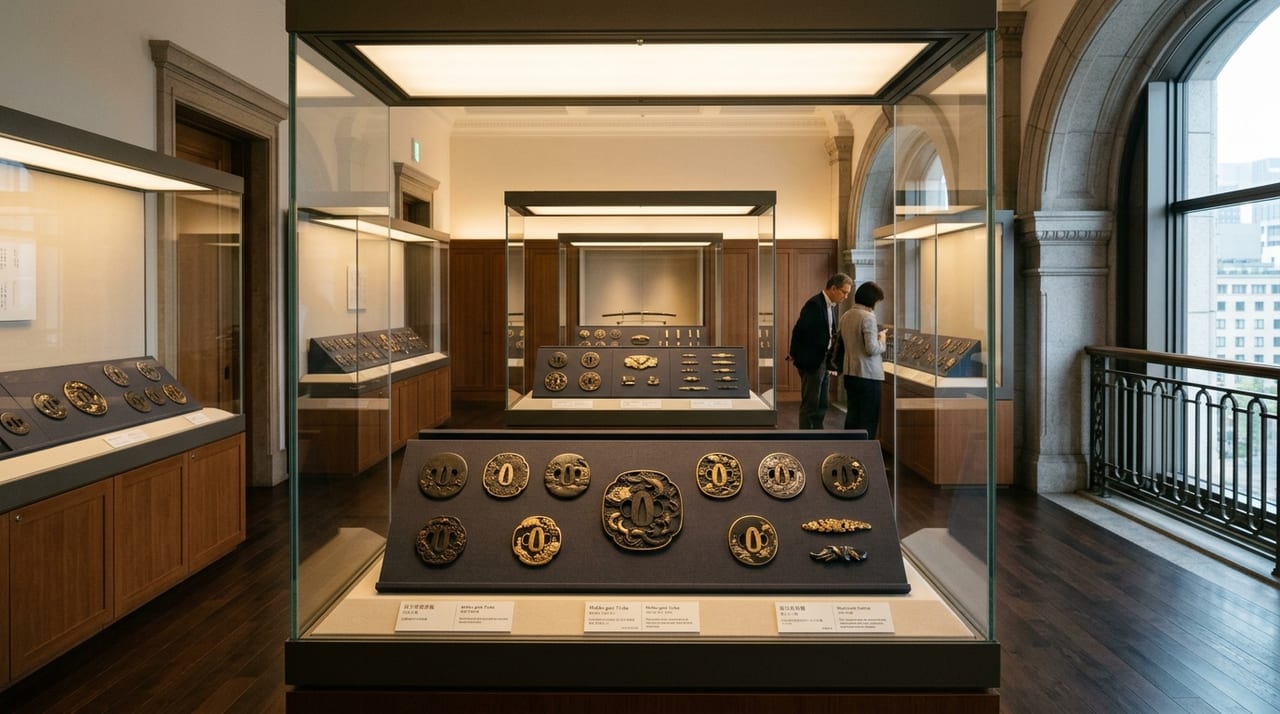
 * Image is for illustrative purposes only.
Mitsui Memorial Museum
三井記念美術館
Overview
Three Centuries of Mitsui Discernment
The Mitsui Memorial Museum is located on the seventh floor of the Mitsui Main Building (completed 1929 (Shōwa 4), designated as a National Important Cultural Property), which adjoins the Mitsukoshi Nihonbashi Main Store. Since opening in 2005 (Heisei 17), it has continued to exhibit the vast collection that the Mitsui family accumulated over more than three hundred years from the Edo period. Throughout the Edo period, the Mitsui family reigned over the three metropolises of Edo, Kyoto, and Osaka as money changers and dry goods merchants. Through their wealth and refined discernment, they formed outstanding collections spanning tea ceremony, Noh, swords, paintings, and ceramics.
Sword Collection
The Mitsui family's sword collection is known for its lineup of renowned blades, including 2 National Treasures and 7 Important Cultural Properties. Throughout the Edo period, the Mitsui family were deep enthusiasts of tea ceremony culture and collected famous swords along with tea utensils. As great merchants of the Edo period with deep ties to the shogunal family and daimyo households, the Mitsui built a collection that embodied the finest of samurai culture. Among the swords, the collection holds the National Treasure tanto 'Hyūga Masamune,' named because it was possessed by Ishida Mitsunari and seized by Mizuno Katsunari at the Battle of Sekigahara. It also holds the National Treasure tanto 'Tokuzen-in Sadamune,' which Maeda Gen'i (Tokuzen-in) received from Toyotomi Hideyoshi. Other Important Cultural Properties include tachi by Norimune, Sukezane, Kuninobu, and Kanemitsu, and others, as well as a sword by Kunihiro.
Fusion with Tea Ceremony
That swords are collected alongside tea utensils in the Mitsui collection symbolizes a high-level fusion of samurai culture and townsman culture. For wealthy merchants of the Edo period, tea ceremony was not merely a pastime but a symbol of social standing and a venue for interaction with daimyo and hatamoto. The Mitsui family's face as tea practitioners and their face as sword enthusiasts were two sides of the same coin. Knowing this cultural background allows a fuller understanding of the depth of the Mitsui collection.
Nihonbashi as a Place
Nihonbashi, where the Mitsui Memorial Museum is located, has been the economic and commercial center of Japan since the Edo period. As the starting point of the Five Edo Highways, it controlled the nationwide flow of goods. It was also the place where Mitsui Echigoya (later Mitsukoshi) transformed Edo's commercial culture with its innovative business practice of 'genkin kakene nashi' (cash only, no credit). Even today, this area, lined with long-established shops such as Mitsukoshi Nihonbashi Main Store, Yamamotoyama, and Eitarō Sōhonpo, is one of the places in Tokyo that most strongly retains the atmosphere of Edo. Visitors can enjoy touring these historic shops together with their museum visit.
Charm of the Building
The Mitsui Main Building (completed 1929) is an imposing stone building in the Neoclassical style, designed by the American architects Trowbridge & Livingston, and designated as a National Important Cultural Property. The museum, set within this dignified building, provides a space befitting the prestige of its exhibits. Masterpieces handed down in the Mitsui family displayed in high-ceilinged galleries convey the aroma of Edo-period merchant culture to the present day. Nihonbashi Mitsui Tower also adjoins the building, so visitors can enjoy a distinctive urban space where the commercial history of Edo and modern business coexist.
Rich Special Exhibitions
The Mitsui Memorial Museum holds 5 to 6 special exhibitions throughout the year. Under diverse themes such as tea utensils, paintings, calligraphy, swords, Noh masks, and Noh costumes, about 4,000 art objects handed down in the Mitsui family are displayed on a rotating basis. Be sure to check the theme of the exhibition currently on view before your visit. The museum shop's goods feature Mitsui's traditional patterns, with a sophisticated lineup typical of an urban museum.
Highlights
- Swords handed down in the Mitsui family: including the National Treasure tanto 'Hyūga Masamune' and 'Tokuzen-in Sadamune,' a collection of renowned blades totaling 2 National Treasures and 7 Important Cultural Properties
- Tea and swords: the breadth of the Mitsui collection, which holds famous tea utensils, including the National Treasure Shino tea bowl 'Unohanagaki,' alongside famous swords
- National Important Cultural Property Mitsui Main Building (completed 1929): a Neoclassical building designed by Trowbridge & Livingston. The only experience in central Tokyo of viewing masterpieces in a dignified space
- Historic Nihonbashi location: located in Nihonbashi, the starting point of the Five Edo Highways, where you can enjoy a stroll combining Mitsukoshi Nihonbashi Main Store, long-established shops, and the commercial history of Edo
- 5 to 6 special exhibitions a year: about 4,000 Mitsui family collection pieces rotate by theme, with a wide range of genres including tea utensils, paintings, swords, and Noh masks
* Opening hours and exhibitions are subject to change. Please check the official website before visiting.