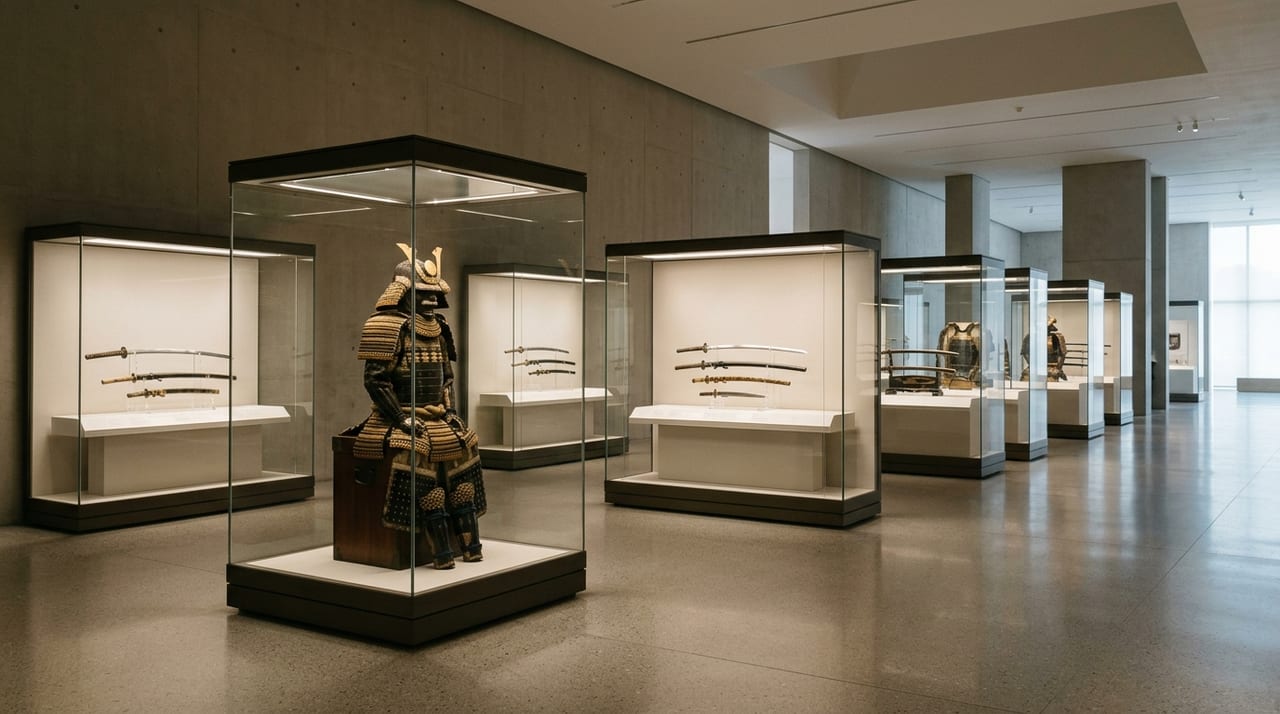
 * Image is for illustrative purposes only.
Tokyo Fuji Art Museum
東京富士美術館
Overview
Overview of the Museum
Tokyo Fuji Art Museum is a private museum that opened on November 3, 1983 (Shōwa 58) in Hachiōji, Tokyo, adjacent to Soka University. Built on an international art collection initiated by Ikeda Daisaku, President of Soka Gakkai International (SGI), it is known as a comprehensive art museum holding approximately 30,000 works, including paintings, prints, photographs, sculpture, and crafts from Japan, the East, and the West. Under its founding philosophy that 'culture and art become a bridge connecting the hearts of people around the world,' it serves as a hub for international cultural exchange and also holds overseas exchange exhibitions that introduce the cultures of countries around the world.
Japanese Sword and Weapons Collection
The Tokyo Fuji Art Museum also holds a collection of arms and armor, including tachi, katana, wakizashi, and tantō, which together allow visitors to trace the history of Japanese swords from the late Heian period to the late Edo period. Important Cultural Properties include the tachi signed 'Aritsuna' (Hōki, late Heian period), the tachi signed 'Ichi' (Fukuoka Ichimonji, mid-Kamakura period), and the tachi inscribed 'Chikakage, resident of Osafune in Bizen Province,' dated a day in the 5th month of Kenmu 2 (1335). The collection also includes tachi by Nagamitsu and Norifusa, works from Yamashiro, Yamato, Bizen, and Sagami, and a katana by Nagasone Okisato (Kotetsu). In armor, the museum holds the ō-yoroi armor used by Shimazu Nariakira and suits of armor (gusoku) used by Oguri Kōzukenosuke Tadamasa. In 2016 (Heisei 28), the special exhibition 'The Tōken: A Thousand Years of Masterful Craft and Beauty' was held.
Sword Fittings and Metalwork Collection
Beyond blades, the museum's strength lies in its collection of sword fittings (sōgu), including tsuba, hilts, and scabbards. Works of Edo-period metalwork are also held, such as the daishō koshirae with black lacquered scabbards, which include the tsuba, fuchi-gashira, and mekugi by Ishiguro Masayoshi and the kozuka and kōgai by Yanagawa Naomasa. Sword fittings represent the pinnacle of Japanese metal art, and their precise chasing and inlay techniques hold a special place among the world's metal crafts. The museum's international perspective offers visitors the opportunity to reassess Japanese sword fittings within the context of world metalwork.
Coexistence of European Painting and Japanese Swords
One of the museum's distinctive attractions is its international collection arrangement, in which masterpieces of European painting, from the Renaissance through the Baroque to Impressionism, are displayed under the same roof as the Japanese sword collection. By comparing Western prints and paintings by Dürer, Rembrandt, and Rubens with the pinnacle of form created by Japanese swordsmiths, visitors can experience both the differences and the universal qualities of Eastern and Western aesthetic sensibilities.
Facilities and Special Exhibitions
The museum building stands in a calm setting surrounded by the vast nature of Hachiōji, and is a large facility with multiple exhibition galleries. Multiple planned exhibitions and special exhibitions are held throughout the year, and in exhibitions focusing on Japanese swords, the museum's notable blades are displayed together. The museum also frequently hosts special exhibitions with works borrowed from outside, offering opportunities for important art objects from Japan and abroad to visit Hachiōji. Accessible by bus from JR Hachiōji Station, it is loved as a place for quiet art appreciation away from central Tokyo, alongside the green campus of Soka University.
Highlights
- Japanese sword collection including Important Cultural Properties ── three Important Cultural Properties: the tachi signed 'Aritsuna,' the tachi signed 'Ichi' (Fukuoka Ichimonji), and the tachi inscribed 'Chikakage, resident of Osafune in Bizen Province'; swords from the late Heian period to the late Edo period
- Sword fittings and metalwork ── Edo-period metalwork, including daishō koshirae with fittings by Ishiguro Masayoshi and Yanagawa Naomasa
- Armor and weapons collection ── armor used by Shimazu Nariakira, suits of armor used by Oguri Tadamasa, unusual helmets (kawari-kabuto), field hats (jingasa), stirrups (abumi), and other armor and weapons
- Comparison with the international collection ── Western paintings from the Renaissance to Impressionism and Japanese swords in a single facility; the contrast between Eastern and Western aesthetic sensibilities highlights the universal beauty of Japanese swords
- Hachiōji's natural setting ── a large facility surrounded by the greenery of the Tama Hills, free from the crowds of central Tokyo, where art can be appreciated calmly and unhurriedly
* Opening hours and exhibitions are subject to change. Please check the official website before visiting.