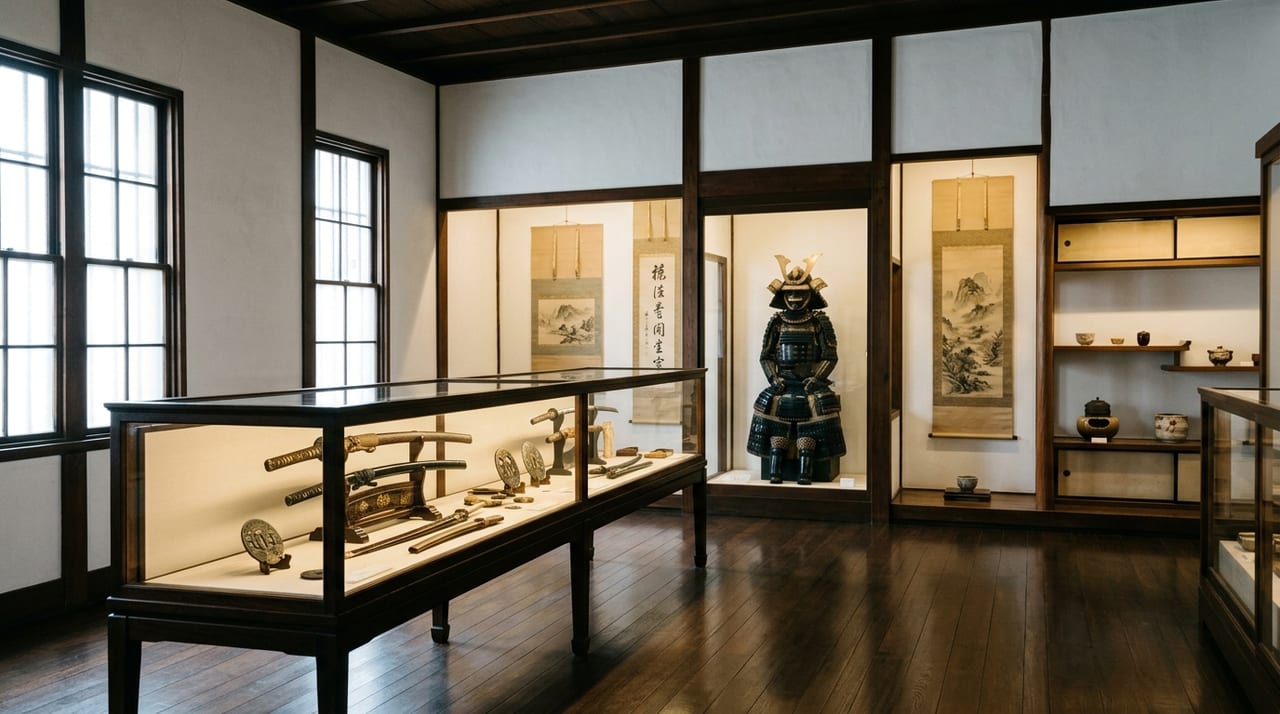
 * Image is for illustrative purposes only.
Eisei Bunko
永青文庫
Overview
Museum Overview
Eisei Bunko is a museum that collects and exhibits art objects and historical materials passed down for 700 years to the Hosokawa family, lords of the former Higo Kumamoto domain with 540,000 koku, preserving treasures of samurai culture. The name “Eisei Bunko” derives from “Ei” in Eigen-an, the Hosokawa family's family temple, and “Sei” in Seiryūji Castle, the castle of Hosokawa Fujitaka (Yūsai), the first head of the early-modern Hosokawa family. It was founded in 1950 (Shōwa 25) by Hosokawa Moritatsu, the 16th head of the family. The current honorary chairman is Hosokawa Morihiro, the 18th head and former prime minister, and the chairman is Hosokawa Morimitsu.
Sword Treasures
The sword collection consists of masterpieces that the successive heads of the Hosokawa family collected and passed down with samurai pride. The greatest treasure is the National Treasure tachi signed “Bungo no kuni Yukihira saku.” Yukihira, a master swordsmith of Bungo Province (present-day Ōita Prefecture) who was active from the late Heian period to the early Kamakura period, is positioned at the pinnacle of Kyushu smithing, with soft, flowing hamon and an elegant tachi form. Very few of Yukihira's works survive, and this sword is the most important for understanding his skill.
Kasen Kanesada
Another highlight is the sword by Izumi no kami Kanesada, known as “Kasen Kanesada.” This sword is said to have been owned by Hosokawa Tadaoki (husband of Garasha). Because Tadaoki put 36 of his retainers to death, the sword came to be called “Kasen Kanesada,” after the Thirty-Six Immortal Poets. Izumi no kami Kanesada was a master of the Mino tradition, the second-generation Kanesada (之定), and his cutting performance earned enormous renown in the Sengoku period as “Seki no Kanesada.” In recent years, the influence of history games has caused a sharp increase in young visitors.
Sword Fittings and Works of Art
The collection of sword fittings is also rich, featuring dignified koshirae and metalwork masterpieces handed down in the Hosokawa family. The collection also includes calligraphy, paintings, tea utensils, and Noh masks that reflect samurai culture, allowing visitors to experience the Hosokawa family's tradition of combining martial and literary arts.
Buildings and Garden
The building is a charming Western-style house on the quiet Mejiro-dai heights, built in 1930 (Shōwa 5) as the administrative office (kaseisho) of the former Hosokawa Marquis family, and it is still used as an exhibition facility as is. The building itself has historical value, and the greenery of the garden, which evokes the remains of a daimyo residence, is pleasant. The adjacent Higo Hosokawa Garden, run by Bunkyo Ward, can be strolled for free, offering quiet time along the Kanda River.
Highlights
- National Treasure tachi signed “Bungo no kuni Yukihira saku” — representative work of Yukihira, a master of Bungo Province from the late Heian to early Kamakura period. Soft, flowing hamon and an elegant tachi form rank at the pinnacle of Kyushu smithing; the most important of Yukihira's works, of which very few survive
- Kasen Kanesada (made by Izumi no kami Kanesada) — famous sword said to have been owned by Hosokawa Tadaoki. Named after the Thirty-Six Immortal Poets because Tadaoki put 36 retainers to death. Masterpiece of the second-generation Kanesada (之定), a master of the Mino tradition
- Hosokawa family sword fittings collection — dignified koshirae, tsuba, kozuka, kōgai, and menuki masterpieces passed down for 700 years. The refinement and craftsmanship of a daimyo house
- Former Hosokawa Marquis family administrative office — charming Western-style building completed in 1930 (Shōwa 5), used as is as an exhibition facility
- Adjacent Higo Hosokawa Garden — strolling pond garden run by Bunkyo Ward (free admission). A quiet setting along the Kanda River, ideal for a walk after viewing the art
* Opening hours and exhibitions are subject to change. Please check the official website before visiting.