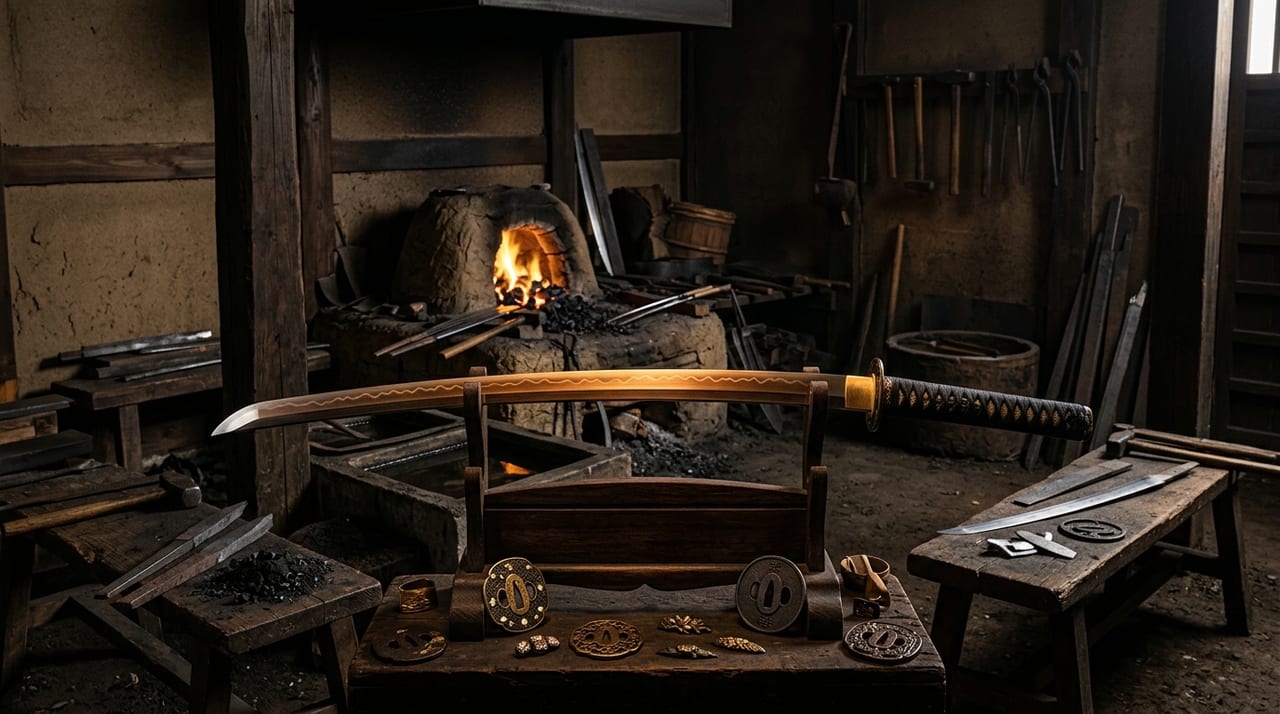
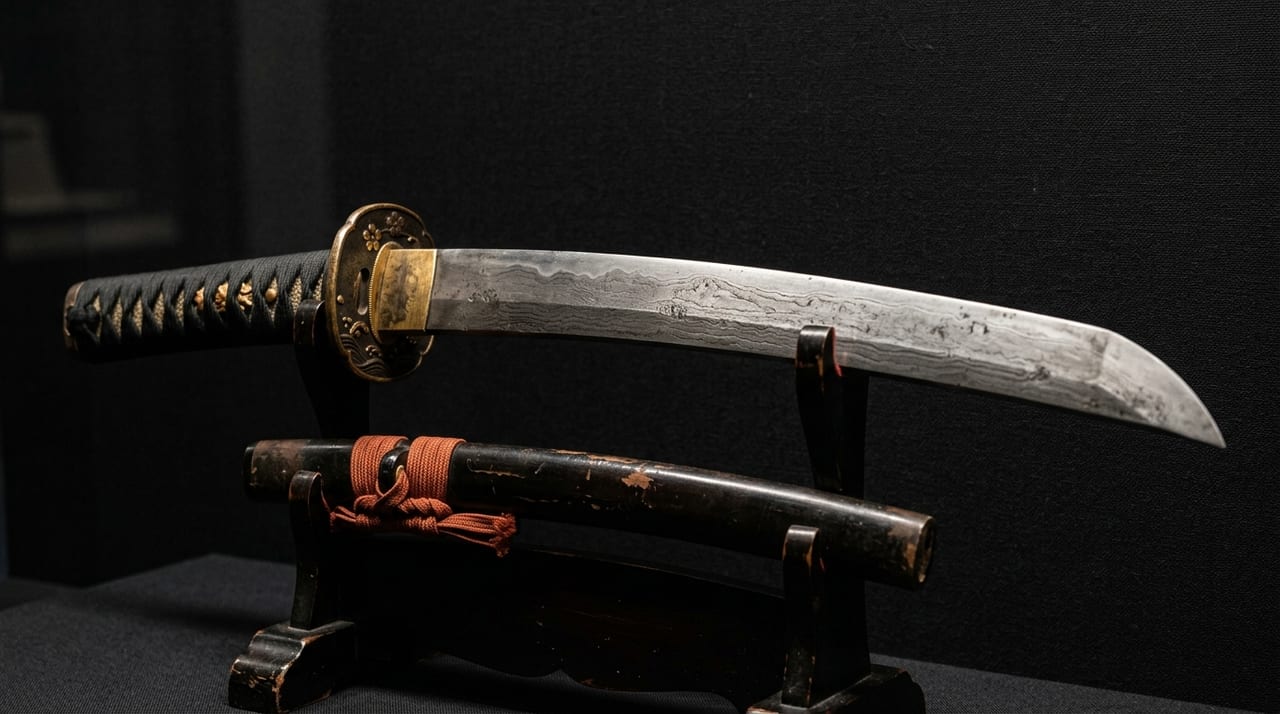
Osafune Mitsutada: Perfecting the 'Mitsutada Choji' and His Enduring Masterpieces
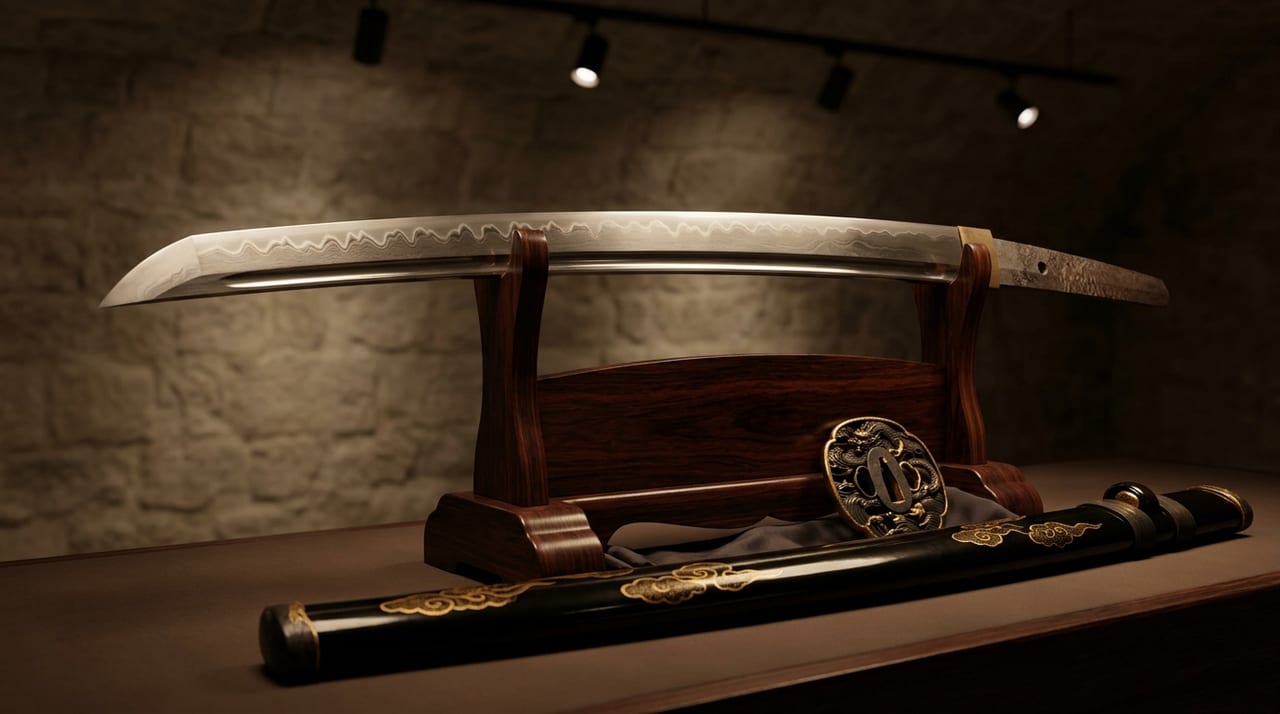 * Image is for illustrative purposes only.
Table of Contents
Who Was Mitsutada—Founder of the Osafune Bizen School
Mitsutada (光忠) was a sword maker who flourished during the middle Kamakura period (early to late 13th century) in Osafune, Bizen Province (present-day Osafune-cho, Setouchi City, Okayama Prefecture). He is positioned as the founding patriarch of the "Osafune Bizen School," and laid the foundation for the school's prosperity over the following centuries.
His name is immortalized in the history of Japanese swords, symbolized by the term "Mitsutada's choji"—a reference to the beauty of his elegant choji hamon (clove-shaped blade pattern). Multiple authenticated works by Mitsutada have been designated as National Treasures and Important Cultural Properties by the NBTHK (Society for Preservation of Japanese Art Swords), and he remains one of the most highly regarded sword makers in the modern era.
Historical Context—A Sword Maker Born from Kamakura Warrior Society
The middle Kamakura period, when Mitsutada was active, was an era when the military government (Kamakura Shogunate) had stabilized and demand for military equipment increased. Retired emperors, imperial family members, and powerful warrior families competed to acquire renowned blades, resulting in increased orders for sword makers.
Since ancient times, Bizen had been rich in high-quality iron sand and charcoal, and sword makers had been concentrating there since the late Heian period. Osafune's location was advantageous for transporting materials using the water transport of the Yoshii River, and by Mitsutada's time, "Bizen blades" had already begun to establish a nationwide reputation.
Within this favourable environment, Mitsutada took the distinctive "beauty of the choji blade pattern" characteristic of Bizen blades to its ultimate expression.
Mitsutada's Hamon—Characteristics of "Mitsutada's Choji"
The signature technique of Mitsutada was the large and graceful choji hamon. This choji pattern became known as "Mitsutada's choji" among later sword makers, serving as their ideal.
Characteristics of the choji hamon:
- Size of the choji: Large clove-shaped formations (large choji) appear in succession. While each choji varies in height—with large, medium, and small sizes intermixed—the overall effect is graceful and flowing.
- Nioi composition: True to the Bizen tradition, the nioi (subtle pattern) is dominant, with the choji outlines spreading gracefully as if shrouded in mist. The expression "like blossoms blooming" is often used to describe this quality.
- Choji-ashi (choji feet): Rich protrusions extend from the base of each choji toward the edge, giving the hamon movement and vitality.
- Boushi (point design): Intricately textured with deep turnings, and the beautiful hamon extends all the way to the tip.
Mitsutada's Jigane—The Essence of Bizen Forging
The jigane (metal structure) of Mitsutada's blades exemplifies the Bizen tradition, characterized by "itame with mixed mokume-style grain (itame ni midarehada-majiri)."
- Jihada (surface grain): Primarily itame with intermixed flowing and tightly-packed sections. While not uniform, this creates an impression of "living metal."
- Jinie (surface brilliance): Fine nie particles are scattered throughout the jigane, creating a bright and clear surface. When light is applied, the entire jigane appears to shimmer.
- Midareutsuri (disordered reflection): Many of Mitsutada's blades display "utsuri" (reflection). This refers to whitish, hazy patterns that appear in the jigane parallel to the hamon, and represents one of the characteristics of the Bizen tradition.
Extant Important Cultural Properties and National Treasures by Mitsutada
Multiple authenticated works by Mitsutada have been designated as National Treasures and Important Cultural Properties, a number that stands out among Kamakura period sword makers.
Tachi with signature "Mitsutada" (Named Blade: Shokudai-kiri Mitsutada)
- Location: Tokugawa Museum (Mito, Ibaraki)
- Designation: Important Cultural Property (some consider it to be of National Treasure caliber)
- Characteristics: A famous blade from the Date family collection. The current blade length has been shortened through polishing, differing from its original tachi form. It carries a legend of having cut through a candlestick stand.
Tachi with signature "Mitsutada" (Named Blade: Ikoma Mitsutada)
- Location: Eisei Bunko (formerly held by the Hosokawa family)
- Designation: National Treasure
- Characteristics: A National Treasure passed down in the Hosokawa family. The "heshikiri" (pressure-cut) anecdote belongs to the sword by Hasebe Kunishige associated with Oda Nobunaga (Heshikiri Hasebe, Fukuoka City Museum) and has nothing to do with Mitsutada; the representative Mitsutada meibutsu of the Hosokawa family is the Ikoma Mitsutada (Eisei Bunko).
Tachi with signature "Mitsutada" (Kyoto National Museum Collection)
- Location: Kyoto National Museum
- Designation: Important Cultural Property
- Characteristics: Highly valued as one of the finest examples preserving Mitsutada's large choji hamon.
Beyond these famous blades, multiple works by Mitsutada have been designated as NBTHK Special Important Swords, scattered across museums and private collections both domestically and internationally.
Mitsutada's Disciples and the Development of the Osafune School
The Osafune School developed extensively from Mitsutada's lineage and disciples. Main successors and their characteristics:
Kagemitsu (景光): Considered to be Mitsutada's grandson (Mitsutada → Nagamitsu → Kagemitsu; his father was Nagamitsu). His blades feature pronounced "kosozori" (curvature near the hilt), embodying the tachi style of the late Kamakura through Nanboku-Chō periods. Multiple extant works are designated as National Treasures.
Kanemitsu (兼光): Son of Kagemitsu. Active during the Nanboku-Chō period, he produced many odachi (great swords) and nodachi. His hamon is large and imposing, reflecting the stylistic changes of his era.
Morimitsu (盛光) and Yasumitsu (康光): Representative sword makers of the "Ōei Bizen" style in the early Muromachi period. Though active more than a century after Mitsutada, they continued the Osafune School's technical lineage.
Appraising Mitsutada—Distinguishing Authentic Works from Imitations and Misattributions
Because of Mitsutada's high reputation, later sword makers created imitations and forgeries bearing his signature. Basic appraisal criteria:
1. Quality of the hamon: Rich large choji with elegant nioi composition. Suspicion should arise if the choji appears coarse or the nie is rough.
2. Brightness of the jigane: The jigane should be bright as befits Bizen forging. Dark, murky jigane is atypical.
3. Presence of utsuri: Authentic Mitsutada works frequently display utsuri.
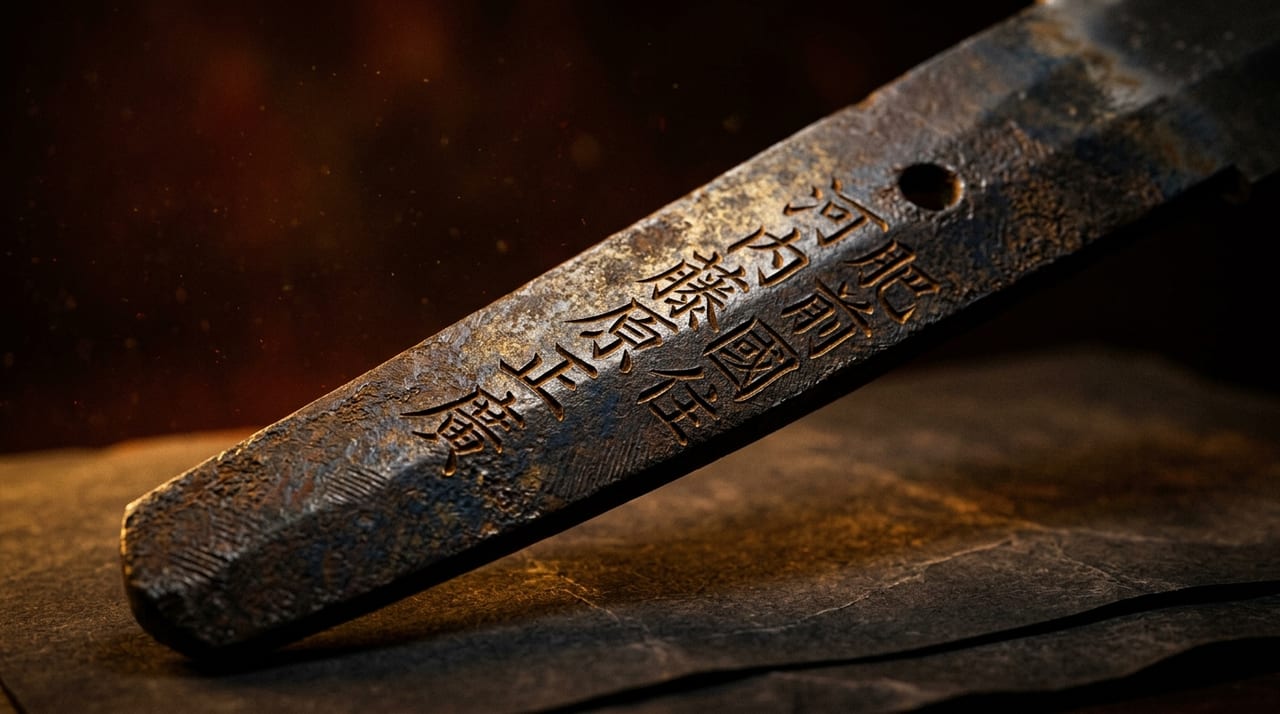
4. Shape of the tang and signature characters: Mitsutada's tang should display patina appropriate to the period, and his signature characters have distinctive stylistic traits. An NBTHK certificate of authenticity provides the greatest assurance.
5. Period patina: Authentic Kamakura-period patina results from over 700 years of natural oxidation and has a characteristic hue. Artificially created patina differs in color and depth.
Where to View Mitsutada's Masterpieces
Major institutions where Mitsutada's works can be viewed:
- Tokugawa Museum (Mito): Offers regular exhibition opportunities for Shokudai-kiri Mitsutada
- Kyoto National Museum: Regularly displays its Mitsutada collection
- Tokyo National Museum: Occasionally displays Mitsutada-related blades in special exhibitions
- Japanese Sword Museum (Tokyo, Ryogoku): Reference materials and appraisal information regarding Mitsutada are available
Conclusion—What Mitsutada Left Behind
Osafune Mitsutada's greatest legacy to the history of Japanese swords was establishing a new aesthetic standard—"the beauty of the choji blade pattern." His large choji became the ideal that all subsequent Bizen sword makers should reference, and surpassing "Mitsutada's choji" became the goal of later craftsmen.
The fact that masterpieces such as Shokudai-kiri Mitsutada and Ikoma Mitsutada have been carefully preserved to the present day attests to the recognition that Mitsutada's works transcended mere weapons and were acknowledged as works of art.
That a sword maker from the Kamakura period is still called "the apex of Bizen blades" 800 years later eloquently testifies to the timeless universality of his technique and aesthetic sensibility.