What Is a Juryo-mei? Reading Provincial Official Titles in Swordsmiths' Signatures
 * Image is for illustrative purposes only.
Table of Contents
What Are Shuryō Mei?
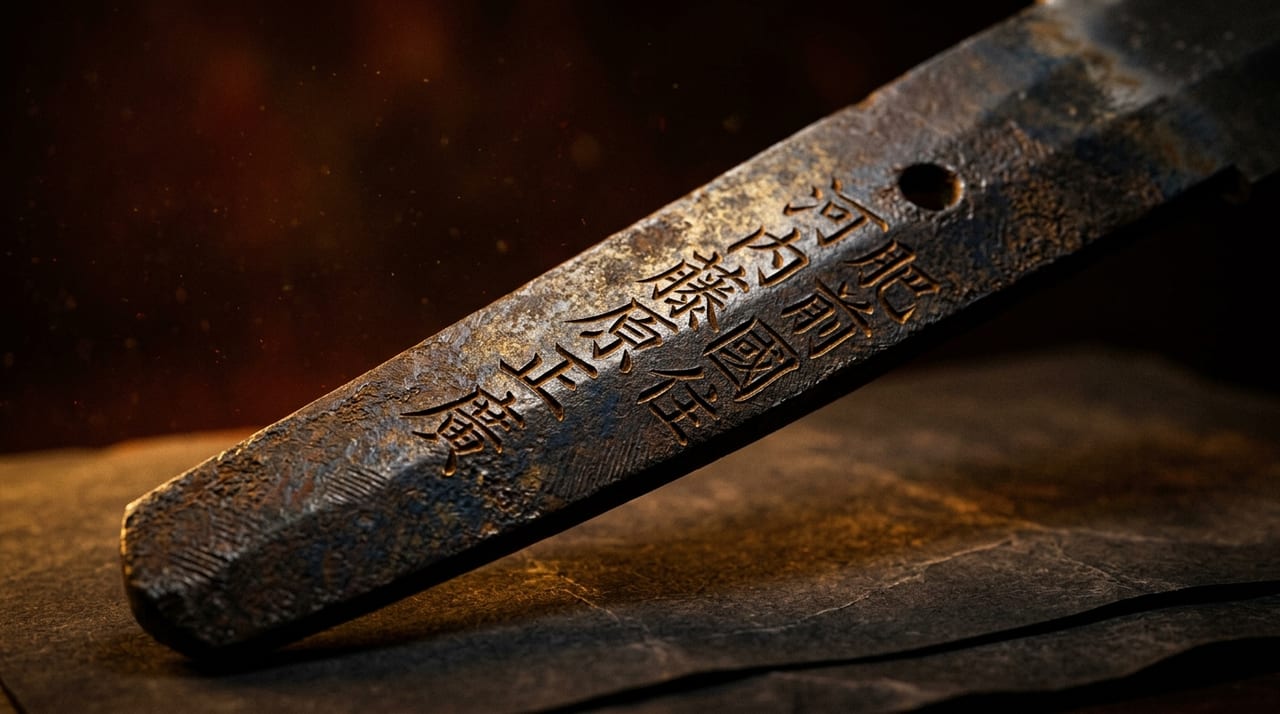
Japanese sword blades have signatures cut into the tang (nakago). Some signatures include official titles before the swordsmith's name, such as "Echizen no Kami Sukehiro" or "Mutsu-no-kami Yoshiyuki." These are called shuryō mei. Originally, these were the titles of court officials who governed provinces under the centralized bureaucratic system. During the Edo period, swordsmiths adopted these titles to add prestige to their work.
The ranks of provincial governors consisted of: kami (守), the top position; suke (介), the vice position; jō (掾), the third rank; and sakan (目), the fourth rank. Sword signatures primarily feature kami and jō, with jō sometimes distinguished as greater or lesser rank. It is important to note that Edo period official titles were honorary designations that had no connection to actual governance. A swordsmith who signed as "Mutsu-no-kami" did not actually rule Mutsu Province.
Shuryō mei are frequently seen among swordsmiths of the Shintō period beginning in the Keichō era. In contrast, swordsmiths of the Kotō period typically used regional or place names, or simply their personal names. The form of the signature itself serves as a clue to dating.
How to Read Shuryō Mei
Shuryō mei become easier to understand when read in the following order:
- Identify the official title portion (for example: Echizen no Kami, Mutsu-no-kami, Izumi no Kami)
- Check for the presence of a family name (some include surnames such as Fujiwara, while others do not)
- Read the swordsmith's name (for example: Sukehiro, Yoshiyuki)
- Check for any dates or characters such as saku or zō that may be added
Since official titles consist of a province name followed by kami or jō, they can be read if you know the names of Japan's old provinces. However, multiple swordsmiths may share the same official title. It is impossible to identify a swordsmith based on the title alone; the title must always be combined with the swordsmith's name for proper identification.
For example, Tsuda Sukehiro of the Osaka Shintō is known for signing as "Echizen no Kami Sukehiro," and Mutsu-no-kami Yoshiyuki is also well documented; this site's explanatory articles compile both their styles and provenance. Reading the explanations for individual swordsmiths, such as the Mutsu-no-kami Yoshiyuki explanation and the Osaka Shintō explanation, will clarify the connection between signature and style.
The System of Shuryō and Kyoto Smithing
How swordsmiths obtained official titles is a subject on which historical sources and scholarly interpretations vary. The most widely accepted theory is that the procedure required involvement with court rank assignments, so swordsmiths sought intermediaries, and prominent smithing families in Kyoto served as intermediaries. The Kyoto Kinmichi family, which used the name Iga no Kami Kinmichi, is known to have been central to this role.
However, the details of procedures, costs, and variations across time periods have not been clarified with sufficient certainty. While it is certain that obtaining an official title was a significant honor for a swordsmith, it is best to regard the system's background without attempting to detail every aspect.
For swordsmiths employed by domains, relationships with the domain lord's preferences and the domain's status can be imagined, but these too cannot be universally generalized. The relationship between domains and swordsmiths is discussed from another angle in the explanation of domain swordsmith patronage systems.
Inferring Production Dates from Signature Changes
Even for the same swordsmith, signatures sometimes changed before and after receiving an official title. For example, a swordsmith might carve only the name before receiving the title, then change to signing with the official title after receiving it. By using this change as a marker, one can roughly divide the works of a single swordsmith into pre-title and post-title periods.
Moreover, some swordsmiths changed their official title partway through their careers. In such cases, differences in the calligraphy of the signature, the manner in which characters are cut, and the official titles themselves become clues for inferring the chronological order of production. Observing whether changes in style coincide with changes in signature adds depth to the appreciation of the work.
One important point to note is that the presence of an official title does not straightforwardly indicate whether a blade is old or new. Since swordsmiths of the second and third generation often inherited the same name, one must always consider the possibility that a signature of the same name might be the work of a different person. For distinguishing between generations, the article on the technique of cutting signatures is also a useful reference.
Approaching Counterfeit Signatures
Famous shuryō mei are also frequent targets of counterfeiting (gimei). Rather than judging based solely on the signature, verify the following points:
- Whether the steel texture (jigane) of the blade's surface aligns with that swordsmith's known style
- Whether the blade pattern's character and form are consistent with documented examples
- Whether the rust color on the tang and file marks (yasurime) are proportionate to the signature's apparent age
- Whether the cutting style of the signature characters exhibits the same characteristics as other authenticated signed works
The fundamentals for distinguishing genuine from counterfeit signatures are outlined in the explanation of signature types and authentication. The signature is only the gateway to a work; it cannot be evaluated separately from the blade's actual quality.
Tips for Reading Signatures on Listing Pages
When viewing swords online, the signature on the tang visible in photographs becomes the primary source of information. For swords bearing shuryō mei, you can read the official title and swordsmith's name using the steps above, then cross-reference them with the information in authentication certificates or registration documents for better understanding. When uncertain about how to read a signature, the description on the listing page or inquiry through the contact form are also options.
Shuryō mei carry historical significance as official titles that Edo period swordsmiths adopted for their names. Understanding how to read them reveals how the spirit of an era and the status of a swordsmith have been inscribed into the tang of a single blade.