Swordsmiths Who Changed Trades After the Sword Abolishment Edict: Records of Transitions to Kitchen-Knife and Farm-Tool Forging
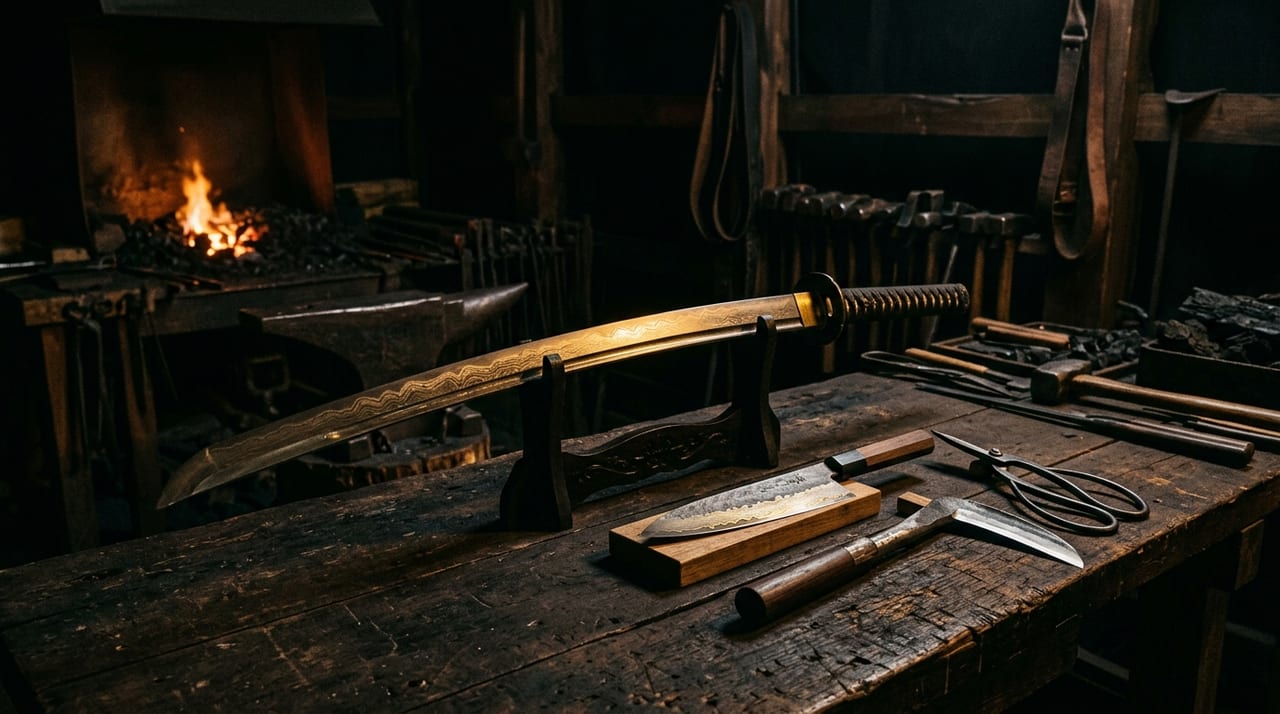 * Image is for illustrative purposes only.
Table of Contents
The Haitōrei as a Turning Point
In March 1876 (Meiji 9), the Meiji government issued the Haitōrei (Edict Prohibiting the Wearing of Swords), banning the wearing of swords except for those in ceremonial dress, military personnel, and police officers. This, alongside the shizoku shokuzumi (disbanding of samurai pensions) that same year, was one of the policies that stripped the samurai class of their economic foundations, and it dealt a direct blow to the demand for Japanese swords. With samurai no longer wearing swords in their daily lives, the demand for practical Japanese swords rapidly declined, forcing the swordsmiths who had made their living forging swords to fundamentally reconsider how they conducted their business. The work of swordsmiths, which had been sustained by the stable clientele of samurai society, lost its footing with this single edict.
The Economic Crisis Faced by Swordsmiths
Even before the Haitōrei, the management of swordsmiths, whose primary clientele had been the samurai class, was already under strain due to the disbanding of samurai pensions after the Meiji Restoration and the dismantling of the class system. The Haitōrei was the definitive event that sealed this trend. With the loss of demand for swords, there were few jobs in which swordsmiths could apply the forging techniques they had cultivated. For swordsmiths who had maintained workshops and apprentices, the sharp drop in demand became a matter of survival, and many chose one of the following paths:
- Seeking new opportunities in the demand for decorative swords and military blades, since the demand for swords had not completely disappeared
- Converting their craft to the production of everyday items that could utilize their forging techniques, such as kitchen knives, agricultural tools, and scissors
- Abandoning blacksmithing entirely to pursue a completely different profession
Of these, the second path was the most practical in terms of maintaining continuity of technique, and indeed, the formation of blade-making centers throughout the country suggests that many swordsmiths took this route. It was significant that the skill of sword-making was not entirely wasted; by redirecting their efforts from sword blades to everyday blades, these craftsmen could continue to apply their accumulated expertise.
Transition to Kitchen Knife Forging
The forging of Japanese swords is a technical system that involves fold-forging tamahagane to create layers of hard and soft steel, producing a sharp blade through heat-treatment. This technique could also be applied to the manufacture of kitchen knives, which require sharp blades. The techniques for forging sword blades and kitchen knives shared much in common in terms of steel handling and the nuances of heat-treatment, and examples of swordsmiths converting to kitchen knife forging were seen throughout the country. The existence of a wide range of demand, from practical knives for farmers to high-end knives for chefs, further encouraged this transition. For craftsmen who had honed their skills in the curvature and jihada of sword blades, the kitchen knife, though smaller in scale, was a tool with much in common in terms of achieving both sharpness and durability.
Transition to Agricultural Tool and Scissors Forging
Many swordsmiths also transitioned to manufacturing agricultural tools such as sickles, hoes, and spades, as well as scissors. Agricultural tools and scissors, like kitchen knives, were tools that required sharp blades and durability, making them fields where the techniques developed through sword-forging could be applied. For swordsmiths whose primary customers had been urban samurai, agricultural tools with consistent demand in rural areas were a rational alternative occupation, opening up new customer bases. Agricultural tools had the advantage of generating continuous replacement demand as consumables, unlike swords, which had the character of luxury goods. While swords were special tools bound to social status, kitchen knives, agricultural tools, and scissors were everyday tools used by people of all classes, and the vastly broader customer base is considered to be another reason why these became chosen alternative occupations.
Regional Transformation as Seen in Seki
Seki City in Gifu Prefecture, long known as a center of sword production, is well-known as a representative example of a region where swordsmith techniques were passed on to the blade industry after the Haitōrei. Seki had been a sword-producing center since the Kamakura period, and after the Haitōrei reduced demand for swords, it transformed into a center for blade production, beginning with kitchen knives, building on its accumulated forging techniques. The reason Seki is known today as "the city of blades" is the result of this historical transmission of technique. While detailed records of individual swordsmiths' career changes are not preserved, it is widely known as an example of technological transition at the regional level. This regional-scale transformation demonstrates that it was not individual swordsmiths converting in isolation, but rather the foundational blacksmithing techniques accumulated in the local area that were passed on to the next industry.
The Technical Legacy of Swordmaking That Persists Today
Though the Haitōrei greatly reduced the number of swordsmiths as a profession, the forging techniques themselves have been passed down to the present day as production methods for everyday items such as kitchen knives, blades, and agricultural tools. The fact that many blade-producing centers throughout Japan trace their lineage back to sword-forging is the result of these successive career transitions during the Meiji period. The techniques for forging swords and crafting everyday tools are connected at their foundation by the forging of steel, and despite the institutional break created by the Haitōrei, these techniques continue to live on in the blade-producing centers of today. For those interested in the history and cultural background of swords themselves, TOUKENZA's online catalog allows you to view actual swords, and we encourage you to consult it as well.