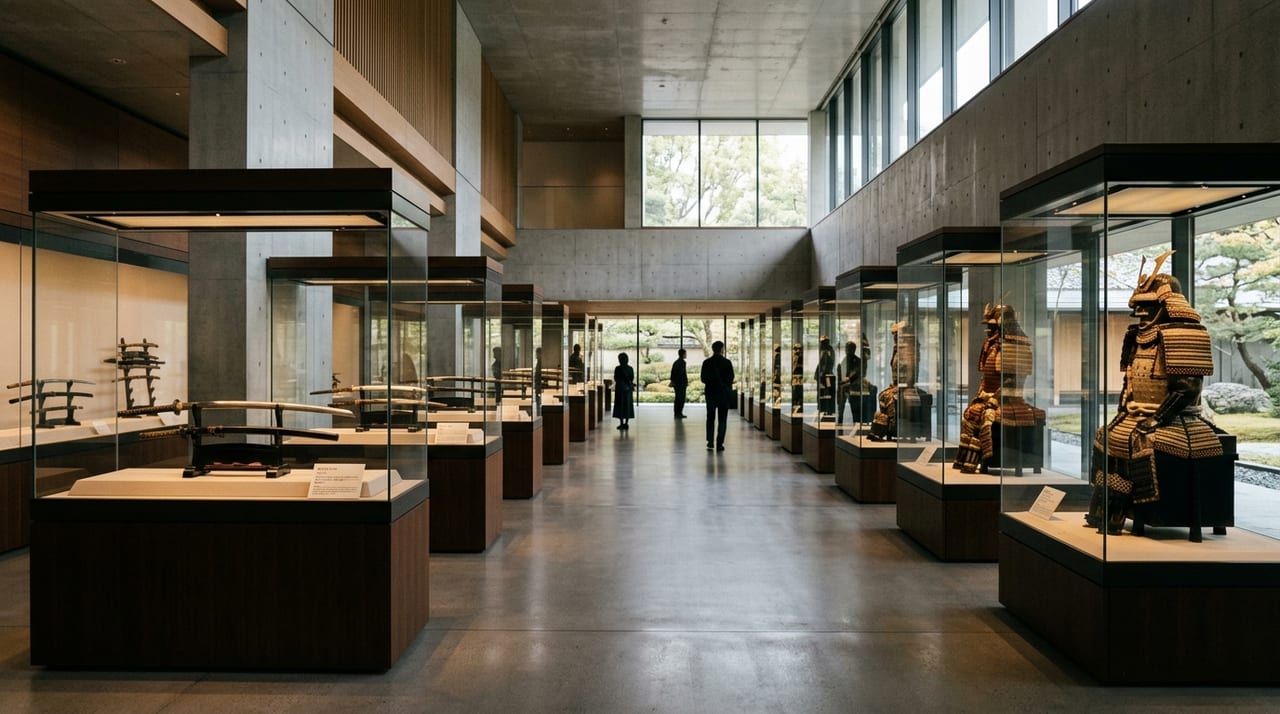
 * Image is for illustrative purposes only.
Yuki Kurabikan
結城蔵美館
Overview
Yuki Kurabikan is an exhibition facility housed in traditional storehouses (kura) in the center of Yuki, Ibaraki Prefecture, opened on 24 May 2014. It comprises two buildings — the main storehouse, used as a venue for new cultural activity, and the side storehouse, which collects and displays historical and cultural materials of Yuki. In the field of arms and armor it is known as the museum that permanently displays a reconstruction of Otegine, one of the Three Great Spears of Japan.
Otegine, One of the Three Great Spears
Otegine ranks with Nihongō and Tonbokiri among the spears traditionally counted as the Tenka Sanmeisō, the Three Great Spears of Japan. It is held by tradition to have been the weapon of Yuki Harutomo, head of the Yuki house, and descended thereafter through the lineage that succeeded to the Yuki name. Distinguished by an exceptionally long blade, the piece is said to have reached a total weight of roughly 22.5 kilograms including its mounting — far beyond that of an ordinary spear, implying extraordinary physical strength on the part of anyone who wielded it in the field.
The original was lost in the modern era, and what visitors see today is a precise reconstruction. Precisely because it is a reconstruction, however, the display conveys the physical scale of the weapon — its weight and dimensions — as something graspable rather than merely observed through glass, and is valuable for understanding the bodily demands that the spear imposed within warrior society. The spear stood alongside the sword as a principal weapon of the samurai, yet opportunities to confront one at full scale are rare; that is the particular significance of this museum for the study of Japanese arms.
The Yuki House and the Town of Yuki
Yuki developed as the seat of the Yuki clan, which held the district from the Kamakura period onward. Yuki Harutomo had no natural heir and, at the urging of Toyotomi Hideyoshi, adopted Hideyasu, the second son of Tokugawa Ieyasu. That adopted heir, known as Yūki Hideyasu, later moved to Echizen and became the progenitor of the Echizen Matsudaira house. Yuki is thus a place where the reorganization of a medieval warrior band of the Kantō into an early modern daimyo house can be traced through both place name and lineage.
The museum's displays are built around this history of the Yuki clan and around the region's industry and culture, of which Yuki tsumugi silk is the best-known expression. Merchant storehouses and clay-walled kura still stand throughout the surrounding streets, so that the townscape itself functions as an extension of the exhibition. Admission is free, reflecting an operating policy that positions the museum as an open gateway to local history.
Highlights
- Permanent display of a reconstruction of Otegine, one of the Three Great Spears of Japan, on the second floor of the side storehouse
- Conveys the physical scale of a great spear said to have weighed some 22.5 kilograms complete with mounting
- Traditionally the weapon of Yuki Harutomo; the original was lost in the modern era, so what survives is a precise reconstruction
- Yuki Harutomo adopted Tokugawa Ieyasu's second son Hideyasu, who became progenitor of the Echizen Matsudaira house
- Two storehouse buildings, free admission, set within a preserved kura townscape that extends the exhibition into the streets
* Opening hours and exhibitions are subject to change. Please check the official website before visiting.