Swords as Rewards for Military Merit: The Custom of Lords Bestowing Blades on Their Retainers
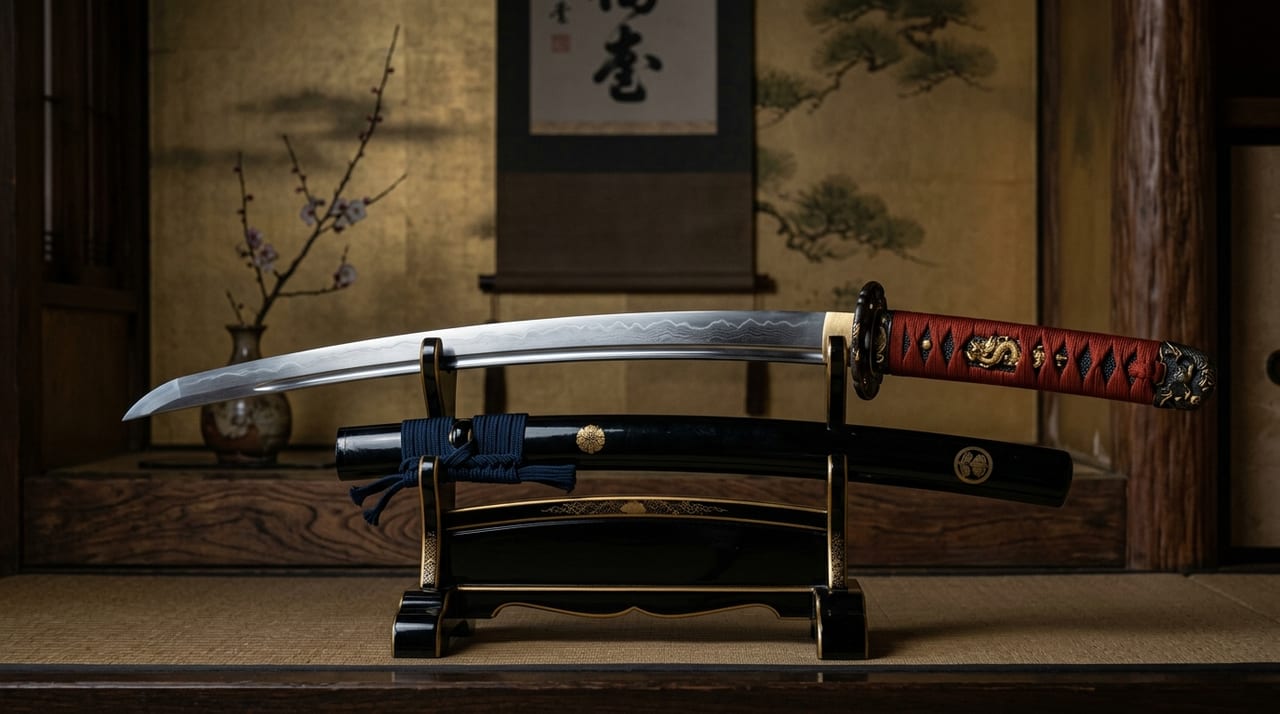 * Image is for illustrative purposes only.
Table of Contents
In the samurai society from the Sengoku period through the early Edo period, as a reward for military service, the custom of presenting swords directly from the daimyo became widespread, alongside increases in fiefs and the issuance of letters of commendation. Swords were not only weapons in actual warfare, but also gifts that embodied the relationship of trust between lord and vassal in material form; it was this dual character that gave the practice of presenting swords its unique weight within samurai society.
Rewards in Samurai Society and the Position of Swords
Military achievements in battle were first officially recorded through letters of commendation. A letter of commendation was a document in which a lord specifically recorded a vassal's war deeds, and it was also an important proof to be passed down to future generations as a matter of family pride. After receiving a letter of commendation, the basic practice was to then grant the practical reward of an increase in fief.
In addition to these, the act of directly presenting a treasured sword or an illustrious famous sword that the lord possessed functioned as a different type of reward. Whereas fiefs and money supported the economic foundation of a family, the presentation of a sword had the following characteristics:
- A proof that made visible the lord's personal trust and evaluation
- A gift embodying honor that could not be converted into money
- A symbol that conveyed the bond between lord and vassal in material form
- A means of passing down to future generations the family's standing and heritage
If a letter of commendation recorded "the fact of military achievement" as a document, then the presentation of a sword was an act that inscribed "the depth of the lord-vassal relationship" in material form. Only when these two overlapped could the military achievements of a single vassal be transmitted to future generations in their complete form.
A Concrete Example of Sword Presentation: The Heshikiri Hasebe
One example with documentary backing of the custom of presenting swords is the "Heshikiri Hasebe," designated as a National Treasure and held by the Fukuoka City Museum. This sword, said to be the work of Hasebe Kunishige, a swordsmith of the Nanbokuchō period, is traditionally recorded in the Kuroda family's documents as having been given by Oda Nobunaga to Kuroda Kanbei (Takao) as a reward for his service when he visited Nobunaga in Tenshō 3 (1575).
The name "Heshikiri" is said to derive from an anecdote in which Nobunaga used this sword to cut down a tea attendant who had fled under a kitchen shelf, simply by pressing it against him without raising the sword high. The fact that a sword bearing an anecdote of Nobunaga himself was presented as a reward to a close attendant clearly shows that the act of presenting a sword went beyond a mere exchange of gifts; it was an act of communicating the lord's personal trust.
This sword, which has been transmitted to the present day bearing the stories of both the lord who gave it and the vassal who received it, shows in a typical form how the custom of presenting swords was a mechanism that enriched the provenance of the blade.
Daihannya Nagamitsu—A Chain of Presentations Spanning Two Generations
As another example with similar characteristics, the National Treasure tachi "Daihannya Nagamitsu," held by the Tokyo National Museum, is also well known. This tachi, which originally belonged to the Ashikaga shogun family, is said to have been given to Tokugawa Ieyasu after it came into the hands of Oda Nobunaga due to his achievements in the Battle of Anegawa in Ganki 1 (1570). Furthermore, Ieyasu is said to have presented this tachi to his vassal Okudaira Nobumasa for his military achievements in the Battle of Nagashino in Tenshō 3 (1575).
The progression of a single famous sword passing from the shogun family to Nobunaga, from Nobunaga to Ieyasu, and from Ieyasu to Nobumasa in the context of different lord-vassal relationships shows that the act of presenting swords was not merely a personal reward, but was deeply bound up with political and historical contexts. The way that the same sword accumulated new anecdotes with each presentation shows that this custom was also a mechanism for continually updating the very provenance of the famous sword.
Letters of Commendation and Swords—Two Forms of Transmitting Memory
A letter of commendation, which functioned as proof of military achievement, was a document whose contents were practical records of specific war deeds. A letter of commendation remained clearly preserved as textual information and held value as a primary source for later researchers.
In contrast, records of sword presentations were often not systematically preserved as official documents, but were rather transmitted as family traditions or statements of provenance. While such records may fall short of the rigor demanded of historical materials compared to letters of commendation, they had the strength of being preserved over the long term as family memory through the transmission of the actual sword itself from generation to generation.
The fact that statements of the form "so-and-so received [this sword] from so-and-so" are often seen in the provenances of famous swords known today is evidence that such customs were widely practiced. Moreover, there are examples where a lord himself bestowed a name on a sword and presented it, and the name "Heshikiri" given to the Heshikiri Hasebe can be understood in this same context. Through the transmission of provenance and name as a unified whole, swords came to take on the character of historical witnesses transcending mere crafted objects.
The View of Swords Revealed by Presentation Blades—Transmitting Family Standing and Memory
Swords that had been presented were preserved as family treasures and were often inherited when the headship of the family changed hands. The very fact that "the sword was received from the lord" enhanced the sword's value and served as proof of the family's standing. Even after entering the Edo period and the loss of opportunities for actual combat, swords with a provenance of being presented continued to be carefully preserved in daimyo and hatamoto families. Their significance was maintained even in the exchange and inheritance of such swords in formal occasions.
Even when separated from the specific context of Sengoku battles, the chain of facts of "who gave it to whom" continued to function as value inscribed on the sword. This clearly demonstrates that in samurai society, swords were understood not merely as weapons, but as objects that made visible the relationships between people and served as mediators of memory across time.
The Pleasure of Reading Provenance—The Depth of Sword Appreciation
In sword appreciation, focusing on the craftsmanship of the blade and the qualities of the core metal and hamon is the foundation of appreciation, but knowing the provenance that a sword bears as it is transmitted down through time brings an additional depth to appreciation. A sword presented as a reward for military service carries overlapping narratives of both the lord who gave it and the vassal who received it.
It is no coincidence that many of the swords called famous swords possess provenances of passing from one lord-vassal relationship to another. To trace a sword's provenance is also to retrace the network of relationships between people in samurai society through the medium of objects. When investigating the provenance of a sword, by consulting not only family traditions and statements of provenance, but also publicly available materials such as explanatory notes accompanying designations as National Treasures or Important Cultural Properties, one's understanding of provenance will become all the more reliable.