The Fall of Osaka Castle and Fire-Damaged Swords: Echizen Yasutsugu's Re-quenching Records and the Tradition of Ichigo Hitofuri
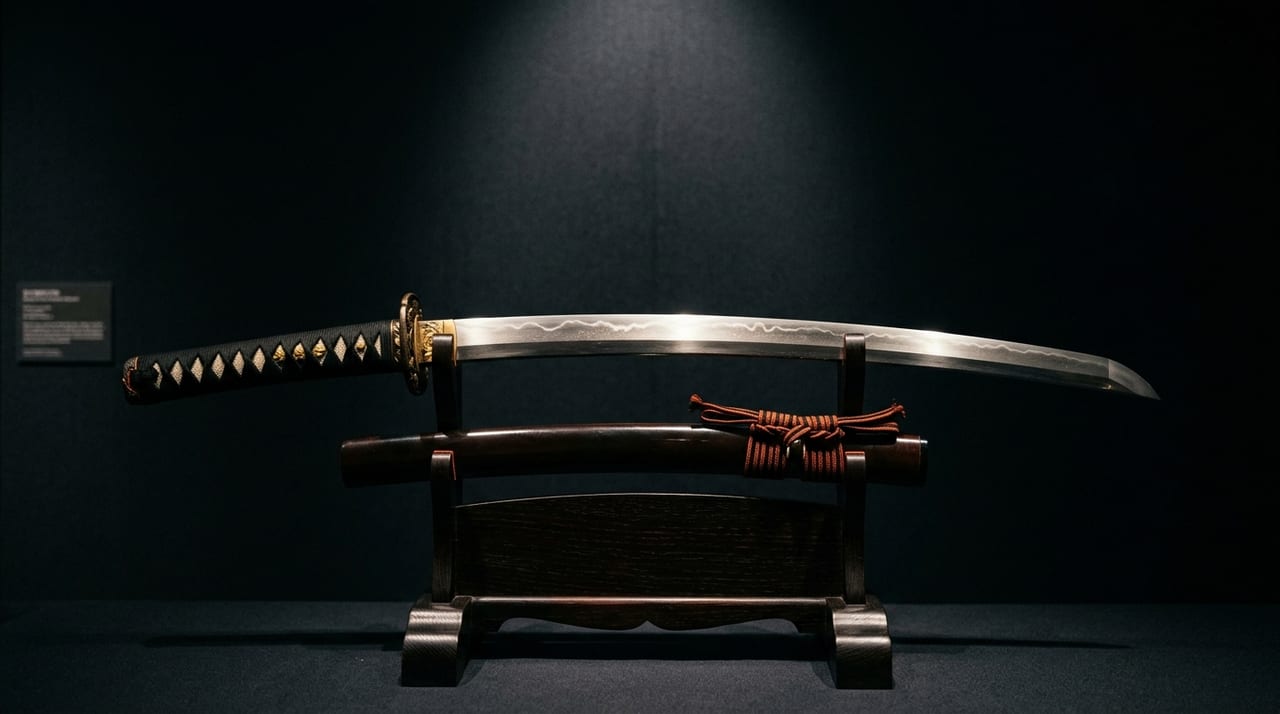 * Image is for illustrative purposes only.
Table of Contents
In the Summer Campaign of Osaka in 1615 (Keichō 20), Osaka Castle was engulfed in flames and fell. Many of the swords inside the castle were also exposed to the fire, and it is said that not a few became "yakemi" (fire-damaged blades), having lost their hamon and the character of their jigane. How were these burned famous swords treated afterward? This article keeps to what can be confirmed in the records.
What Is a Fire-Damaged Sword?
A sword gains the hardness of its edge and its hamon through a heat treatment called yaki-ire (quenching). When a blade is exposed to the high temperatures of a fire, this quenched state collapses, and the hamon and the workings of the jigane can no longer be seen. This is a yakemi.
A fire-damaged sword cannot recover its original hamon. For this reason, a method called "saiba" (re-quenching), in which the quenching is done over again, is used. Re-quenching is a restoration technique, but it also has a limit: it cannot fully reproduce the original style of the work. This point is explained in detail in the following article.
The Re-quenching Ordered by Ieyasu
The explanation by the Nagoya Japanese Sword Museum states that in 1615 (Keichō 20 / Genna 1), after the end of the Summer Campaign of Osaka, Echizen Yasutsugu (Echizen Yasutsugu) received an order from Tokugawa Ieyasu and re-quenched the Japanese swords that had been burned in the fall of Osaka Castle (source: the Nagoya Japanese Sword Museum's explanation of Echizen Yasutsugu).
The points worth noting in this explanation are as follows.
- The time was after the end of the Summer Campaign of Osaka
- The one who gave the order was Tokugawa Ieyasu
- The work was the re-quenching of swords burned in the fall of the castle
According to the same explanation, Yasutsugu at this time re-quenched a number of famous swords, beginning with the tachi "Ichigo Hitofuri," and this led him to begin making copies of ancient famous swords as well.
There is also a concrete example of a re-quenched sword. The Tokugawa Art Museum's explanation states that the tantō "Meibutsu Ōsaka Naga-mei Masamune" in its collection was exposed to fire when Osaka Castle burned along with the fall of the Toyotomi family, and was re-quenched by the first Echizen Yasutsugu under Tokugawa Ieyasu (source: the Tokugawa Art Museum's explanation of its collection).
Yasutsugu was a tōkō who was taken into the service of Yūki Hideyasu and later made swords at the request of Tokugawa Ieyasu and his son Hidetada. His life is summarized in the following article.
The Tradition Surrounding Ichigo Hitofuri
The representative sword said to have been burned in the fall of Osaka Castle and re-quenched by Yasutsugu is the tachi "Ichigo Hitofuri," attributed to Awataguchi Yoshimitsu. The Nagoya Japanese Sword Museum's explanation states that its nagasa, which had been 2 shaku 8 sun 3 bu (about 85.8 cm) before the re-quenching, was shortened by suriage to 2 shaku 2 sun 8 bu (about 69.1 cm), and that the original mei was kept at that time and made into a gaku-mei (source: the Nagoya Japanese Sword Museum's explanation of Beloved Swords of Toyotomi Hideyoshi).
After the re-quenching, Ichigo Hitofuri was kept by the Owari Tokugawa family. In 1863 (Bunkyū 3), in the Bakumatsu period, Tokugawa Mochinaga, the 15th lord of the Owari domain, presented it to Emperor Kōmei, and it is now a gyobutsu of the Imperial Household.
However, what this article has checked goes only as far as the explanations of the holding museums and the Japanese Sword Museum; it has not consulted the original texts of the contemporary records. For details such as the timing of the suriage, it is prudent to accept them in line with how the explanations are worded.
Yasutsugu, Summoned by the Two Gosho
That Yasutsugu was held in high regard by the shogunal house can also be seen from the inscriptions on his surviving works. On the wakizashi that Yasutsugu dedicated to Atsuta Shrine (a jūyō bunkazai, held by Atsuta Shrine), the mei carries a phrase recording the dedication to Atsuta Daimyōjin, followed by the phrase "summoned by the two Gosho to Edo in Musashi Province." It is an inscription showing that he was summoned by the two Gosho and made swords in Edo. The Nagoya Japanese Sword Museum's explanation states that this inscription records how Yasutsugu was granted the hollyhock crest and the character "Yasu" by Tokugawa Ieyasu (source: the Nagoya Japanese Sword Museum's explanation of Echizen Yasutsugu).
This wakizashi is a separate matter from the record of re-quenching the fire-damaged swords of Osaka Castle. To read accurately, one should distinguish the re-quenching of burned swords from new work made for the shogunal house, as separate jobs.
Do Not Confuse It with Later Great Fires
The re-quenching of meibutsu is sometimes confused with events of a later age. For example, Sōza Samonji is a sword that was burned in the Great Fire of Meireki in 1657 (Meireki 3) and then re-quenched. Honebami Tōshirō was found undamaged at the Summer Campaign of Osaka, but it became a fire-damaged blade in the Great Fire of Meireki and was restored by the hand of the third Echizen Yasutsugu (source: the Nagoya Japanese Sword Museum's explanation of the Great Fire of Meireki). Both the period and the person who carried out the work differ from the re-quenching after the Siege of Osaka.
When reading about a sword burned in a fire, checking separately "which fire" and "which generation of swordsmith" is the shortest way to avoid mix-ups.
From the Viewpoint of Sword History
The fall of the Toyotomi family, in which the famous swords gathered at Osaka Castle were burned or changed hands, was also a major turning point for the circulation of swords. The whole picture is covered in the following article.
A fire-damaged sword is one that carries on its blade both the misfortune of the fire and the act of restoration through re-quenching. When researching the provenance of a surviving meibutsu, whether it has a history of being burned is also an important clue.
Summary
- That Yasutsugu re-quenched fire-damaged swords on Tokugawa Ieyasu's orders after the Summer Campaign of Osaka can be confirmed from the explanations of the Nagoya Japanese Sword Museum and the Tokugawa Art Museum
- Ichigo Hitofuri is said to have been burned in the fall of Osaka Castle and re-quenched by Yasutsugu, and its nagasa was shortened by suriage from 2 shaku 8 sun 3 bu to 2 shaku 2 sun 8 bu
- The mei on the wakizashi at Atsuta Shrine shows that Yasutsugu was summoned by the two Gosho, but that is a separate matter from the re-quenching of the burned swords itself
- The re-quenching after the Great Fire of Meireki (1657) was the work of a different period and a different smith
If your interest in the provenance of swords and the lineages of swordsmiths has grown, you can browse the swords on offer in the online catalog (sword list). Please send any questions through the contact form.