The Tansetsu Technique: Furnace Temperature Management and the Process of Integrating Kawagane and Shingane
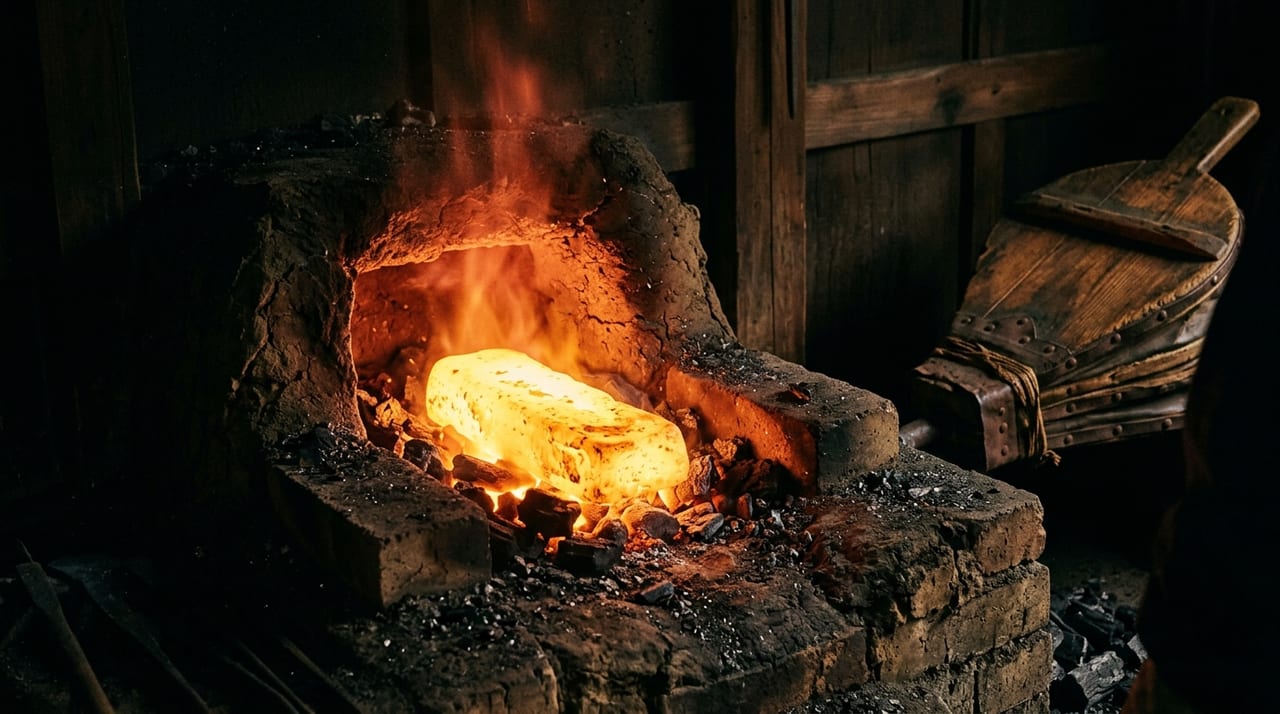
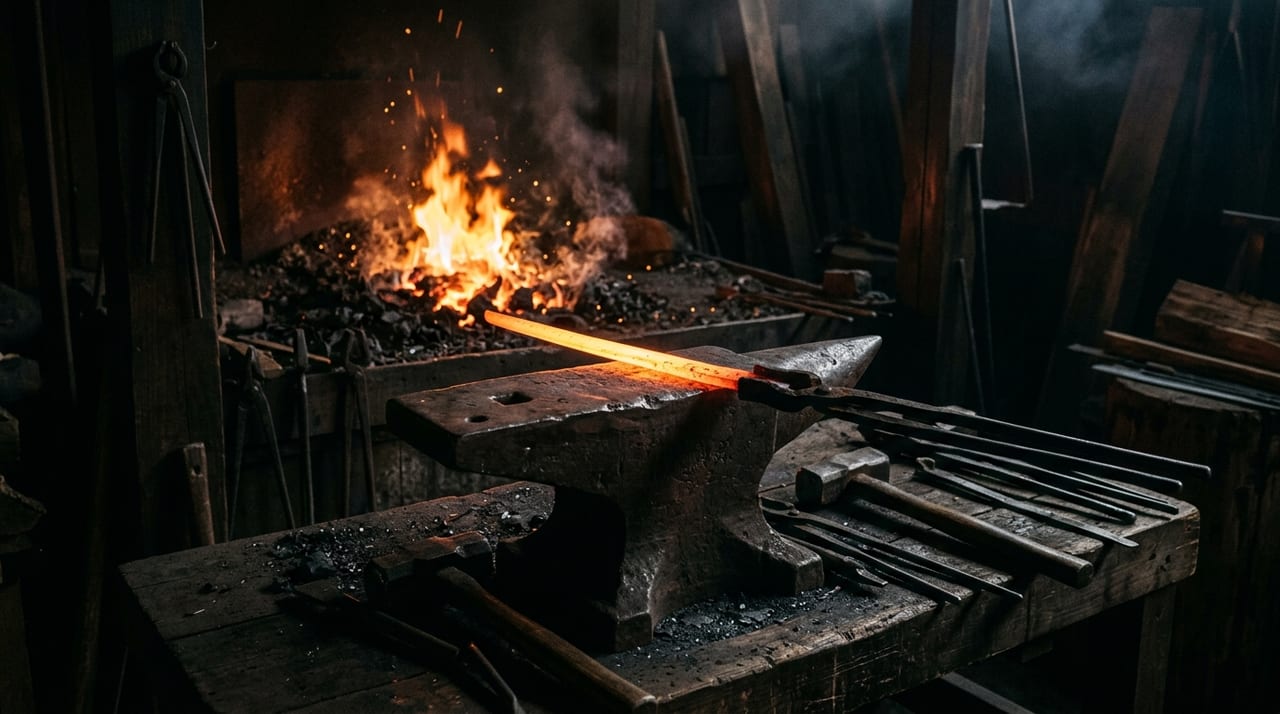
 * Image is for illustrative purposes only.
Table of Contents
Tansetsu — The Forge-Welding Technique That Creates the Nihontō's Structure
The blade of a nihontō is not made from a single steel but has a composite structure combining multiple steels. The core technique that realizes this composite structure is tansetsu — called "forge welding" in English — a high-temperature pressure-bonding weld.
The purpose of tansetsu is to integrate steels of differing carbon content into a single piece. The nihontō's typical structures — "hon-sanmai" and "shihōzume," among others — are all realized through this tansetsu technique. The respective roles of kawagane and shingane and the differences in their carbon content are explained in detail in The Composite Structure of Kawagane and Shingane.
Why Is a Composite Structure Necessary — Achieving Both Hardness and Toughness
The performance demanded of a nihontō is essentially contradictory:
- To cut: the edge must be hard (high-carbon steel)
- To resist breaking: the blade must have toughness (low-carbon steel)
A single carbon content cannot satisfy both requirements. Therefore, tōkō:
- Kawagane: high-carbon steel (approximately 0.5–1.0% carbon) used on the outside of the blade and at the cutting edge
- Shingane: low-carbon steel (approximately 0.2–0.5% carbon) placed at the core (interior) of the blade
By integrating this two-layer (or multi-layer) structure through tansetsu, they realize an ideal blade that is "hard on the outside and tough at the core."
The Tansetsu Process — A Race Between Furnace Temperature and Speed
Preparation: Shaping the Steel
Before performing tansetsu, the kawagane and shingane are each shaped into appropriate forms. How many times the orikaeshi tanren is repeated at this stage determines the density of the steel (for the relationship between fold count and quality, see Fold Count and Steel Changes in Orikaeshi Tanren).
Shaping the kawagane: The kawagane, which has undergone repeated orikaeshi tanren, is shaped into a tray-like form to encase the shingane. This shape determines the cross-sectional structure after tansetsu.
Shaping the shingane: The shingane is shaped into a rectangular bar of appropriate size to serve as the core material enclosed within the kawagane.
Cleaning the Bonding Surfaces
The success of tansetsu depends greatly on the cleanliness of the bonding surfaces. If oxide scale remains on the bonding surfaces, complete fusion is impeded.
Traditional cleaning methods:
- Use of straw ash (warahai) as flux: During heating, straw ash is sprinkled on to function as a "flux" that dissolves and removes the oxide scale
- Repeated striking: After heating, the steel is quickly struck lightly to physically remove scale
Temperature Management — The Range for Tansetsu Temperature
The temperature range required for successful tansetsu is approximately 1,200–1,300°C. At this temperature, steel reaches a "white-heat (hakkan)" state, and the metal acquires a viscosity close to semi-molten.
Temperature judgment by furnace color:
- Orange (approximately 800–900°C): suitable for tanren but insufficient for tansetsu
- Yellow-white (approximately 1,100–1,200°C): approaching tansetsu-capable temperature
- White (approximately 1,200–1,300°C): correct temperature for tansetsu
- Dazzling white (above 1,300°C): overheated, danger of "yake" (burning)
The danger of "yake": When the temperature is too high, the crystal grains of the steel coarsen dramatically, resulting in a "yake" state in which strength after tansetsu drops sharply. Steel that has once experienced "yake" can sometimes no longer be reused.
Executing Tansetsu — The Most Critical Moment
Immediately after being removed from the furnace, the steel loses temperature by the second. The tōkō and his apprentice quickly perform the following:
- Remove the kawagane (wrapped around the shingane) from the furnace
- Quickly place it on the anvil
- Fix the positions of the kawagane and shingane with the first strike
- Strike the whole evenly to press-bond the bonding surfaces
The time allowed for this is approximately 3–10 seconds. Moving from furnace to anvil, delivering the first strike, and hammering continuously — all within this short time — requires perfect coordination between the tōkō and his apprentice.
"The weight and position of the first strike is the life of tansetsu," it is said, and the judgment at this moment determines whether the bond succeeds or fails.
Types of Tansetsu Defects and Their Effects
If tansetsu fails, serious defects remain in the blade.
Ware (Cracking) and Hakuri (Delamination)
The kawagane and shingane do not bond completely, and after polishing the kawagane may delaminate, or voids may remain inside the blade. This is a fatal defect that causes breakage in actual use.
Tansetsusen (Weld Lines)
A phenomenon where the bonding surfaces do not fully fuse and remain as boundary lines. They can appear as unnatural lines during appreciation and significantly reduce the blade's evaluation.
Uneven Distribution of Carbon
If the temperature during tansetsu is uneven, carbon can diffuse near the bonding surfaces and the carbon distribution may not match the design. This leads to uneven hamon and instability in yaki-ire.
The Significance of Tansetsu as Understood Through Modern Science
Modern metallurgy evaluates the traditional tansetsu technique from the following perspectives:
As diffusion bonding (Diffusion Bonding): Tansetsu is a form of "solid-phase diffusion bonding" in which metal atoms mutually diffuse under high temperature and pressure to achieve bonding. In high-quality tansetsu, the boundary at the bonding surface disappears and the result becomes a single homogeneous steel.
Synergy with tanren effects: The hammering performed simultaneously with tansetsu promotes grain refinement (ultra-fine microstructure formation through repeated deformation). This is why the steel of a nihontō is improved in quality not only through orikaeshi tanren but through the combination of "tansetsu plus tanren." For a more concrete view of the in-furnace bonding process as specific working procedures, see Tansetsu Technique in Warikomi-zukuri.
Conclusion — The Soul of the Nihontō Resides in Tansetsu
Tansetsu is not merely a technique for integrating multiple steels into a single piece; it is the foundational technique that creates the nihontō's unique structure of "hard on the outside, soft on the inside." Furnace temperature management, the use of flux, and swift execution — only when all of these come together perfectly is a nihontō that neither breaks nor fails to cut born.
Traditional tansetsu technique can only be acquired through oral transmission from master to apprentice and practical training, and even as modern science clarifies its principles, the transmission of technique continues to depend on direct experience passed from person to person. This is one of the essential reasons why the craft of nihontō kaji is protected as "cultural heritage."