The Fundamentals of Hi-zukuri: How Temperature Management in the Forge and the Timing of Hammer Blows Determine the Shape of the Blade
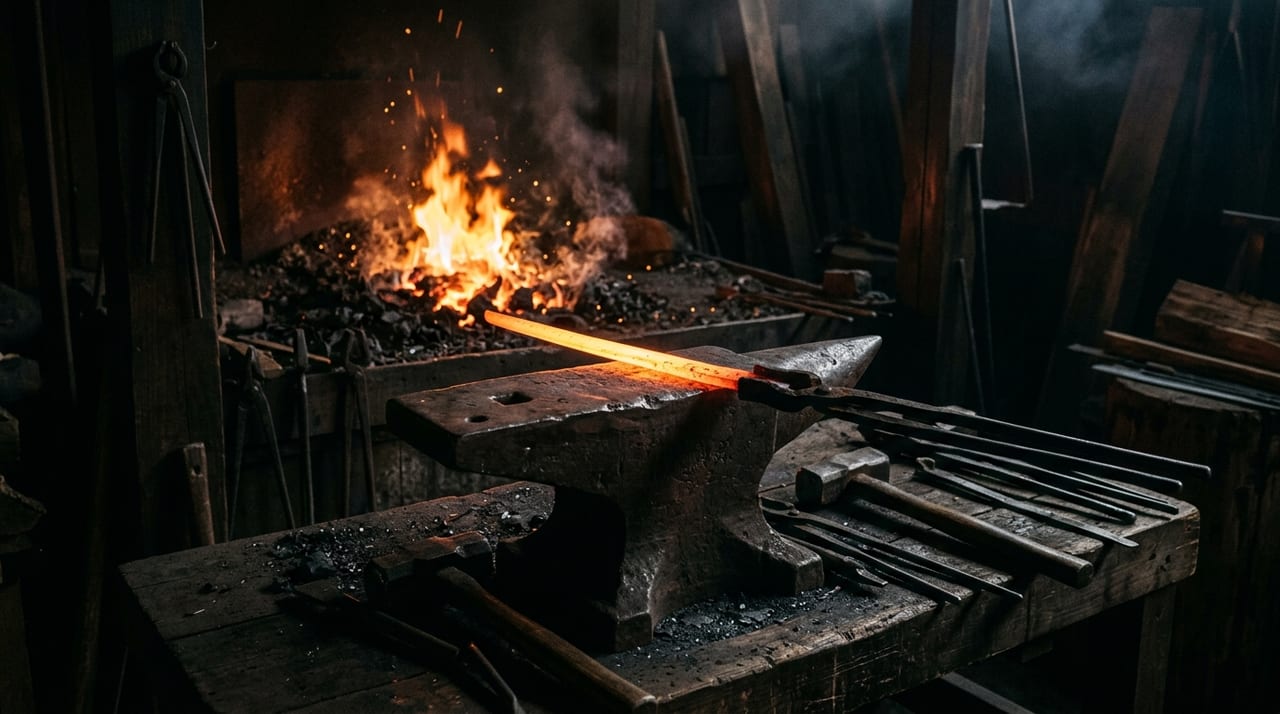 * Image is for illustrative purposes only.
Table of Contents
What Process Does Hi-zukuri Refer To?
The manufacturing process of a nihontō broadly follows the sequence: tsukurikomi → sunobe → hi-zukuri → tsuchioki → yaki-ire (quenching) → kenma (polishing). Among these, hi-zukuri is the process of shaping the steel—which has become rod-like through tsukurikomi and sunobe—into the actual form of the sword: nagasa (blade length), sori (curvature), blade width, and the position of the shinogi (ridge line).
Tsukurikomi is the process of incorporating the shingane (core steel) into the kawagane (jacket steel) that has completed orikaeshi tanren (folding), creating the structure unique to nihontō that combines hard and soft steel. In sunobe, which follows tsukurikomi, the combined steel billet is drawn out lengthwise and the overall cross-sectional shape is refined. Hi-zukuri is the work of bringing the sunobe material closer to the final shape of the sword using hammers (large hammer and small hammer) and a chisel (tagane).
Whether this process can be executed accurately has a major bearing on the quality of the final blade form, and for this reason hi-zukuri is considered one of the moments at which a tōkō's skill is most directly tested.
Temperature Management: Reading the Color of the Flame and the State of the Steel
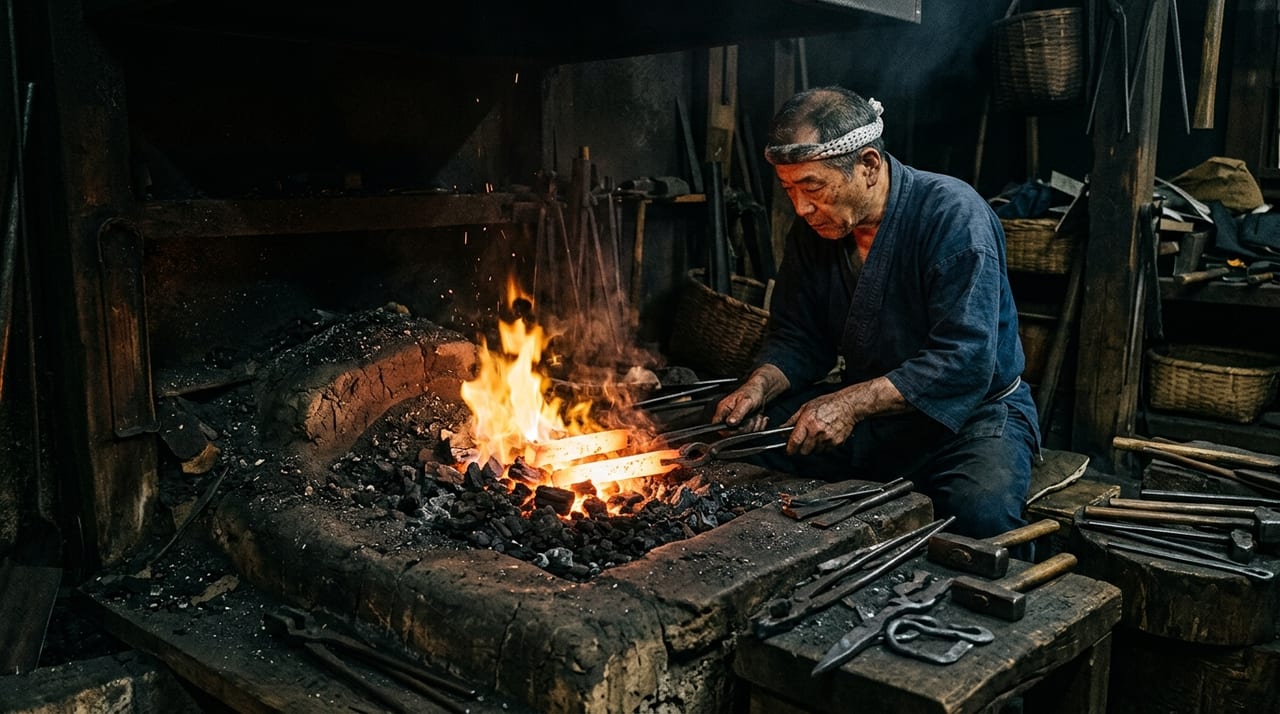
Temperature management in hi-zukuri is not carried out with precision thermometers as with modern industrial products. The tōkō judges the optimal working temperature by observing with the naked eye the color of the flame heating the steel and the way the steel glows and its color.
| Color | Approximate Temperature | Condition |
|---|---|---|
| Black-red (kuro-aka) | around 400–600°C | The steel is hard and difficult to deform even when struck with a hammer. Striking at this temperature range risks causing internal cracks, so it is considered a temperature at which one must not strike. |
| Red (aka) to orange-red (daidai-aka) | around 700–900°C | The steel begins to soften and can be shaped with a hammer. This temperature range is often used during the sunobe stage. |
| Yellow-red (ki-aka) to yellow (ki) | around 900–1100°C | This is the temperature range most commonly used in the hi-zukuri of nihontō. It is considered the optimal forging temperature for tamahagane, and the steel softens sufficiently to respond readily to hammer blows. |
| White (shiro) to white-bright (hakkō) | 1200°C or above | The steel becomes overheated (burned), and there is a risk that carbon combustion makes the steel brittle. One must not strike at this temperature. |
The tōkō discerns these temperature colors in a dimly lit forge with little natural light. Traditional forges are often built to limit the amount of light admitted so that changes in color are easier to read.
The "Maai" of Hammer Blows: A System of Timing and Force Distribution
Alongside temperature management, the "maai" (timing and spacing) of hammer blows forms the foundation of hi-zukuri. The time during which the steel is at the right working temperature is extremely short (roughly several seconds to a dozen or so seconds), and the required deformation must be applied within that limited time.
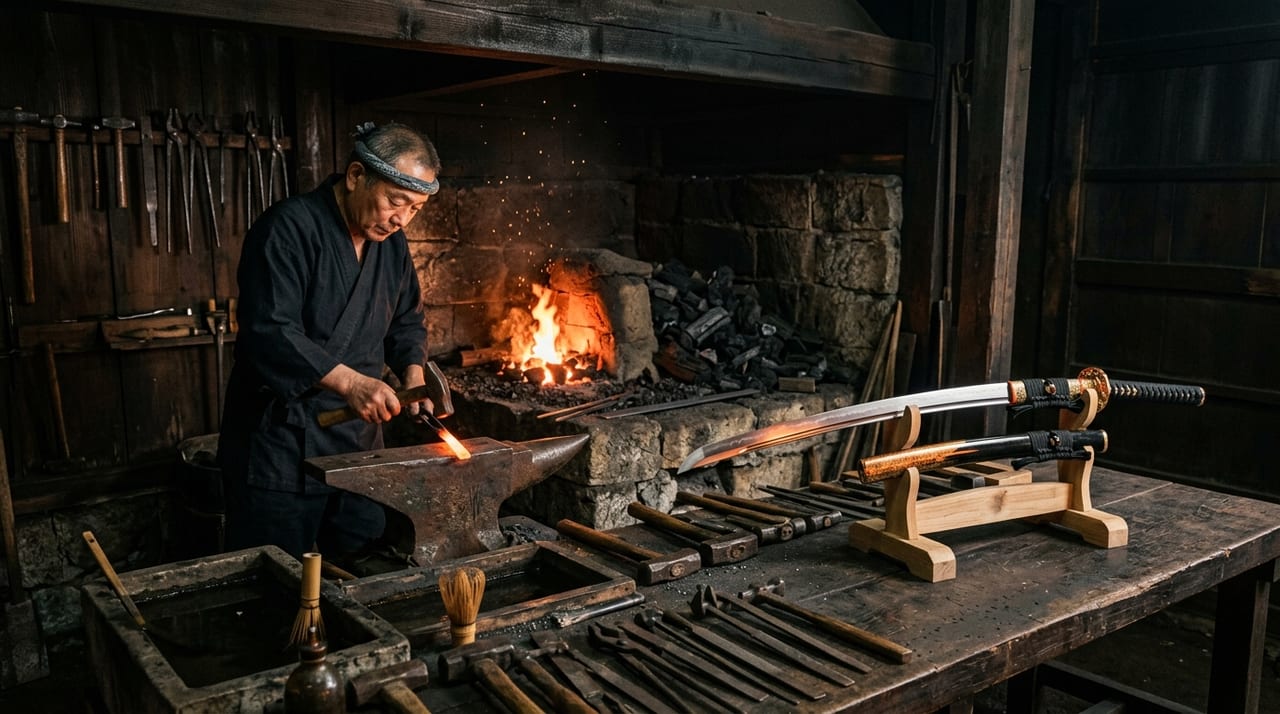
Division of roles between the large hammer (ozuchi) and small hammer (kozuchi): In a traditional forge, the basic work arrangement was one of two or more people, with the tōkō (kaji) holding the small hammer and an apprentice taking the role of "uchiko," swinging the large hammer. The tōkō would make "directional strikes" with the small hammer to indicate the position and force of each blow, and the uchiko would bring down the large hammer accordingly. Today many tōkō work alone, and electric hammers are sometimes used as an auxiliary.
The relationship between strike strength and amount of deformation: Striking hard produces greater deformation, but reduces dimensional accuracy. Striking lightly makes it easier to maintain form, but processing efficiency is low. The tōkō adjusts the force of each blow in real time to match the amount of deformation required at each part of the blade.
Positioning of the shinogi: The cross-sectional form of shinogi-zukuri unique to nihontō—a structure in which the angle of the surface differs between the edge side and the mune (back of the blade) side, centered on the shinogi (ridge line)—is determined by how the chisel and hammer are used during hi-zukuri. If the position of the shinogi is even slightly off, it becomes difficult to correct in the subsequent polishing process.
Formation of Sori: Harnessing Cooling and Stress
The beautiful sori of a nihontō is formed through the manipulation carried out during hi-zukuri and the stress changes caused by cooling during yaki-ire (quenching). During the hi-zukuri stage, the tōkō shapes the blade to a form that is roughly close to a straight sword, but the rapid cooling during yaki-ire causes the edge side to contract significantly, naturally producing sori.
However, sori does not arise from yaki-ire alone. By intentionally performing "uchi-zori"—forging with the edge side turned slightly inward—during the hi-zukuri stage, the tōkō controls the amount and shape of the sori after yaki-ire.
The difference between koshi-zori (where the apex of the sori is near the base) and saki-zori (where the apex is near the kissaki (point)) arises from the control of the material's shape during hi-zukuri and differences in the direction and speed of cooling during yaki-ire.
Forge Equipment: Hodo, Fuigo, and Toishi-tsuchi
It is also necessary to understand the basic equipment of a forge that makes hi-zukuri possible.
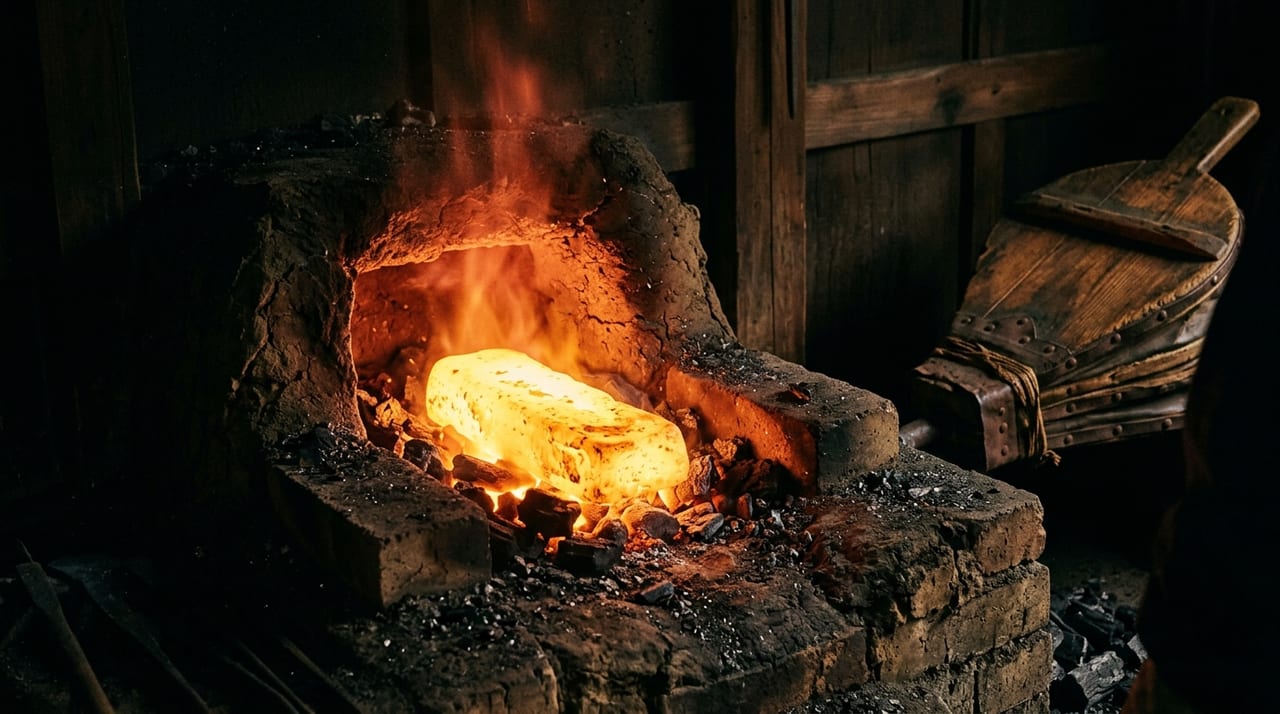
The hodo (fire bed) is the furnace used to heat the steel, fueled by charcoal (primarily pine charcoal). The amount and arrangement of the charcoal directly affects the heating temperature and uniformity. Confirming whether the steel as a whole is being heated uniformly is done by the tōkō carefully observing the interior of the furnace while adjusting the amount of charcoal.
The fuigo (bellows) is the air-supply device for the furnace; historically, hand-operated box-type bellows were used. Increasing the airflow raises the temperature, and reducing it lowers it. Today electric fans are often used, but fine temperature adjustment still depends on the experienced senses of the smith.
The kinuta and kanatoko (anvil) are the platforms that receive the hammer blows, and their hardness and shape affect how the steel deforms.
Experiencing Hi-zukuri: Modern Sword Forging Apprenticeship and Opportunities for Observation
Today, "sword-forging skill preservation training" is conducted under a program of the Agency for Cultural Affairs, and apprentice tōkō in training learn by experiencing actual hi-zukuri in their master's forge. There are also facilities that offer forge experience sessions for the general public, held in regions with deep connections to swords and tatara (traditional smelting), such as Seki City in Gifu Prefecture and Okuizumo in Shimane Prefecture.
For collectors and enthusiasts as well, observing an actual hi-zukuri session is extremely valuable for deepening one's understanding of swords. Seeing with one's own eyes the tōkō's handiwork and the color of the steel rising from the hodo provides an intuitive understanding of questions such as "why does this sword have this sori?" and "why does it have this cross-sectional shape?"
Conclusion: Hi-zukuri Is the Process That Determines the "Character" of a Sword
Hi-zukuri is not a mere shaping operation, but a creative process in which the sensibility and experience of the tōkō are concentrated. The eye that reads temperature, the rhythm of swinging the hammer, the manipulation of the material with sori calculated in advance—only when these are integrated is the individuality that is "characteristic of this tōkō" inscribed in the blade.
When appreciating the differences in the forms of nihontō, keeping the process of hi-zukuri in mind allows what might be seen as mere "visual differences" to appear as "the crystallization of a tōkō's judgment and skill." The depth of nihontō appreciation is inseparably bound up with background knowledge of production such as this.