Shinshintō of the Late Edo Period — The Restoration Movement Beginning with Suishinshi Masahide and the Flourishing of Swords in the Bunka–Bunsei Era
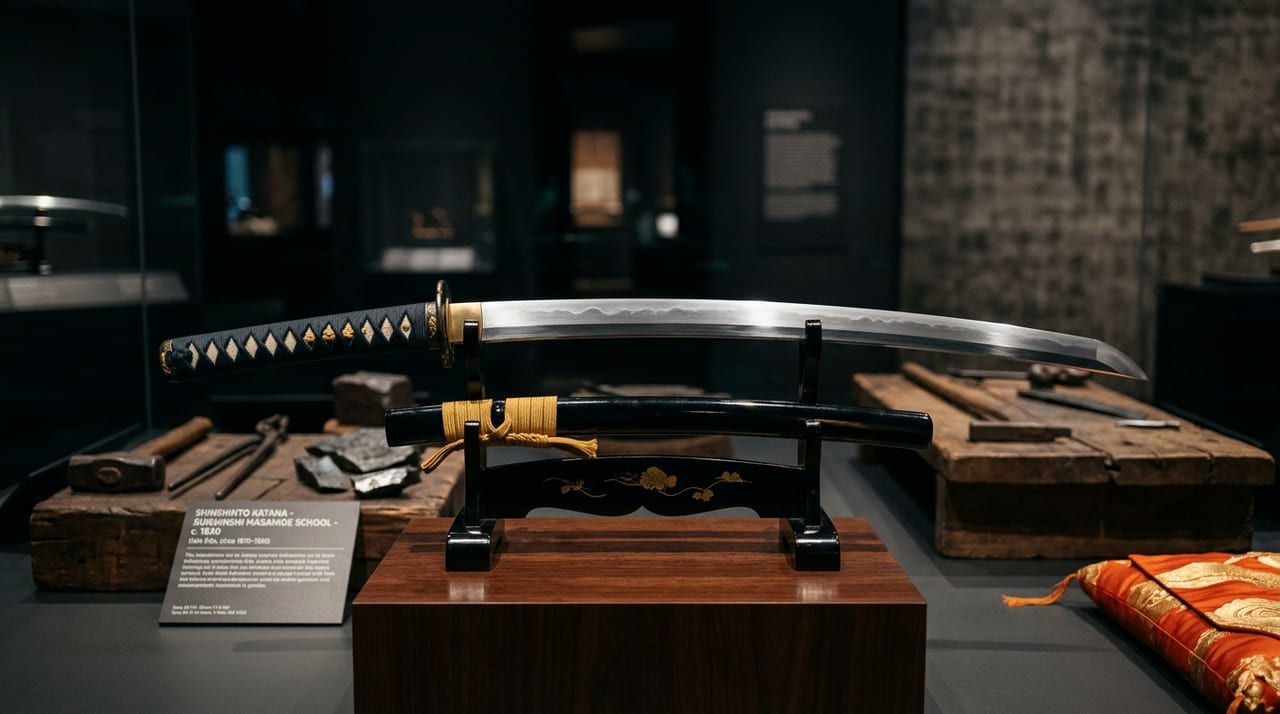 * Image is for illustrative purposes only.
Table of Contents
What Period Does Shinshintō Refer To?
In the periodization of Japanese swords, "shinshintō" refers to swords made from the Kansei era (1789) to the early Meiji period (the Sword Abolishment Edict (Haitōrei) of 1876). It is the period following shintō (Keichō through Kansei), and reached its peak in the late Edo period centered on the Bunka (1804–1818), Bunsei (1818–1830), and Tenpō (1830–1844) eras.
Although this was a peaceful era in which the practical utility of swords had markedly declined, sword culture paradoxically flourished greatly. The appreciation, collecting, and study of sword techniques as a pastime of the warrior class became popular, and it was a transitional period in which tōkō were also shifting their social standing from mere makers of utilitarian objects to artists and craftsmen.
Suishinshi Masahide's Restorationist Philosophy——Champion of the Return to Kotō
The most important figure who opened up the era of shinshintō was Suishinshi Masahide (c. 1750–1825). Born in Dewa Province (in the area of present-day Nanyo City, Yamagata Prefecture, within Yonezawa Domain), Masahide came to Edo and became a tōkō, serving as the ideological pillar of the shinshintō movement as both theorist and practitioner.
Masahide's principal work, Tōken Jitsuyōron, criticized the excessive yaki-ire (quenching) and decorative hamon practiced during the shintō period, and argued that one should learn from the material selection, forging techniques, and quenching temperatures of kotō (especially works of the Heian and Kamakura periods). Specifically, he emphasized the following points.
- Purity and selection of tamahagane — Rather than cheap iron or nanbantetsū, he recommended using high-quality tamahagane from Izumo (produced by tatara (traditional smelting)). Masahide argued empirically for what might seem an obvious point: that the purity of the steel is directly linked to the quality of the hamon and jihada.
- Restoration of forging techniques — In order to reproduce the fine jikei and utsuri characteristic of kotō, he endeavored to bring the number of orikaeshi tanren (folding) passes and temperature control closer to classical methods. This research was passed on to his disciples and contributed to raising the overall technical standard of shinshintō.
- Return to dignified hamon — Rather than the excessively ornate hamon seen in shintō of the late Edo period (midareba and showy gunome), he idealized suguha and classically styled chōji. This direction was strongly inherited by his disciple Taikei Naotane and others.
Masahide also wrote Tōken Bengi, in which he critically discussed the excessive yaki-ire (quenching) and deterioration of materials that had become prevalent during the shintō period (Keichō through Kansei). If Tōken Jitsuyōron offered constructive guidelines for restoration, Tōken Bengi was its counterpart, a treatise that documented the technical regression of the time as a written record. Reading the two works together reveals that Masahide was not merely an idealist but also had the aspect of a hands-on technical critic.
The jigane in Masahide's own swords is characterized by a fine itame jihada with evenly distributed ji-nie, and his hamon display a working style centered on gunome, notare, and chōji, with the prominent ōnie of the Sōshū-den tradition. His blades are predominantly uchigatana and wakizashi with a consciously classical form, consistently prioritizing functional beauty and dignity over decoration. His greatest legacy was organizing into documents and theory the techniques that had been passed from master to disciple as oral and secret traditions; the assessment that he "elevated the empirical skills of craftsmen into a theoretical culture" derives from this.
The Sword Boom of the Bunka–Bunsei Era and Its Background
Behind the wide acceptance of Suishinshi Masahide's ideas was the intellectual climate of the Bunka–Bunsei Era. In this era, kokugaku and kōshōgaku flourished, and interest in the culture and techniques of ancient Japan grew among the intellectual class. In the field of swords as well, this spirit of "restoration" provided impetus, and the study and emulation of kotō were actively pursued.
A patron culture had been established in which the warrior class at the daimyō and hatamoto level commissioned works from prominent tōkō, and prominent tōkō in Edo were able to devote themselves to research and production while earning stable income. In particular, the tōkō of Masahide's school spread throughout the country as retained tōkō of various daimyō houses, promoting the spread of shinshintō in the regions.
Representative Shinshintō Tōkō——The School of Masahide and Parallel Currents
The most renowned of Suishinshi Masahide's direct disciples was Taikei Naotane (1778–1857). While inheriting his master's restorationist philosophy, Naotane opened up his own artistic realm and became a representative tōkō of Edo shinshintō, known for the beauty of his jihada and the dignity of his hamon.
On the other hand, Minamoto Kiyomaro (1813–1854) was a tōkō who was active in his own independent style in the same era as Masahide. Though short-lived, his hamon possess a singular forcefulness even among shinshintō, and he remains highly regarded today. Even in modern sword research since the Meiji period, Kiyomaro is described as a figure of extraordinary genius.
Furthermore, Hosokawa Masayoshi of Dewa Province and tōkō of the Hizen tradition also left important marks throughout the country during the shinshintō period, and shinshintō was by no means a monolithic Edo-centered phenomenon but a movement with regional characteristics throughout the country.
Points of Appreciation for Shinshintō——Where Do They Differ from Kotō?
There are several points for distinguishing shinshintō from kotō and shintō.
- Jihada — Among shinshintō, there are many works forged with conscious attention to itame and mokume jihada out of admiration for kotō, but the deep utsuri (niū) characteristic of kotō rarely appears. The fineness of jikei was a point of beauty that master Suishinshi Masahide aimed for, but in practice there are many elements that are difficult to reproduce.
- Hamon — Excluding works in the Kiyomaro style, suguha-type works are relatively numerous, reflecting the master's teachings. However, tōkō who specialized in midareba and gunome also existed, and no sweeping generalization can be made.
- Nakago — The finish of the nakago shows period-specific characteristics in the fineness of the yasurime and the shape of the file marks. The nakago finished with the careful treatment called keshō-yasuri (decorative filing), characteristic of shinshintō, demonstrates the high level of consciousness among tōkō of the period.
The Sword Abolishment Edict (Haitōrei) (1876) and the End of Shinshintō
The Sword Abolishment Edict (Haitōrei) of 1876 (Meiji 9) prohibited the wearing of swords, and the social utility of swords was completely lost. This law was a historic turning point marking the end of the shinshintō period, and many tōkō were forced to close their workshops.
However, the Sword Abolishment Edict (Haitōrei) did not lead to the disappearance of Japanese swords but rather prompted their redefinition as "art swords." The Meiji government entered Japanese swords in exhibitions as important craft objects and introduced them to overseas audiences as well. This trend would lead to the revival of gendaitō tōkō (gendaitō) in the later Shōwa period.
The legacy of shinshintō lies in the spirit of restoration and the methodology of technical research that has been inherited by present-day tōkō. The attitude of "learning from kotō" that Suishinshi Masahide advocated continues to live on as a fundamental philosophy of Japanese sword-making to this day.