Independence as a Swordsmith — The System and Reality of Leaving the Master's Forge to Open One's Own Workshop
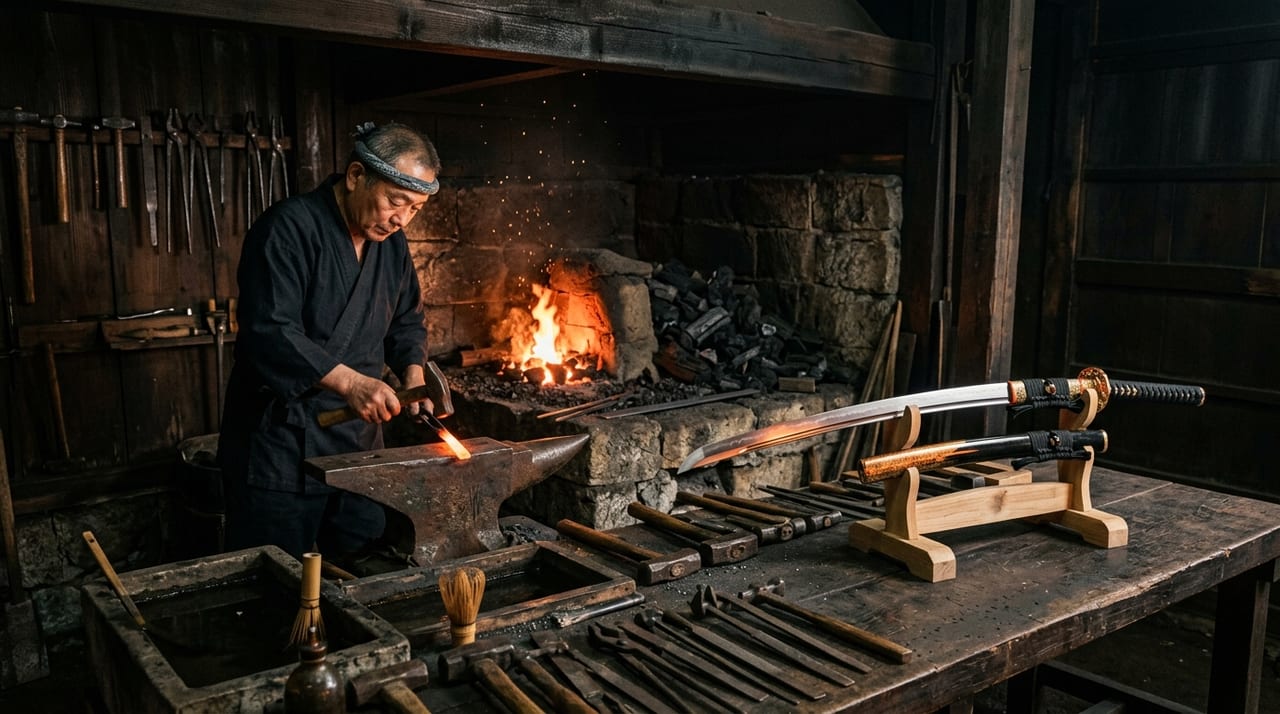 * Image is for illustrative purposes only.
Table of Contents
What Does "Independence" Mean for a Modern Tōkō?
Among Japan's traditional crafts, sword-forging is a profession with a uniquely specific concept of "independence." Whereas independence for a typical artisan follows the path of completing an apprenticeship under a master and then starting out on one's own, the tōkō's independence is distinctive in that it is tied to a legal procedure — obtaining, as the smith responsible for making the sword, an approval for production for each sword.
Under Article 18-2 of the Act for Controlling the Possession of Firearms or Swords and Other Such Weapons (Jūtōhō), anyone who intends to make a sword of value as a work of art must obtain approval, for each sword to be made, from the Board of Education of the prefecture where they live. When a smith seeks approval for production for the first time, the Commissioner for Cultural Affairs grants it (Act for Controlling the Possession of Firearms or Swords and Other Such Weapons (e-Gov Law Search), Article 18-2; Rules on Approval of the Production of Art Swords (e-Gov Law Search), Article 2).
For a modern tōkō, therefore, "becoming independent" means not merely leaving the master's forge to work in one's own space, but becoming able to obtain approval for production as the smith responsible for making the sword, and to make swords on that basis.
The First Approval for Production — Requirements for a "New Tōkō"
For a smith seeking approval for production for the first time, the Rules on Approval of the Production of Art Swords require, in addition to the sword to be made having value as a work of art, the following conditions (Rules on Approval of the Production of Art Swords (e-Gov Law Search), Article 2, Paragraph 1). Becoming independent also requires preparing a forge.
- Apprenticeship history under a master: The smith has devoted themselves continuously for five years or more to honing their skills under a swordsmith (master) who has received approval for production, and that swordsmith certifies that they have acquired sufficient skill to be responsible for making swords.
- Guarantee and training: Two or more registration examiners guarantee the smith, and the smith has completed the training on sword production conducted by the Commissioner for Cultural Affairs.
- Securing a place of manufacture: It is necessary to prepare one's own forge (a workshop equipped with a furnace, anvil, bellows, and other tools). When renting premises to set up a forge, conditions such as fire-prevention equipment, smoke-exhaust facilities, and noise-mitigation measures for the neighborhood must be met, and the initial investment is considerable.
The Relationship with the Master — The Human Side of "Independence"
More complex than the legal and procedural formalities is the settling of the relationship with the master. Under the traditional apprenticeship system (tosei seido), the relationship between apprentice and master is not a simple employment relationship but a comprehensive bond encompassing livelihood, technique, and spirit.
- The custom of a gratitude payment: There is a custom of paying the master a gratitude fee upon becoming independent. The amount varies widely depending on the relationship with the master, the number of years of apprenticeship, and the master's standing, and no clear market rate exists. It is a personal arrangement in which the human relationship between master and apprentice and the master's financial circumstances are intertwined.
- A relationship resembling "noren-wake": Some masters continue the relationship even after an apprentice's independence, providing guidance on forging techniques, assistance with procuring materials (tamahagane), and introductions to sales channels. It is close to the shop custom of "noren-wake," in which the master's reputation and brand support the apprentice's activities after independence.
- The master-apprentice bond that continues after independence: In the traditional tōkō community, showing respect to, keeping in contact with, and maintaining relations with one's former master is considered important even after independence. New Year's greetings, attendance at the master's exhibitions — the master-apprentice relationship continues for a long time after independence.
The Greatest Challenge After Independence — Securing Income and Developing Sales Channels
After clearing the four hurdles of acquiring skill, obtaining approval for production, managing the relationship with the master, and preparing equipment, the greatest challenge facing an independent tōkō is "how to make a living."
Making a livelihood solely from sword-forging is not easy. The Rules on Approval of the Production of Art Swords set no annual limit on the number of swords (Rules on Approval of the Production of Art Swords (e-Gov Law Search)), but prefectural examination standards set the number of forging days per sword, which effectively limits how many can be made (Aomori Prefecture "Approval for Manufacture of Art Swords" Examination Standards), and unless a high selling price can be set for each sword within that constraint, it is difficult to live on the profit remaining after deducting manufacturing costs (tamahagane, fuel, polishing fees, and fitting costs).
Independent tōkō adopt diversification strategies drawing on sources of income such as the following.
- Experience forging programs: An increasing number of tōkō offer paid "sword-forging experience" and "smithing experience" programs for the general public. These function as a source of income for tourists, school groups, and corporate groups.
- Manufacture of tōsōgu and small items: Income is supplemented by making and selling tōsōgu (tsuba, habaki, menuki, and other fittings), small edged tools (kozuka, kogatana), and craft objects. Their price range is lower than that of Japanese swords, but the base of buyers is broader.
- Hosting lectures: Appreciation events and lectures for sword enthusiasts are held at the forge, with participation fees as income. In an era of growing interest in swords, demand for such programs is also increasing.
Defining "Success" in Independence — The Evaluation Criteria of the Tōkō Community
The indicators of "success" in the world of the tōkō differ from those of general business. Rather than sales figures or number of employees, the following indicators are valued.
- Recognition at sword exhibitions and appraisal competitions: A track record of awards at the Shinsakumeitōten (sponsored by the NBTHK) serves as the official indicator of a tōkō's technical evaluation. A history of prizes such as "Tokusha" (Special Prize) and "Yūshūshō" (Excellence Award) directly determines both a tōkō's standing and the prices of their works.
- The mukansha qualification: Obtaining the mukansha (examination-exempt) qualification signifies the highest level of technical recognition as a tōkō. Works by mukansha tōkō are also highly regarded on the market.
- Training disciples: Taking on one's own disciples and passing technique to the next generation is considered the mark of a "fully-fledged master." A tōkō who has trained disciples as a master is treated with respect within the tōkō community.
Independence as a tōkō is not merely a professional milestone but an act of taking on the great responsibility of transmitting sword culture. The long journey of establishing one's own individual style while preserving the technique and spirit learned from the master is set in motion at the milestone of independence.